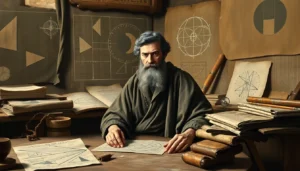
Education and Scientific Formation
Isaac Newton was born on 4 January 1643 (old style) in Woolsthorpe‑by‑Colsterworth, Lincolnshire, England, into a modest farming family. After his father’s death in 1642, his mother, Hannah Ayscough, remarried, leaving the young Isaac in the care of his grandparents. Newton attended the local grammar school in Grantham from 1655, where he received a solid grounding in Latin, Greek, and arithmetic. His teachers recognized his precocious talent, especially in geometry, and encouraged his interest in mechanical devices, leading him to construct a small model of a wind‑mill and an experimental water‑wheel.
In 1661, Newton entered Trinity College, Cambridge, on a scholarship. The curriculum was then dominated by Aristotelian natural philosophy, but the intellectual climate was changing rapidly under the influence of the new scientific method pioneered by Francis Bacon and the experimental successes of Galileo and Kepler. Newton distinguished himself in mathematics, mastering Euclid’s Elements and the works of Descartes. He also discovered, independently, the method of infinite series that would later become a cornerstone of calculus.
The outbreak of the Great Plague forced Cambridge’s temporary closure in 1665. Newton returned to Woolsthorpe for what he later described as his “annus mirabilis” – a year of intense personal research. He began to formulate his theory of color by decomposing white light with a prism, investigated the nature of motion by constructing a reflecting telescope, and laid the groundwork for the universal law of gravitation. The isolation of this period allowed him to develop the analytical tools—particularly the nascent calculus—that would later underpin his major works.
Research Career
When Cambridge reopened in 1667, Newton returned to Trinity as a junior fellow. He was appointed Lucasian Professor of Mathematics in 1669, a position he held for 33 years. The professorship gave him the freedom to pursue theoretical research while also delivering public lectures on optics and mechanics.
Newton’s research was largely self‑directed, but he maintained correspondence with continental scholars such as Christiaan Huygens, Edmond Halley, and Gottfried Wilhelm Leibnas. In 1684, a letter from Halley concerning the motion of the Moon prompted Newton to write his first manuscript on universal gravitation, later published as “De Motu Corporum in Gyrum” (On the Motion of Bodies in an Orbit) in 1685.
In 1687, after a brief stint as Warden and then Master of the Royal Mint (where he led a major reform of English coinage and tackled counterfeiting), Newton presented his magnum opus, the Philosophiæ Naturalis Principia Mathematica (Principia), to the Royal Society. The work synthesized his three laws of motion, the inverse‑square law of gravitation, and a mathematical framework for planetary motion derived from Kepler’s laws.
Newton continued his experimental work in optics, publishing the treatise Opticks in 1704. He also refined his reflecting telescope design, known as the Newtonian telescope, which eliminated chromatic aberration and remains a standard design for modern amateur astronomers.
Discoveries, Inventions, and Methods
Universal Gravitation. Newton hypothesised that every particle of matter attracts every other particle with a force proportional to the product of their masses and inversely proportional to the square of the distance between them. This law unified terrestrial gravity with celestial mechanics, explaining planetary orbits, tides, and the trajectories of comets.
Three Laws of Motion. Newton codified the principles governing the behaviour of bodies:
- First law (inertia): a body remains at rest or in uniform motion unless acted upon by a net external force.
- Second law: the rate of change of momentum of a body is proportional to the applied force (commonly expressed as F = ma).
- Third law: for every action, there is an equal and opposite reaction.
Calculus (Fluxions). Independently of Leibniz, Newton developed the method of fluxions, a mathematical technique for dealing with changing quantities. He introduced the notation of “fluxions” (derivatives) and “fluents” (integrals), providing the analytical machinery needed to solve problems in dynamics and geometry.
Reflecting Telescope. By employing a concave primary mirror to collect and focus light, Newton’s design solved the problem of chromatic aberration inherent in refracting telescopes. The simple yet powerful construction proved essential for astronomical observation and inspired future telescope makers.
Optical Theory. Through meticulous prism experiments, Newton demonstrated that white light is a mixture of colours, each refracted at a slightly different angle. He argued that colours are inherent properties of light, not modifications caused by the medium, laying foundations for modern optics.
Publications, Recognition, and Debate
Major Works. Newton’s most influential publications include:
- Philosophiæ Naturalis Principia Mathematica (1687, 2nd ed. 1713, 3rd ed. 1726) – the cornerstone of classical mechanics.
- Opticks (1704, 2nd ed. 1717) – a comprehensive study of light, colour, and experimentation.
- Arithmetica Universalis (published posthumously, 1707) – a treatise on algebra and infinite series.
Royal Society Honors. Newton was elected a Fellow of the Royal Society (FRS) in 1672 and later served as its President from 1703 until his death. In 1729, the Society awarded the first Copley Medal posthumously to honor his contributions.
Priority Disputes. Newton’s development of calculus led to a protracted controversy with Gottfried Wilhelm Leibniz over priority. While both mathematicians arrived at similar results independently, nationalistic tensions between England and the Continent intensified the debate. Modern scholarship generally acknowledges simultaneous invention.
Religious and Philosophical Context. Newton’s theological writings, many unpublished during his lifetime, reveal a deep engagement with biblical chronology and natural theology. His belief in a rational, law‑governed universe reinforced the Enlightenment view of nature as comprehensible through reason.
Impact on the Field
Newton’s synthesis of observation, experiment, and mathematics established the scientific method as a systematic approach to inquiry. The laws of motion and universal gravitation dominated physics for over two centuries, providing the framework for engineering, astronomy, and later, the development of celestial mechanics by Pierre‑Simon Laplace and others.
Calculus transformed mathematics, enabling the precise description of change and laying the groundwork for later advances in analysis, differential equations, and modern physics. Newton’s methods underpin contemporary engineering, economics, and computer science.
His optical research catalysed the design of better instruments and contributed to the eventual discovery of electromagnetic theory. The Newtonian telescope remains a staple in both professional observatories and amateur setups.
Beyond scientific achievements, Newton’s administrative reforms at the Royal Mint modernised British coinage and improved fiscal stability, illustrating how scientific expertise can influence public policy.
Overall, Isaac Newton stands as a central figure in the Scientific Revolution, his work bridging the gap between medieval natural philosophy and modern science, and shaping the intellectual landscape of the modern world.