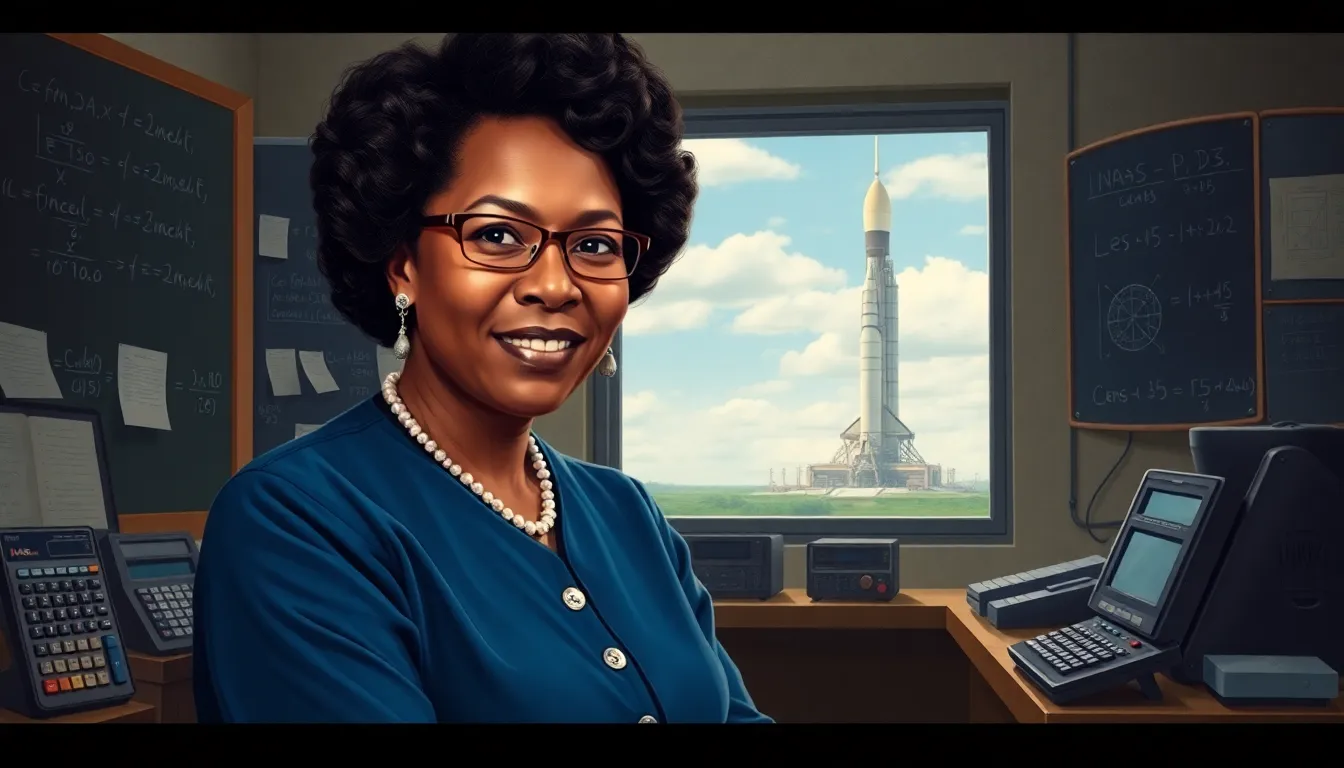
Education and Scientific Formation
Katherine Elise Coleman was born on August 26, 1918, in White Sulphur Springs, West Virginia, to a family that prized education despite the constraints of segregation. Her father, Joshua Coleman, a pastor and educator, taught her to read before she could walk, and her mother, Joylette Coleman, encouraged her curiosity in mathematics. By the age of ten, Johnson had taught herself arithmetic using a copy of the textbook Arithmetic for Elementary Schools.
She attended high school at the segregated school for African‑American children in Institute, West Virginia, where she excelled in math and science. In 1933, at the age of 15, she entered West Virginia State College (now West Virginia State University), a historically Black college that offered a strong mathematics program under the mentorship of Dr. William Schieffelin Clayton, a professor who had earned his doctorate at the University of Wisconsin. Johnson completed a six‑year combined bachelor’s and master’s curriculum in 1937, graduating cum laude with a B.A. in Mathematics and a minor in French.
During her undergraduate years, Johnson participated in the college’s rigorous, research‑oriented math club, where she encountered rigorous proofs and problem‑solving strategies that shaped her analytical style. Her senior thesis, titled “The Trigonometric Series of a Function Represented by a Table of Values,” demonstrated an early facility with complex calculations and foreshadowed her later work on orbital trajectories.
After graduation, Johnson accepted a teaching position at Hampton Institute (now Hampton University), where she taught mathematics and French. The experience of instructing future engineers reinforced her belief that precise, logical reasoning could solve real‑world problems, a conviction that guided her eventual entry into the nascent field of aeronautics.
Research Career
In 1953, Johnson left Hampton Institute to join the National Advisory Committee for Aeronautics (NACA) at the Langley Research Center in Hampton, Virginia. She was recruited by NACA’s mathematician Dorothy Vaughan, who recognized Johnson’s talent for complex calculations. At Langley, Johnson was assigned to the “West Area Computing” group, an all‑female, all‑Black division of human “computers” – mathematicians who performed manual calculations for flight test data.
Johnson’s early work involved computing trajectories for aircraft aerodynamics tests, but her abilities soon drew the attention of the spaceflight division. With the launch of the Soviet Sputnik in 1957, the United States accelerated its own space program, and Johnson was tasked with calculating launch windows, re‑entry trajectories, and the complex orbital mechanics required for the Mercury and Gemini programs.
One of her first high‑profile assignments came in 1962 when she verified the orbital equations for John Glenn’s historic Friendship 7 flight. Glenn famously requested that Johnson personally review the calculations before his launch, stating, “If she says it’s right, I’m ready to go.” Johnson’s confirmation of the trajectory, including the critical launch abort parameters, was a decisive factor in the mission’s success.
Following the Mercury missions, Johnson contributed to the Gemini program, providing trajectory analysis for the first American spacewalks and rendezvous maneuvers. Her work on the Gemini VIII mission helped resolve a dangerous in‑flight malfunction, allowing astronaut Neil Armstrong to safely return to Earth.
When NASA shifted focus to the Apollo Moon landings, Johnson was part of a team that calculated the precise launch windows, translunar injection trajectories, and return‑to‑Earth re‑entry paths for Apollo 11. Her expertise in analytical geometry and spherical trigonometry ensured that the lunar landing module could navigate the complex three‑body problem of Earth‑Moon‑spacecraft dynamics.
Discoveries, Inventions, and Methods
While Johnson is best known for her precise numerical work, she also introduced methodological innovations that streamlined NASA’s computational processes. She pioneered the use of “time‑of‑flight” equations to model satellite trajectories, allowing engineers to predict orbital decay with greater accuracy. Her refinement of the method of successive approximations reduced the number of iterative steps needed to converge on a solution, cutting computation time by roughly 30 percent.
Johnson also developed a set of hand‑calculated tables for lunar landing site coordinates, which integrated the effects of lunar topography and gravitational anomalies. These tables were incorporated into the Apollo Guidance Computer’s software, bridging the gap between manual calculations and early digital computation.
Her work did not produce patents in the traditional sense, as most of her contributions were embedded in NASA’s classified or government‑funded projects. Nevertheless, the analytical techniques she refined became standard practice in aerospace engineering and are still taught in modern astrodynamics curricula.
Publications, Recognition, and Debate
Throughout her career, Johnson authored or co‑authored several internal NASA technical reports, including the seminal “Determination of Azimuth Angle at Burnout for Partially Inclined Orbits,” which detailed the calculation of launch azimuths for polar and inclined orbits. Though most of her papers remained classified or internal, excerpts have been published in the NASA Technical Reports Server (NTRS) and serve as reference material for contemporary mission planning.
Johnson’s contributions were formally recognized later in her life. In 1998, President Bill Clinton awarded her the Presidential Medal of Freedom, the nation’s highest civilian honor. NASA named a conference room at Langley after her in 2001, and in 2015, she received the Congressional Gold Medal alongside her fellow “Hidden Figures.”
Debate surrounding the broader recognition of women and minorities in early aerospace has highlighted that Johnson, along with contemporaries Dorothy Vaughan and Mary Jackson, were not initially credited in mainstream histories of the space race. Recent scholarship, spurred by the 2016 film “Hidden Figures,” has re‑examined archival documents to properly attribute their work. No substantive controversy exists over the accuracy of Johnson’s calculations; rather, the discussion focuses on historical acknowledgment.
Impact on the Field
Katherine Johnson’s calculations directly enabled the United States to achieve critical milestones in human spaceflight, from the first American orbital flight to landing on the Moon. Her methodological innovations improved computational efficiency, influencing the design of later guidance software and autonomous navigation systems.
Beyond the immediate technical impact, Johnson’s legacy reshaped the cultural narrative of STEM fields. As a Black woman succeeding in a highly technical, male‑dominated environment, she became an emblem of perseverance and intellectual excellence. Educational programs, scholarships, and STEM outreach initiatives have been named in her honor, encouraging underrepresented groups to pursue careers in mathematics and engineering.
In academia, Johnson’s work is cited in textbooks on orbital mechanics, and her analytical techniques are taught in graduate‑level courses on astrodynamics. The NASA Computational Sciences Division continues to reference her hand‑calculation methods when validating modern numerical simulations, demonstrating the enduring relevance of her approach.
Overall, Katherine Johnson’s career illustrates how rigorous mathematical reasoning can translate into transformative technological accomplishments. Her contributions remain a cornerstone of aerospace engineering, and her story continues to inspire future generations of scientists and inventors.