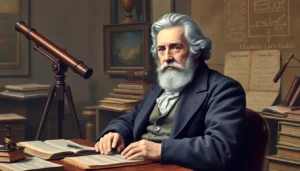
Education and Scientific Formation
Euclid’s early life remains shrouded in uncertainty, and ancient sources provide few reliable details. Classical tradition places his birth sometime around 300 BCE, likely in the Greek world, though the precise city is unknown. The most widely accepted hypothesis, based on references in later Hellenistic literature, is that Euclid was educated in the Greek intellectual tradition that prized rigorous logical argument and systematic proof.
During the Hellenistic period, the great Library of Alexandria functioned as a magnet for scholars from across the Mediterranean. It is probable that Euclid arrived in Alexandria as a young mathematician seeking the vibrant scholarly community that flourished under the patronage of the Ptolemaic dynasty. There, he would have been exposed to the works of earlier Greek mathematicians such as Thales, Pythagoras, and the members of the Pythagorean school, as well as the burgeoning field of deductive geometry that had been developing since the time of Eudoxus of Cnidus.
Although no contemporary record names Euclid’s mentors, it is reasonable to infer that he interacted with the leading mathematicians of his day, possibly including the astronomer and mathematician Autolycus of Pitane, who was known to be active in Alexandria. The intellectual environment of the Library emphasized the collection, translation, and critical examination of earlier works, providing Euclid a unique opportunity to synthesize and systematize existing geometric knowledge.
Research Career
Euclid’s professional life is most closely associated with the Museum of Alexandria, the research institute attached to the Library. The Museum employed scholars (the “aristoi”) to conduct investigations in mathematics, astronomy, engineering, and the natural sciences. While specific titles or appointments for Euclid are not recorded, the preface to his principal work, the Elements, indicates that he taught mathematics in Alexandria, suggesting a formal instructional role.
Within this scholarly community Euclid likely participated in collaborative projects such as the measurement of the Earth’s circumference, the design of sundials, and the refinement of astronomical models. The collaborative nature of the Museum’s work is evident in surviving commentaries that reference shared methods of proof and common geometric constructions. Euclid’s ability to organize and present this collective knowledge in a coherent deductive system points to his central role as both a researcher and educator.
Discoveries, Inventions, and Methods
The most enduring contribution of Euclid is his method of axiomatic deduction, embodied in the Elements. In this twelve‑book treatise Euclid assembled definitions, postulates (axioms), and common notions, from which he derived a vast array of propositions about plane geometry, solid geometry, number theory, and the theory of proportions. The logical structure—starting from a modest set of intuitive assumptions and proceeding through rigorous proofs—became the prototype for mathematical exposition for millennia.
Key geometric results attributed to Euclid include the theorem that the base angles of an isosceles triangle are equal, the Pythagorean theorem (Proposition 47 of Book I), and the construction of regular polygons such as the pentagon, hexagon, and heptagon using only a straightedge and compass. Euclid also formalized the method of exhaustion, an early form of integral calculus, in his treatment of the area of circles and the volume of cones and pyramids.
Beyond the Elements, Euclid authored several other works now known only through later references: the Data, which deals with the nature of geometric data and the conditions under which a problem is solvable; the On Parallel Lines, a treatise on the parallel postulate; the Catoptrica, concerning the geometry of mirrors; and the Optics, a work on visual perception. Although the original manuscripts are lost, fragments quoted by later mathematicians such as Pappus of Alexandria confirm Euclid’s broad interests across geometry, optics, and number theory.
Publications, Recognition, and Debate
The Elements stands as Euclid’s sole surviving book in its entirety. Its first known edition dates to the 10th‑century Arabic translation by Al‑Hamadhani, later rendered into Latin by Adelard of Bath in the 12th century and by William of Moerbeke in the 13th century. These translations introduced Euclid’s geometry to medieval Europe, where the work became a staple of the university curriculum.
Euclid’s influence was sustained through centuries of commentary. Notable medieval scholars such as Campanus of Novara, Robert of Chester, and later Isaac Newton referenced Euclid’s propositions. In the 19th century, mathematicians like Carl Friedrich Gauss and Henri Lebesgue revisited Euclid’s axioms, leading to the development of non‑Euclidean geometries when the parallel postulate was shown to be independent of the other axioms.
Euclid’s reputation as the “Father of Geometry” emerged during the Renaissance, when humanist scholars emphasized the ancient Greek legacy of rational thought. While there have been debates about the originality of certain propositions—some historians argue that Euclid may have compiled rather than invented many results—the consensus holds that his methodological innovation—the systematic, deductive presentation—was itself a revolutionary intellectual achievement.
Impact on the Field
The impact of Euclid’s work is both profound and pervasive. The axiomatic method established in the Elements became the cornerstone of modern mathematics, influencing the development of formal logic, set theory, and the philosophy of science. Geometry curricula worldwide still follow the logical progression laid out by Euclid, and many of his propositions are taught as foundational theorems in secondary education.
Beyond pure mathematics, Euclid’s constructions informed ancient engineering, architecture, and astronomy. The use of straightedge‑and‑compass constructions persisted through the Middle Ages into modern engineering design, while his treatment of proportions undergirded the work of later scholars such as Archimedes and Ptolemy.
In the 20th century, the formalist program of David Hilbert sought to place Euclid’s axioms on a firmer logical footing, leading to the modern axiomatic set‑theoretic foundations of geometry. Moreover, the discovery of consistent non‑Euclidean geometries expanded the conceptual landscape of mathematics and inspired Einstein’s general theory of relativity, which models gravitation in a curved spacetime geometry that departs from Euclidean assumptions.
Euclid’s legacy continues to influence contemporary scientific discourse. The term “Euclidean” is used to describe spaces that obey Euclid’s postulates, while “non‑Euclidean” denotes alternative geometrical frameworks. In education, UNESCO’s International Year of Geometry in 2015 highlighted Euclid’s enduring relevance, and the International Mathematical Union commemorated the 2,300‑year anniversary of the Elements with global scholarly events.
In sum, Euclid’s life, though sparsely documented, produced a body of work whose methodological rigor reshaped the practice of mathematics, set a template for scientific reasoning, and laid the geometric foundations upon which modern science stands.