Early Life and Military Formation
Yuri Alekseyevich Gagarin was born on 9 March 1934 in the village of Klushino, then part of the Russian Soviet Federative Socialist Republic (RSFSR) in the Soviet Union. His family were modest peasants; his father, Aleksei Ivanovich Gagarin, worked as a carpenter, while his mother, Anna Timofeyevna, tended the household and raised Yuri and his three siblings. The hardships of the Second World War, including the German occupation of nearby villages and the death of several relatives, left a lasting impression on the young Gagarin and fostered a sense of resilience.
Gagarin’s education began in the local school of Gzhatsk (now Gagarin, renamed in his honour in 1968). He excelled in mathematics and physics, subjects that later facilitated his understanding of aeronautics. In 1951, at the age of 17, he entered the Leninist Komsomol and was selected to attend the Industrial Technical School of the Ministry of Aviation Industry in Orenburg. After completing a two‑year technical program, he applied to the Soviet Air Force and was accepted into the Lenin Komsomol Air Force Pilot School (now the Orenburg Higher Military Aviation School of Pilots) in 1955.
During his pilot training, Gagarin demonstrated exceptional aptitude for flight maneumane, situational awareness, and quick decision‑making. He graduated in 1957 with the rank of junior lieutenant and was posted to the 101st Fighter Aviation Regiment stationed at Luostari (Jaluzovo) in the Murmansk Oblast. There, he flew the MiG‑15 and later the MiG‑17, aircraft that were still the backbone of the Soviet Air Defence Forces during the early Cold War. His performance earned him the Order of the Red Banner of Labour before he had even left the ground.
Wartime Context and Role
Gagarin’s military career unfolded against the backdrop of the Cold War, a period of geopolitical tension between the Soviet Union and the United States that never escalated into direct large‑scale combat on European soil after World War II. The Soviet Air Force (VVS) was heavily focused on defending the northern frontiers against possible NATO incursions, particularly over the Arctic and the Barents Sea. While Gagarin never saw combat in a conventional war, his service as a fighter pilot contributed to the broader deterrent posture of the USSR.
The Soviet leadership recognized the strategic value of space as an extension of air power. In 1958, Soviet Premier Nikita Khrushchev announced the creation of a dedicated space programme, and the Ministry of Defence began to recruit experienced pilots for the newly formed cosmonaut corps. These pilots were chosen for their physical fitness, mental resilience, and familiarity with high‑performance aircraft—qualities Gagarin possessed in abundance.

Major Campaigns, Battles, and Decisions
In March 1960, Gagarin was selected as one of the 20 candidates for the first Soviet group of cosmonauts. The selection process was intensive: candidates underwent rigorous medical examinations, psychological testing, and water‑survival training. Gagarin, then a senior lieutenant, distinguished himself with a calm demeanor during high‑stress simulations, notably a crash‑landing drill in which he successfully egressed a submerged capsule.
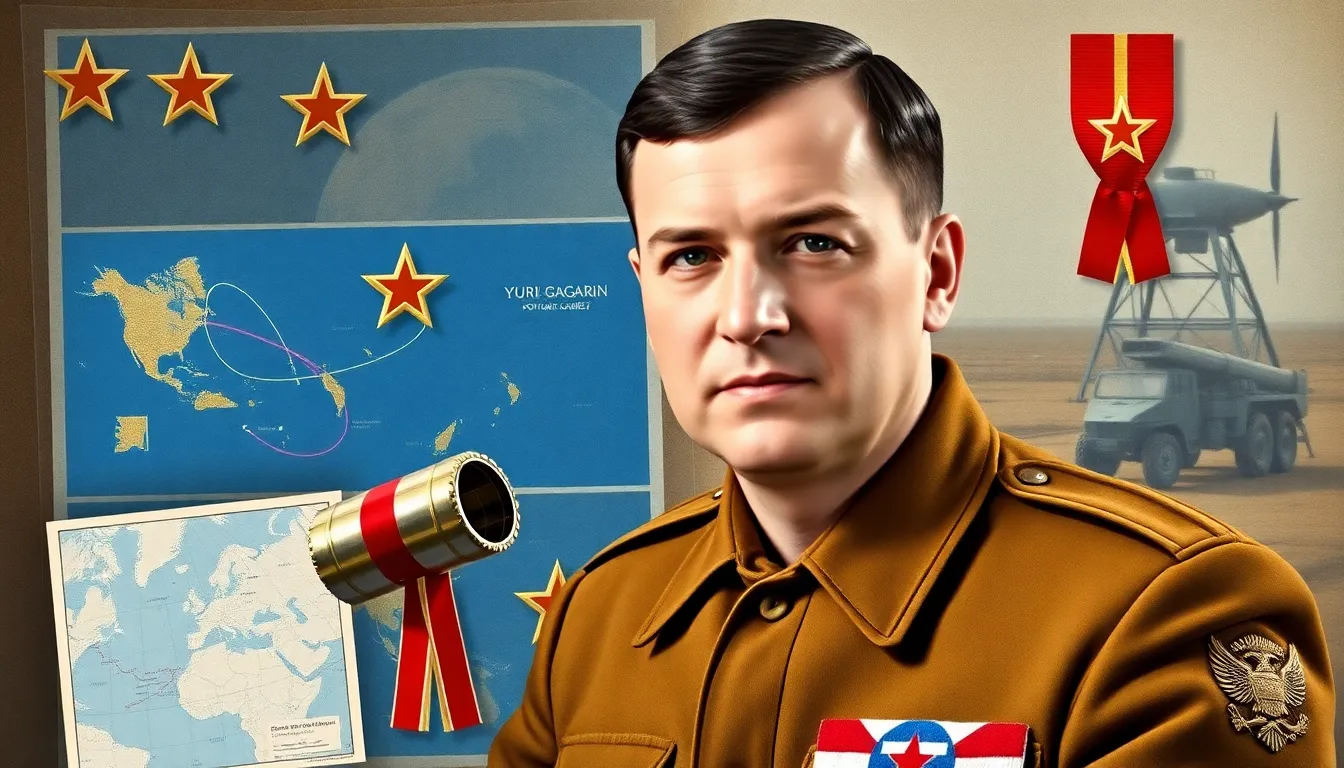
After a year of intensive preparation, Gagarin was assigned to command the Vostok‑1 flight. The mission, designated Vostok 1 (“Eastern Star”), was a single‑seat orbital flight intended to demonstrate the feasibility of human spaceflight and to achieve a propaganda victory in the Space Race. On 12 April 1961, at 06:07 UTC, Gagarin lifted off from Baikonur Cosmodrome’s Site 1/5 atop a Vostok‑rocket. He completed one full orbit of the Earth, reaching a maximum altitude of 327 km, and safely parachuted to the ground near the town of Engels after re‑entry.
The flight lasted 108 minutes and was monitored by both the Soviet military’s tracking stations and international observers. While the mission was principally a scientific and political achievement, the military implications were substantial: it proved that the Soviet Union could place humans in space, potentially paving the way for reconnaissance satellites and intercontinental ballistic missile (ICBM) technologies. Gagarin’s success prompted a rapid acceleration of Soviet space‑defence projects, influencing NATO strategic planning throughout the 1960s.
Leadership, Courage, and Controversies
Gagarin’s conduct during the Vostok 1 flight has been extensively documented in the official mission report and the post‑flight debriefings. He maintained composure during an unexpected attitude change in the capsule’s descent module, reporting his observations calmly to ground control. His ability to remain stead‑y under life‑threatening conditions earned him the title of Hero of the Soviet Union, the highest civilian award, and the Order of Lenin.
Despite his celebrated status, Gagarin’s life was not devoid of controversy. After his historic flight, he was thrust into a highly politicised role, becoming a symbol of Soviet technological prowess and an instrument of state propaganda. Critics later argued that the Soviet media amplified his humble background to craft a mythic “people’s hero,” sometimes downplaying the contributions of engineers such as Sergei Korolev. Additionally, rumors persisted about the exact circumstances of his death on 27 March 1968, when a MiG‑15UTI training flight crashed near Kirzhach. While the official investigation cited pilot error and poor weather, alternative theories have been circulated in post‑Soviet literature, though none have been substantiated by credible evidence.
Gagarin’s military rank advanced to senior lieutenant in 1961 and to captain in 1964. He remained a member of the Soviet Air Force throughout his cosmonaut career, receiving further decorations including the Order of the Red Banner of Labour (second award) and the International Lenin Peace Prize. His leadership style—characterised by modesty, approachability, and an emphasis on teamwork—was noted by his fellow pilots and later by Soviet space programme officials.
Later Life, Memory, and Legacy
Following his historic flight, Gagarin was assigned to the Training Division of the Soviet Cosmonaut Corps, where he mentored subsequent groups of cosmonauts, including Valentina Tereshkova, the first female cosmonaut. He also served as a deputy of the Soviet of the Union from 1962 to 1965, contributing to legislative discussions on scientific education and aeronautical development.
In 1965, Gagarin graduated from the Lenin Military-Political Academy with a degree in political science, reflecting the Soviet practice of blending military service with ideological education for high‑profile personnel. He subsequently held the post of deputy director of the Gagarin Cosmonaut Training Centre (TsPK) in Star City, a role that combined administrative duties with public outreach.
Gagarin’s untimely death in a routine training flight at the age of 34 shocked the nation and led to a period of national mourning. The Soviet government decreed a massive commemorative programme: streets, schools, and square were renamed in his honour; the city of Gzhatsk was renamed Gagarin; and numerous monuments were erected across the former USSR. In 1978, the Vostok 1 capsule was placed on display at the Moscow Memorial Museum of Cosmonautics, and in 1981 a lunar crater was formally named “Gagarin” by the International Astronomical Union.
Historians have reassessed Gagarin’s role within the broader Cold War narrative. While his flight was undeniably a triumph of engineering and personal bravery, it also served as a catalyst for the militarisation of space, influencing the development of satellite reconnaissance and early warning systems. Modern scholars view Gagarin as a figure at the intersection of civilian exploration and military strategy, a duality that shaped the strategic doctrines of both superpowers during the 1960s.
Today, Yuri Gagarin remains a cultural icon, commemorated annually on Yuri’s Night (12 April) worldwide. His image appears on Russian postage stamps, banknotes, and on the Russian 100‑rouble coin issued in 2011. Military academies in Russia continue to teach his flight as a case study in risk management, human factors engineering, and the integration of aerospace capabilities into national defence planning.