Early Life and Military Formation
Gaius Julius Caesar was born on 12 July 100 BC into the patrician Julian gens, a family that claimed descent from the goddess Venus. His father, also named Gaius, served as a praetor, and his mother, Aurelia Cotta, came from a well‑connected plebeian family. The early loss of his father in 84 BC placed the young Caesar under the guardianship of his uncle, Quintus Julius Caesar, who oversaw his education.
Caesar received a traditional aristocratic education: study of Latin literature, Greek philosophy, and rhetoric. Crucially for his later military career, he attended the gymnasium where he learned basic martial exercises and horsemanship, and he was mentored by the veteran general Marcus Marius, then a dominant political figure. In 84 BC Caesar entered the equestrian order and began his public career as a military tribune with the 13th Legion, stationed in Illyria. This posting gave him his first experience of command, logistics, and the discipline of a Roman legion.
His early service was interrupted by the political turbulence of the 80s BC, including the violent clashes between the Marian and Sullan factions. Caesar’s familial connections to the Marian camp made him a target after Sulla’s pro‑senatorial victory. He was forced into hiding and subsequently proscribed, a period that forged his personal resilience and political acumen. By 78 BC he had regained his standing, securing the quaestorship in Spain, where he further honed his administrative and financial skills—competencies that later proved vital in supporting large‑scale campaigns.
Wartime Context and Role
The late Roman Republic was marked by intense social conflict, territorial expansion, and a series of civil wars that pitted rival aristocratic factions against each other. By the mid‑40s BC, the Republic’s eastern provinces were largely under the control of the Senate, while the western provinces (particularly Gaul) remained only loosely integrated.
Caesar’s ascent to the consulship in 59 BC, shared with Marcus Calpurnius Bibulus, placed him at the center of the political and military apparatus. As consul, he secured the command of the newly formed legio X Equestris, a veteran unit that would become his personal core army. This command, granted through the lex Vatinia, obliged Caesar to lead Roman forces abroad for five years, a period he would fill with the Gallic Wars (58–50 BC) and later civil wars. His rank during these campaigns was that of legatus pro praetore, giving him near‑imperial authority over command, strategy, and diplomacy.
The strategic stakes were high: control of Gaul would secure the Republic’s northern frontier, provide a lucrative source of wealth and manpower, and increase Caesar’s political capital. Moreover, the looming rivalry with Pompey Magnus—who held the command of the Spanish provinces—created a precarious balance that would later erupt into open conflict.
Major Campaigns, Battles, and Decisions
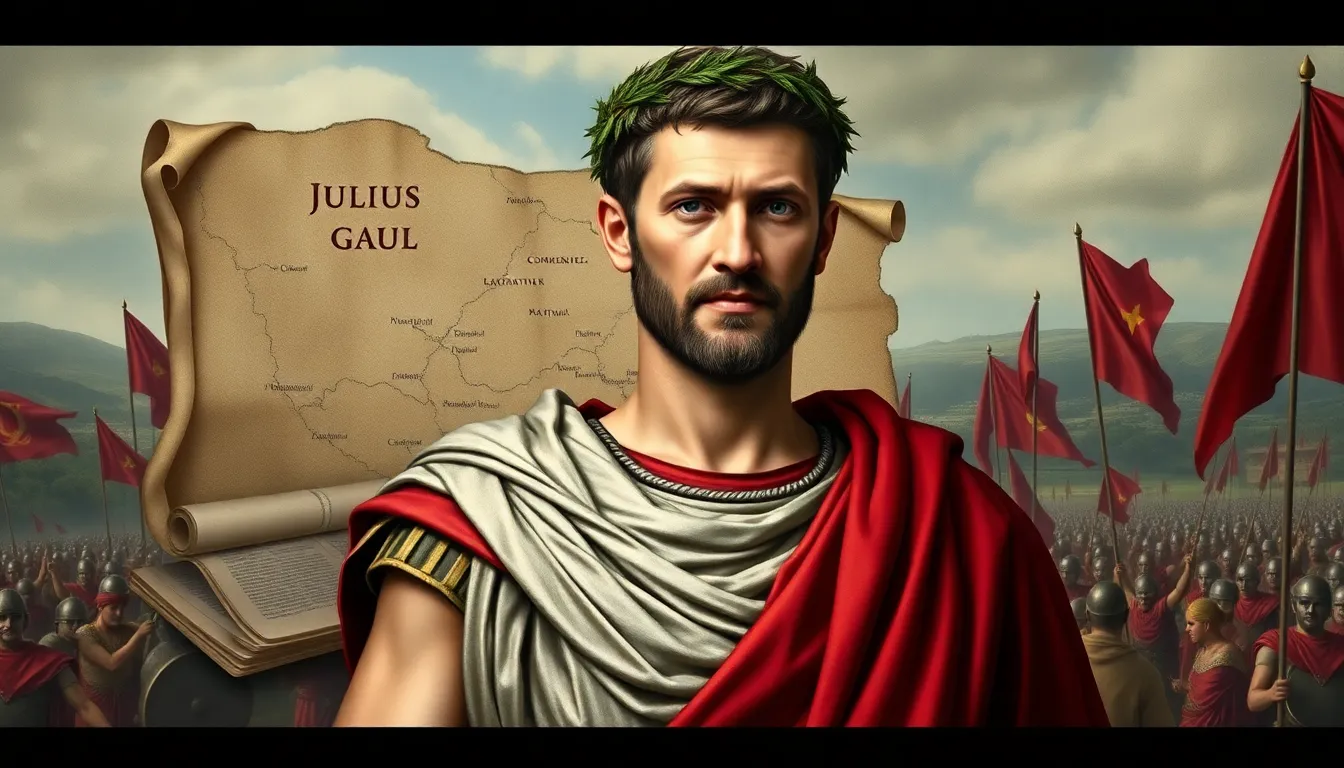
Conquest of Gaul (58–50 BC)—Caesar’s most extensive military undertaking began with the invasion of the Helvetii in 58 BC. Facing a migratory tribe threatening Roman territories, Caesar employed rapid forced marches and decisive cavalry actions at the Battle of Bibracte, compelling the Helvetii to return home. This victory established his reputation for bold maneuvering and strategic use of intelligence.
In 57 BC Caesar turned his attention to the Belgic tribes. At the Battle of the Sabis (modern Aisne), his forces faced a numerically superior coalition. By exploiting the terrain, deploying disciplined manipular formations, and executing a surprise infantry–cavalry wedge, Caesar achieved a decisive victory, which secured the Roman foothold in northern Gaul.
The subsequent campaigns against the Aquitani, the Germanic Suebi under Ariovistus (55 BC), and the rebellious Gaulish chieftain Vercingetorix (52 BC) displayed Caesar’s strategic flexibility. In 55 BC he conducted two expeditions across the English Channel, marking the first recorded Roman forays into Britain; while these raids yielded limited territorial gain, they demonstrated logistical ingenuity—constructing a fleet of transport ships and coordinating amphibious landings under hostile conditions.
The climactic confrontation at the Siege of Alesia (52 BC) epitomizes Caesar’s engineering prowess. Encircled by a Vercingetorix army of up to 150,000, Caesar ordered the construction of dual fortifications: a circumvallation to contain the besieged Gauls and a contravallation to repel external relief forces. The fortifications, extending over 20 km with ditches, palisades, and towers, exemplify Roman siegecraft. When Vercingetorix attempted a breakout and Gaulish relief forces attacked, Caesar’s troops repelled both assaults, culminating in Vercingetorix’s surrender and the effective subjugation of Gaul.
Political and Civil Conflict (49–45 BC)—Following the conclusion of the Gallic Wars, Caesar faced the Senate’s demand to relinquish his command. The passage of the senatus consultum ultimum and the revocation of his imperium led Caesar to cross the Rubicon River in January 49 BC—an act that initiated the civil war against Pompey and the Optimates. His rapid march south, the decisive battle at Pharsalus (48 BC), and subsequent campaigns in Egypt, Pontus, and Africa showcased a blend of strategic audacity and logistical mastery.
In Egypt, Caesar’s alliance with Cleopatra VII—facilitated by the Battle of the Nile (47 BC)—secured a crucial grain supply for Rome and reinforced his political stature. In the subsequent African campaign, Caesar’s tactical use of the 10th Legion in the Battle of Thapsus (46 BC) neutralized the forces of Metellus Scipio and the remnants of the Optimates.
His final campaign against the remaining opposition in Hispania culminated at the Battle of Munda (45 BC), where, despite being outnumbered, Caesar’s disciplined infantry and effective cavalry flanking turned a potential defeat into a narrow victory. These campaigns, completed in a span of four years, solidified Caesar’s control over the Roman world.
Leadership, Courage, and Controversies
Caesar’s leadership style combined personal charisma, relentless work ethic, and an innovative approach to command. He was known to fight alongside his troops, sharing hardships in the field—a practice that enhanced morale and loyalty. Contemporary sources, such as Plutarch, note his willingness to endure the same physical strain as his soldiers, often leading from the front during assaults.
His strategic innovations include the extensive use of fortified camps (castra) after each day’s march, ensuring logistical security and psychological dominance. He refined the Roman legion’s flexibility by organizing cohorts of 480 men, allowing rapid redeployment on the battlefield—a structure that persisted for centuries.
Controversially, Caesar’s campaigns were marked by severe civilian casualties and harsh reprisals. Ancient historians report the mass enslavement of Gaulish populations after Alesia and the systematic destruction of dissenting towns. Modern scholarship debates the scale of these actions, acknowledging both the Roman practice of punitive warfare and the propagandistic amplification found in later Roman literature.
Politically, Caesar’s accumulation of power sparked intense debate about the erosion of Republican institutions. His appointment as dictator perpetuo in 44 BC, combined with ongoing reforms (e.g., the Julian calendar), raised concerns among the Senate and led to his assassination on the Ides of March—a decisive event illustrating the tension between military authority and civilian governance.
Ethical assessments of Caesar’s tactics, such as his rapid forced marches and deliberate use of fear to secure loyalty, continue to be examined by military ethicists. While admired for logistical brilliance, critics point to the undermining of traditional Roman checks on power and the precedent set for later autocratic rulers.
Later Life, Memory, and Legacy
Caesar’s life ended abruptly in 44 BC, but the aftermath of his death reshaped Roman politics. His adopted heir Octavian (later Augustus) leveraged Caesar’s legacy to consolidate power, ending the Republic and establishing the Principate. The ensuing Augustan era institutionalized many of Caesar’s reforms, including the reorganization of the army and the proliferation of his literary works.
Caesar’s own autobiographical commentaries—Commentarii de Bello Gallico and Commentarii de Bello Civili—remain central primary sources for scholars, offering insight into Roman military logistics, reconnaissance, and propaganda. Their clear, concise Latin style set a standard for military reporting.
Throughout the centuries, Caesar’s image has been appropriated across political spectra: Renaissance humanists celebrated him as a model of civic virtue; 19th‑century European nationalists invoked his name to justify imperial ambitions; and modern military academies study his campaigns for lessons in operational art and combined‑arms tactics.
Monuments and commemorations include the Arch of Septimius Severus (which incorporates reliefs of Caesar’s triumphs), the French “Statue of Julius Caesar” in Paris, and numerous coin issues throughout antiquity bearing his portrait. In contemporary scholarship, Caesar is evaluated as both a brilliant military commander and a pivotal political figure whose actions accelerated the transition from Republic to Empire.
The historiography of Caesar continues to evolve. Recent archaeological findings—such as fortified camp sites in northern France and recovered Roman‑Gaulish artifacts—provide more nuanced views of his campaigns, confirming some ancient accounts while challenging exaggerated casualty figures. Moreover, interdisciplinary studies explore the psychological impact of his leadership on Roman soldiers, contributing to a fuller understanding of his enduring influence on military thought.
Overall, Julius Caesar remains a complex figure: a commander whose strategic innovations reshaped ancient warfare, a statesman whose concentration of power altered the course of Roman history, and a cultural symbol whose legacy continues to inform debates on leadership, ethics, and the balance between military authority and civilian control.