Early Life and Military Formation
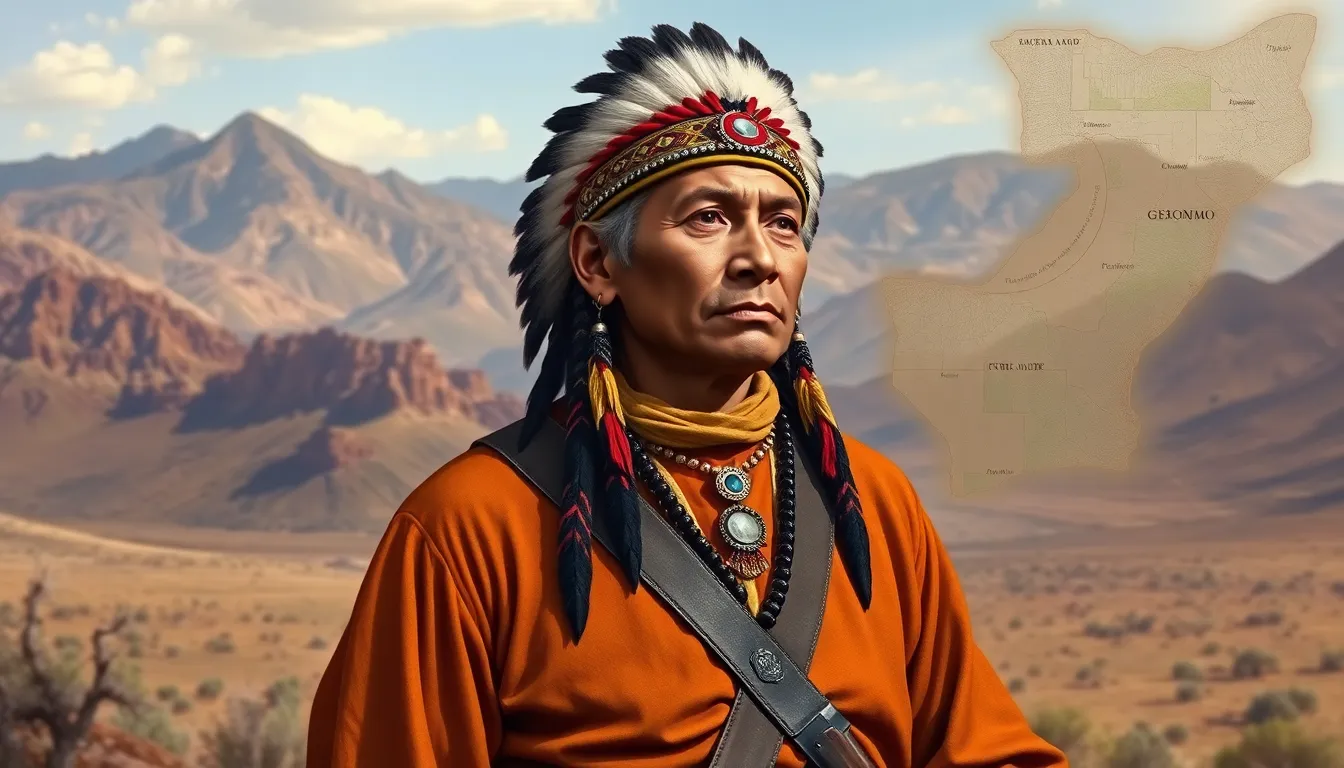
Geronimo was born Goyathlay (“One Who Yawns”) around 1829 in the region that is now southeastern Arizona, then part of the Mexican territory of Sonora. He belonged to the Bedonkohe (or Bidu’ka) subgroup of the Chiricahua Apache, a people organized into loosely linked bands that practiced a nomadic lifestyle based on hunting, raiding, and seasonal migration. Oral histories recorded by his own descendants indicate that his father, Ahnandia, was a respected warrior who taught young Geronimo the skills of tracking, horsemanship, and guerrilla warfare. In 1845, at roughly sixteen, Geronimo married his first wife, Alope (also rendered Alope or Tulum). The marriage cemented alliances with the neighboring Mimbreño Apache, a common practice that fortified inter‑band cooperation against external threats.
Unlike soldiers in formal armies, Apache warriors received their training through participation in raids and defensive actions. From an early age Geronimo accompanied seasoned fighters on expeditions against rival tribes and Mexican settlements. The Apache tradition of oral transmission meant that strategic knowledge—such as the use of the rugged Sierra Madre terrain for ambushes—was conveyed through storytelling, demonstration, and apprenticeship rather than through formal academies. By his early twenties Geronimo had earned a reputation for daring raids on Mexican caravans and for his skill in evading capture, traits that would later define his anti‑colonial campaign.
Wartime Context and Role
The mid‑19th century saw the United States and Mexico expanding their frontiers into Apache homelands. Following the Mexican‑American War (1846–1848) and the Gadsden Purchase (1853), the U.S. Army established forts across the Southwest to protect settlers and to enforce treaties that sought to confine Apache bands to reservations. The policy of forced relocation and the imposition of European‑style agriculture conflicted sharply with Apache cultural values, sparking a series of armed resistances now collectively termed the Apache Wars (c. 1849–1886). Within this volatile environment, Geronimo emerged as a war leader (or “tłʼáá’k”) for his band, responsible for organizing raids, negotiating temporary truces, and deciding when to break peace accords.
Geronimo’s rank and status were fluid, reflecting Apache social organization, which emphasized merit and consensus over fixed hierarchy. He was never commissioned by any colonial power, yet his role as a strategic commander is evident in the coordination of multi‑band raids and in his capacity to mobilize warriors quickly in response to external incursions. His primary mission, as articulated in surviving Apache testimonies, was the defense of his people’s autonomy, sacred sites, and familial structures against encroaching settlers and military forces.
Major Campaigns, Battles, and Decisions
Geronimo first entered the historical record during the 1850s, when Mexican military reports noted a series of raids on silver mines and ranches in the Sierra Madre Occidental. In 1851 his band engaged Mexican troops in the Battle of the Gila River, a skirmish that, while small in scale, demonstrated Apache mastery of the terrain and the ability to inflict disproportionate casualties on numerically superior forces. By the early 1860s Geronimo had allied with other prominent Apache leaders, including Cochise and Mangas Coloradas, to resist the construction of the Pacific Railroad through Apache territory.
The most documented phase of Geronimo’s military activity occurred after the 1882 surrender of his band to General Edward O. C. Ord at Fort Bowie. Disillusioned by broken promises—particularly the failure to protect his family from Mexican militia attacks—Geronimo escaped the reservation with a small group of followers in 1885. Over the next two years he led a series of raids across the Arizona–Mexico border, most notably the 1886 raid on the San Carlos Reservation that resulted in the death of several soldiers and the capture of livestock. These actions forced the U.S. Army, under General Nelson A. Miles, to launch a massive pursuit involving over 2,000 cavalry and infantry, culminating in the famed pursuit through the canyons of the Sierra del Búfalo.
Geronimo’s final engagement took place on August 27, 1886, when he and a handful of warriors were surrounded at the foothills of the Sierra Madre by Miles’ forces. Recognizing the futility of continued resistance and fearing the annihilation of his people, Geronimo surrendered. This surrender marked the end of organized Apache armed resistance, though sporadic skirmishes continued for a few years thereafter.
Leadership, Courage, and Controversies
Geronimo’s leadership style combined personal bravery with a strict adherence to Apache codes of conduct. Contemporary U.S. officers, such as Lieutenant Charles A. Sevier, recorded observations that Geronimo would fight at the front of his warriors, sharing the same risks and hardships. Apache oral histories emphasize his concern for the welfare of non‑combatants, noting that during raids he would attempt to protect women and children, contrasting with some contemporaneous accounts that depicted Apache raids as indiscriminate.
Controversy surrounds several aspects of Geronimo’s legacy. Some historians argue that his repeated surrenders and renegotiations with U.S. authorities were pragmatic tactics aimed at preserving his people, while others view these actions as evidence of opportunistic leadership. Additionally, the narrative of Geronimo as a singular villain or heroic rebel was shaped by 19th‑century newspapers that often sensationalized his raids to sell copies, leading to the propagation of exaggerated casualty figures. Modern scholarship, drawing on Apache oral traditions and Army after‑action reports, suggests that the actual number of combatants involved in his final raids numbered fewer than 100, with civilian casualties considerably lower than claimed in contemporary press.
Geronimo’s capture and subsequent imprisonment at Fort Sill (Indian Territory, now Oklahoma) sparked debate over the ethical treatment of Native leaders. While General Miles claimed to have offered generous terms, the conditions at Fort Sill—including forced relocation, cultural suppression, and exploitation for public spectacle—have been criticized by scholars such as Robert M. Utley. The policy of using Geronimo as a “living exhibit” at World’s Fairs and expositions further complicated his legacy, turning a war leader into a symbol of exotic curiosity rather than a political actor.
Later Life, Memory, and Legacy
After his relocation to Fort Sill, Geronimo lived under the supervision of the Indian Service until his death on February 17, 1909. In his final years he converted to Christianity, taking the name “Goyathlay” as a baptismal name, and he became a father figure to younger Apache youths, urging them to preserve cultural knowledge amidst forced assimilation policies. He died of pneumonia at the age of 79 and was buried with a modest marker at the Fort Sill cemetery, a site later designated a National Historic Landmark.
Geronimo’s memory has been invoked in various political and cultural contexts. During the early 20th‑century “Indian Renaissance,” Apache activists referenced his resistance as a rallying point for land rights. In the 1930s the Works Progress Administration (WPA) produced a series of murals depicting his surrender, framing it as a tragic but inevitable outcome of “civilization.” Later, during the 1960s civil rights era, Native American groups adopted Geronimo as an exemplar of anti‑colonial struggle, celebrating his defiance in songs, poetry, and protest banners.
Academic reassessment over the past several decades has moved away from mythologizing Geronimo, instead situating him within the broader context of Apache resistance, tribal politics, and the pressures of U.S. expansion. Scholars emphasize the importance of distinguishing between the warrior’s documented actions—such as the 1885 escape from the San Carlos Reservation—and the layers of legend created by popular media, including Hollywood portrayals that exaggerate his physical size and martial prowess.
Today, Geronimo is commemorated through several sites and public artworks, including the Geronimo Springs Trail in Sierra Vista, Arizona, and a bronze sculpture at the National Museum of the American Indian. His name appears in educational curricula as a case study of indigenous resistance, and his likeness continues to be the subject of debate over cultural appropriation, especially in the use of his image for sports team mascots. The ongoing dialogue reflects a broader reevaluation of how military figures from colonized peoples are remembered within American historical memory.