Early Life and Military Formation
William Joseph Donovan was born on January 1, 1883, in New York City to Irish immigrant parents, James and Annie Donovan. The family lived in modest circumstances on the Lower East Side, a neighbourhood that exposed young William to both the hardships of immigrant life and the civic engagement of the burgeoning American city. He attended public schools before earning a scholarship to the prestigious Columbia University, where he graduated with a Bachelor of Arts in 1905. While at Columbia, Donovan demonstrated a keen interest in athletics, becoming a star on the varsity baseball team and earning the nickname “Wild Bill” for his aggressive playing style.
After completing his undergraduate studies, Donovan pursued a legal education at Columbia Law School, receiving his LL.B. in 1908. He briefly practiced law in New York, but his sense of public service was sparked by the outbreak of the Mexican Revolution and the ensuing political instability along the U.S. southern border. In 1917, following the United States entry into World War I, Donovan volunteered for military service, receiving a commission as a captain in the infantry of the United States Army.
Donovan’s initial training took place at the Infantry School at Fort Benning, Georgia, where he distinguished himself in courses on small‑unit tactics and leadership. He was subsequently assigned to the 165th Infantry Regiment (formerly the famous “Fighting 69th” of the New York National Guard) and deployed to the Western Front in 1918. His service in France saw him briefly attached to the staff of General John J. Pershing’s American Expeditionary Forces, where he gained exposure to operational planning and intelligence‑gathering at a strategic level.
Wartime Context and Role
World War I marked the United States’ first large‑scale involvement in a European conflict, and its military establishment lacked a unified intelligence apparatus. Donovan’s experience on the Western Front, where he observed the effectiveness of British and French intelligence networks, impressed upon him the need for a professional, centralized intelligence service. After the armistice, he returned to civilian life, resumed his law practice, and entered politics, serving as a New York State Senator (1919–1922) and later as a special assistant to the U.S. Attorney General, where he handled cases involving espionage and subversive activities during the Red Scare.
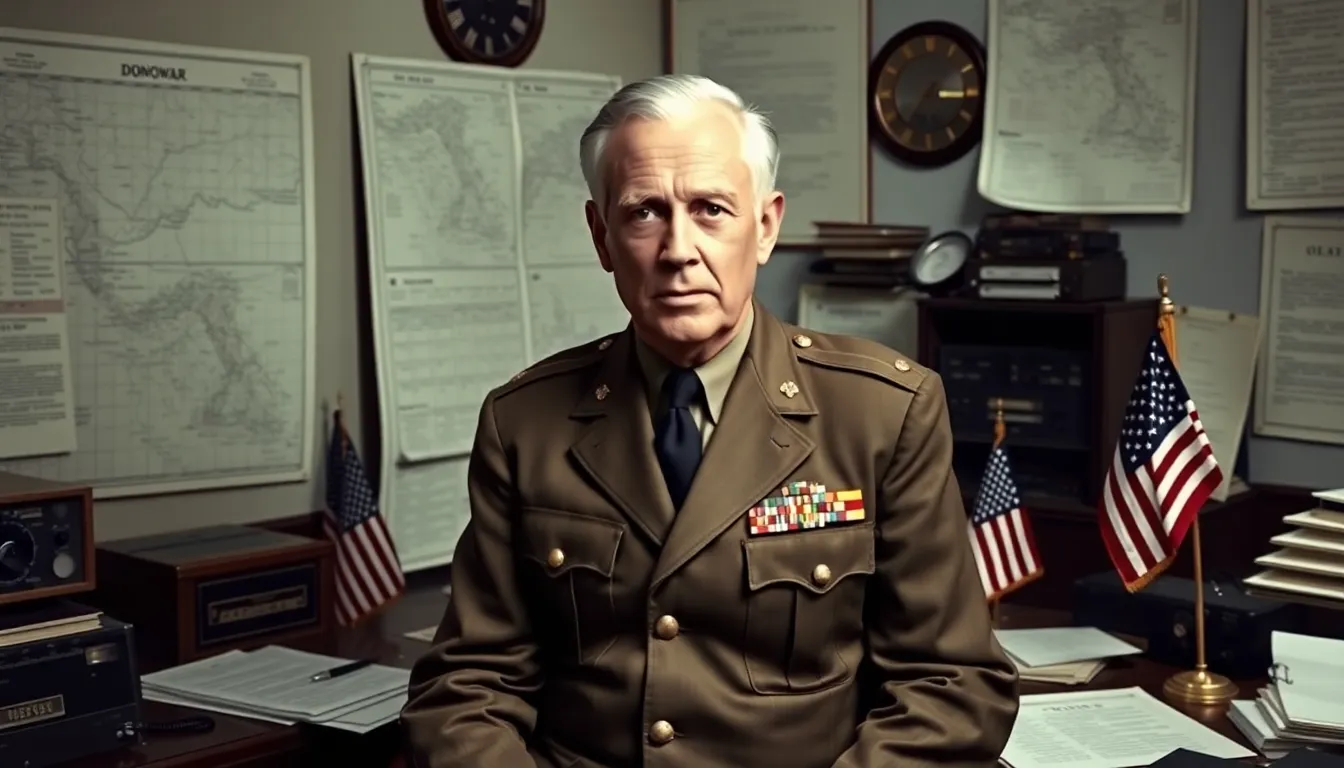
During the interwar years, Donovan maintained close ties to the Army Reserve, rising to the rank of lieutenant colonel. He also cultivated relationships with prominent political and military figures, including future President Franklin D. Roosevelt and General George C. Marshall. These connections would prove instrumental when the United States entered World War II.
Major Campaigns, Battles, and Decisions
Following the Japanese attack on Pearl Harbor in December 1941, President Roosevelt recognized the urgent need for a coordinated intelligence and special operations agency. In June 1942, Roosevelt appointed Donovan as Coordinator of Information (COI), a position that consolidated existing wartime information functions under a single civilian director. Within months, the COI was expanded and renamed the Office of Strategic Services (OSS), with Donovan at its helm as Director.
The OSS was conceived as a hybrid organization: it combined espionage, sabotage, psychological warfare, and the gathering of strategic intelligence. Donovan oversaw the recruitment of a diverse cadre of operatives, ranging from academic scholars to seasoned soldiers, and established a number of specialized units:
- OSS Operational Group (OG): Conducted sabotage missions behind enemy lines, most famously the disruption of German railway networks in occupied France.
- OSS Morale Operations (MO): Produced propaganda leaflets and broadcasts aimed at undermining Axis civilian morale.
- Research and Analysis (R&A): Produced comprehensive intelligence briefs that informed Allied strategic planning.
One of Donovan’s most consequential decisions was to authorise Operation Anthropoid, the 1942 plan to assassinate Reinhard Heydrich, the chief architect of the Final Solution. Although the operation was ultimately carried out under the auspices of the Czech resistance, DSS support and coordination were instrumental.
Donovan also played a pivotal role in supporting the French Resistance. Under his direction, OSS agents parachuted into Nazi‑occupied France, delivering arms, explosives, and training to Maquis groups. These operations intensified following the Allied landings in Normandy (June 6, 1944), as resistance sabotage facilitated the disruption of German supply lines and communication networks, contributing to the rapid breakout from the beaches.
In the Asian theater, Donovan approved the establishment of the Sino‑American Cooperative Organization (SACO), a joint intelligence venture with the Nationalist Chinese government. SACO agents infiltrated Japanese‑held territories in China, gathering valuable signals intelligence and conducting guerrilla attacks against Japanese installations.
Beyond field operations, Donovan advocated for the creation of a post‑war central intelligence agency. His 1945 report, “A Report to the President on the Development of a Centralized Intelligence Organization,” laid the groundwork for the National Security Act of 1947, which ultimately established the Central Intelligence Agency (CIA). While Donovan did not become its first director, his advocacy earned him the moniker “Father of the CIA.”
Leadership, Courage, and Controversies
Donovan’s leadership style was characterized by an unorthodox willingness to bypass bureaucratic constraints in favour of operational effectiveness. He famously declared that the OSS would “do anything short of murder” to achieve its objectives, a statement that reflected both his pragmatic approach and the moral ambiguities inherent in covert warfare.
Critics have highlighted several controversies associated with Donovan’s tenure:
- Use of Torture and Coerced Interrogation: Some OSS interrogators employed harsh techniques on captured enemy agents, leading to post‑war debates about the ethical limits of intelligence work.
- Political Partisanship: After the war, Donovan entered the 1948 Democratic presidential primaries, positioning himself as an anti‑communist candidate. Observers argue that his political ambitions may have colored some wartime decisions, particularly regarding intelligence sharing with Soviet allies.
- Legal Status of OSS Operations: Because the OSS operated under a civilian directorate but conducted military‑type missions, questions arose about the legality of its actions under the Geneva Conventions, especially concerning sabotage and partisan support.
Despite these issues, Donovan was widely respected by his subordinates for his personal bravery and hands‑on involvement. He frequently accompanied agents on dangerous missions, and his willingness to share risks fostered high morale within the organization. His Medal of Honor citation, awarded posthumously in 1977, lauds his “extraordinary heroism” and “visionary leadership” in establishing a modern intelligence capability for the United States.
Later Life, Memory, and Legacy
After the OSS was dissolved in September 1945, Donovan returned to civilian life, briefly serving as a special adviser to President Harry S. Truman on intelligence matters. He ran unsuccessfully for the Democratic presidential nomination in 1948, losing the primary to incumbent President Truman. In the 1950s, Donovan continued to write and lecture on intelligence, publishing his memoir, The Story of the Office of Strategic Services (1950), which offered an insider’s view of wartime espionage.
Donovan died on February 7, 1959, in New York City, at the age of 76, after a brief illness. He was interred at Arlington National Cemetery, a testament to his military service and national stature.
Historical assessments of Donovan have evolved over time. Early Cold War scholarship celebrated him as a visionary who forged the United States’ intelligence apparatus. Revisionist historians later scrutinised the OSS’s shadowy activities and questioned the ethical dimensions of covert actions. Nevertheless, most contemporary scholars agree that Donovan’s contributions laid the institutional foundations for modern U.S. intelligence, and his emphasis on inter‑agency cooperation remains relevant in today’s security environment.
Today, Donovan is commemorated through several memorials, including a bronze bust at the CIA headquarters and the naming of the USS William J. Donovan (SSN‑753), a Los Angeles‑class submarine commissioned in 1996. His legacy endures in academic curricula on intelligence studies, and his life continues to be the subject of biographies, documentaries, and scholarly articles.