Early Life and Military Formation
Hannibal was born in 247 BC in Carthage (modern‑day Tunisia), the son of the prominent noble Hamilcar Barca, a leading general during the First Punic War (264–241 BC). The Barca family belonged to the aristocratic elite that dominated Carthaginian politics and the military aristocracy. According to Polybius, Hamilcar took the infant Hannibal to the military camp at an early age, reportedly swearing the child on an altar that he would forever be an enemy of Rome. This anecdote reflects the familial culture of lifelong hostility toward the Roman Republic, though its literal truth cannot be verified.
Hannibal received an extensive education befitting a Carthaginian aristocrat. He was taught traditional Punic subjects—law, commerce, and religious rites—as well as Greek literature and philosophy, which were increasingly fashionable among Carthaginian elites. Military training was integral: he learned the use of the quadroon (a four‑horse chariot), the pilum‑style throwing spear, and cavalry tactics under the tutelage of his father’s veteran officers. At approximately age 14, after Hamilcar’s death in 228 BC, Hannibal assumed command of the cavalry of the New Carthaginian army in Iberia (modern Spain), a position that gave him early experience in leading mixed infantry‑cavalry forces.
Wartime Context and Role
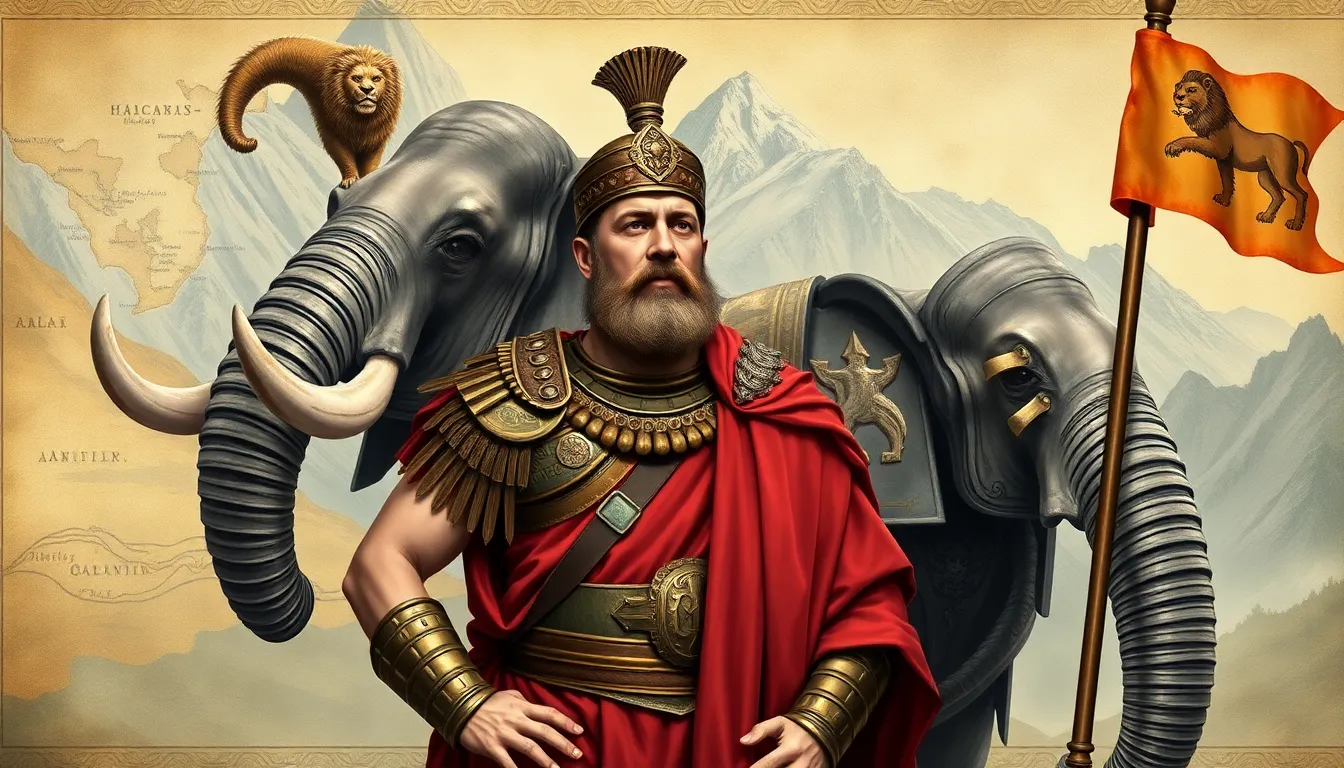
The Second Punic War (218–201 BC) erupted from long‑standing competition for influence in Sicily and Spain. After the death of the Carthaginian governor in Iberia, the Romans seized Saguntum, a city under Carthaginian protection, prompting Carthage, under the direction of the Senate, to authorize Hannibal’s expedition against Rome. At the time of his appointment as commander‑in‑chief of the Carthaginian forces in Iberia, Hannibal held the rank of *strategos* (general) and commanded a heterogeneous army composed of Iberian infantry, Celtic and Iberian cavalry, Numidian light cavalry, and a contingent of war elephants.
The strategic objective was twofold: first, to break Roman control in Iberia and then to open a new front on the Italian peninsula, thereby forcing Rome to divert forces from other theaters. Hannibal’s initial rank in the Carthaginian hierarchy placed him under the political oversight of the Carthaginian Senate, which retained the power to recall or replace him, but his operational autonomy was considerable given the distance from Carthage and the urgent wartime circumstances.
Major Campaigns, Battles, and Decisions
Crossing the Rhone (218 BC): After securing support from the Celtic tribes of Gaul, Hannibal led his army eastward, confronting the Roman‑occupied Rhône River. Using a combination of pontoon bridges and forced crossings, he managed to transport the bulk of his force, including 37 elephants, across the river without significant loss—a logistical achievement that demonstrated his capacity for meticulous planning.
Alpine Crossing (218 BC): The most celebrated episode of Hannibal’s career is his crossing of the Alps into northern Italy. Polybius estimates the journey took several weeks and involved the loss of up to two‑thirds of his men and most of his elephants due to harsh weather, rugged terrain, and skirmishes with local tribes. Modern scholarship, citing archaeological and climatological data, suggests that Hannibal likely used the Col de la Traversette route, although the exact pass remains debated.
Battle of Trebia (218 BC): Upon descending into the Po Valley, Hannibal engaged a Roman force near the Trebia River. Employing a classic double‑envelopment, he lured the Romans across the river, then attacked with his superior cavalry and Iberian infantry. The Romans suffered heavy casualties, estimated at 17,000, while Carthaginian losses were comparatively low.
Battle of Lake Trasimene (217 BC): Hannibal executed a masterful ambush against the Roman consul Gaius Flavius Aemilius Muspulus. By concealing his troops in the forested hills surrounding the lake and timing the attack as the Romans marched along a narrow causeway, Hannibal inflicted one of the most decisive defeats in Roman history, with casualties possibly exceeding 15,000.
Battle of Cannae (216 BC): In what is often cited as the epitome of tactical brilliance, Hannibal deployed a convex‑formed infantry line that gradually yielded to the advancing Roman legions, then closed the formation into a concave pocket, enveloping the Roman army. Contemporary estimates place Roman casualties at 50,000–70,000, a proportion unprecedented in ancient warfare. The victory reshaped the strategic calculus of the war, prompting several Italian city‑states to defect to Carthage.
Italian Campaign (216–203 BC): Following Cannae, Hannibal attempted to capitalize on Roman disaffection by marching toward Rome itself. However, the lack of sufficient siege equipment, waning Carthaginian reinforcements, and the resurgence of Roman political unity under the Fabian strategy (avoidance of open battle) limited his capacity to capture the capital. Over the next decade, Hannibal conducted a series of regional engagements—such as at the Battle of the Metaurus (207 BC), where a Carthaginian detachment was defeated, and the Battle of Zama (202 BC) in Africa—ultimately culminating in his recall to Carthage.
Battle of Zama (202 BC): After a prolonged stalemate in Italy, Hannibal returned to North Africa to defend Carthage against the invading Roman general Publius Cornelius Scipio Africanus. At Zama, Hannibor’s forces faced a disciplined Roman legionary formation supported by Numidian cavalry under Masinissa. Despite his innovative use of war elephants, the Romans neutralized them, and Hannibal’s cavalry was outmaneuvered. The defeat forced Carthage to sue for peace, ending the Second Punic War.
Leadership, Courage, and Controversies
Hannibal’s leadership style combined personal bravery with a willingness to delegate authority to capable sub‑commanders such as Hasdrubal, Mago, and the Numidian cavalry leader Syphax. He was known to share hardships with his troops, a practice that increased loyalty and morale. His strategic vision—invading Italy through the Alps—reflected a willingness to incur high logistical costs for potential political gains.
Controversially, ancient sources differ on Hannibal’s treatment of civilian populations. While Polybius portrays him as sparing non‑combatants, Livy records instances where Hannibal’s troops looted towns that resisted, suggesting a pragmatic, sometimes ruthless, approach to sustaining an army far from home.
Ethical debates also focus on Hannibal’s use of mercenaries and allied tribal forces, who occasionally pursued personal vendettas, exacerbating civilian suffering. Modern historians caution that attributing singular responsibility to Hannibal for such actions may reflect Roman propaganda aimed at demonizing the enemy.
In terms of military honors, Carthage did not have a formalized system of medals comparable to later Roman or modern awards. However, Hannibal’s victories earned him the post‑humous title *Barca* (shining), and later Carthaginian and Roman writers commemorated his battlefield feats in poetry and historiography.
Later Life, Memory, and Legacy
After the war, Hannibal entered Carthaginian politics, serving as *suffete* (chief magistrate) around 195 BC. He implemented economic reforms, including debt relief for the poor, which antagonized the Carthaginian elite. Facing Roman demands for his surrender, Hannibal fled to the court of King Antiochus III of Syria, where he served as military adviser.
Hannibal died around 183 BC, traditionally said to be by suicide (ingesting poison) to avoid capture by Roman agents. The precise circumstances remain uncertain due to the lack of contemporary Carthaginian records.
His legacy has been shaped by both Carthaginian remembrance and Roman historiography. Ancient authors such as Polybius (who admired his tactics) and Livy (who emphasized his threat) contributed divergent narratives. During the Renaissance, military treatises, including those of Machiavelli and later Clausewitz, cited Hannibal as an exemplar of strategic ingenuity.
In modern scholarship, Hannibal is analyzed as a case study in operational art, logistics, and coalition warfare. Debates persist regarding the feasibility of his Italian campaign, the realism of his elephants’ effectiveness, and the extent to which his actions were driven by personal ambition versus state policy.
Commemorations include statues in modern Tunisia, the naming of military academies, and the use of his name in various cultural works. However, unlike Roman heroes, Hannibal lacks a unified cultic worship; his memory remains principally academic and symbolic of anti‑Roman resistance.