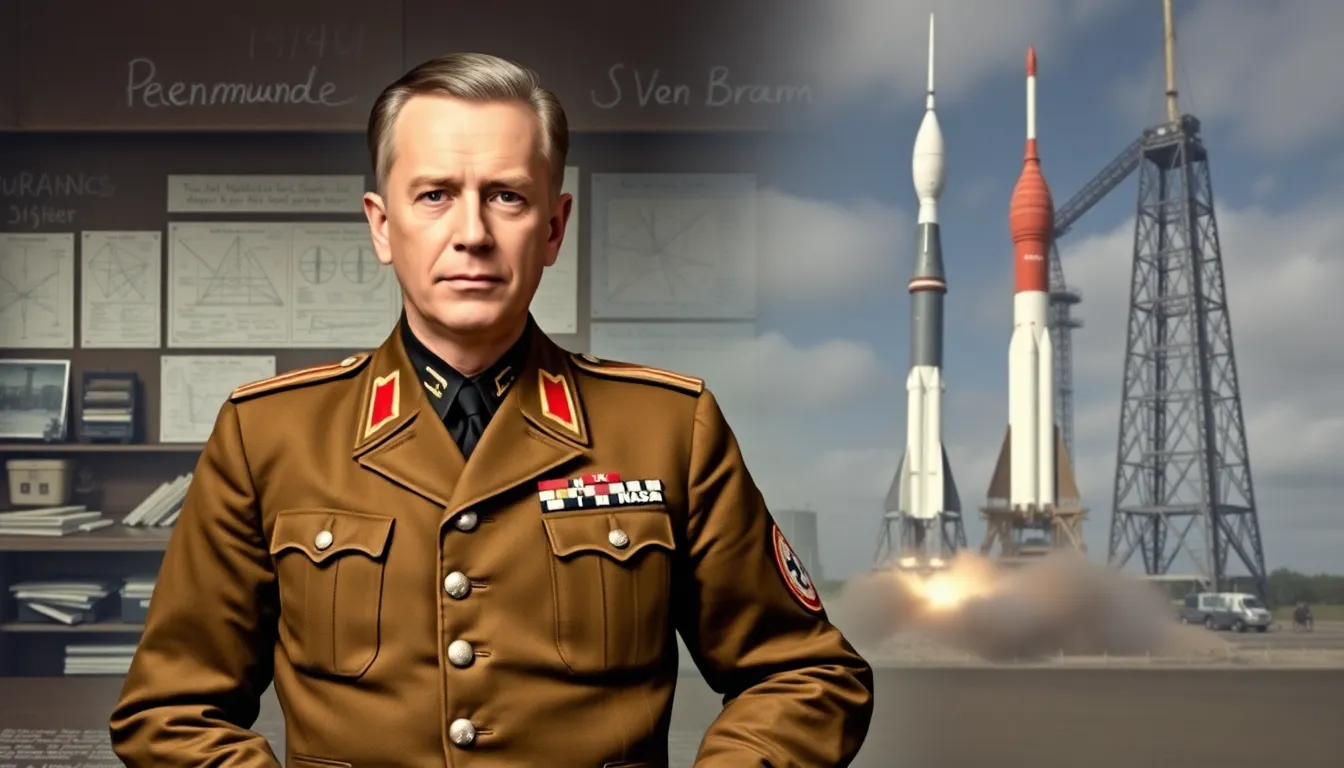
Early Life and Military Formation
Wernher Magnus Maximilian Freiherr von Braun was born on 23 March 1912 in Wirsitz, then part of the Province of Posen in the German Empire (today Wyrzysk, Poland). He came from an aristocratic family that prized education and service to the state. His father, Magnus von Braun, was a civil servant, and his mother, Emmy von Quistorp, managed the household. From an early age von Braun showed a fascination with astronomy and mechanics, building model rockets and studying the works of Hermann Oberth.
In 1929, at the age of 17, von Braun entered the Technical University of Berlin, where he studied mechanical engineering. He joined the National Socialist German Workers’ Party (NSDAP) in 1930 and the SS in 1932, a decision later contextualized by historians as stemming from a mixture of career ambition, nationalist sentiment, and the limited opportunities available to a young engineer in a politicised environment.
Von Braun’s military education began in earnest when he was conscripted into the German Army’s artillery branch in 1935. He completed officer training at the Wehrmacht’s artillery school in Hammelburg and was commissioned as a Leutnant (Second Lieutenant). Simultaneously, he was seconded to the Army Research Center in Peenemünde, where the German military was developing large‑scale rocket technology. His dual status as a commissioned officer and a research engineer positioned him at the nexus of military command and scientific innovation.
Wartime Context and Role
By the late 1930s, Germany’s rearmament program under Adolf Hitler prioritized new weapons that could break the stalemate of trench warfare encountered in World War I. The V‑2 (Vergeltungswaffe 2) rocket, an armed ballistic missile, was conceived as a “revenge weapon” capable of striking London, Antwerp and other Allied cities from a distance. Von Braun was appointed chief of the rocket development group at Peenemünde in 1937, a position that made him responsible for the technical direction of the program while retaining his rank in the Wehrmacht.
During World II, von Braun held the army rank of Hauptmann (Captain) and was promoted to Major in 1944. Officially, his role was that of a military scientist; he was not a field commander, but his status as a commissioned officer gave him access to resources, protected his research staff, and placed him within the chain of command of the Heereswaffenamt (Army Ordnance Office). The V‑2 rockets were deployed from mobile launch platforms and from the underground site at La Romaine (near Paris) beginning in September 1944. By war’s end, more than 3,000 V‑2s had been launched, causing roughly 9,000 civilian deaths, a figure that underlines the moral controversies surrounding the program.
Major Campaigns, Battles, and Decisions
Von Braun’s most consequential operational decision was the relocation of the Peenemünde facility to the Mittelwerk underground complex in Nordhausen (the “Mittelwerk” program) in late 1943, after Allied bombing made the coastal site untenable. This move, overseen by von Braun and SS‑Obergruppenführer Hans Kammler, shifted production to a forced‑labor system that employed concentration‑camp prisoners under brutal conditions. While von Braun was not directly responsible for the prison administration, historians note that his knowledge of the workforce’s composition implicates him in the broader ethical context of the project.
Operationally, von Braun advocated for the use of the A‑4 (V‑2) as a strategic weapon rather than a conventional artillery piece. He argued that its supersonic speed and lack of a return trajectory would make it impossible for the Allies to intercept. The first successful test launch occurred on 3 October 1942, and subsequent flights refined guidance, thrust, and payload capabilities. Throughout 1944‑45, von Braun oversaw the integration of more powerful liquid‑oxygen/ethanol engines, the development of the A‑5 test vehicle, and attempts to create a guidance system that could improve accuracy—efforts that laid groundwork for later post‑war missile designs.
Despite setbacks, the V‑2 program achieved several technical milestones: the first human‑made object to reach sub‑orbital space, the first to travel faster than the speed of sound, and the first to demonstrate a multi‑stage propulsion concept. These achievements, though occurring in the shadow of a total war, directly influenced the Allied rocket programs captured at the end of the conflict.
Leadership, Courage, and Controversies
Von Braun’s leadership style combined scientific rigor with a pragmatic approach to bureaucratic navigation. Colleagues described him as charismatic, meticulous, and willing to engage with military superiors to secure funding and protect his team. His ability to translate complex engineering problems into actionable tasks earned him the respect of both civilian scientists and army officers.
Nevertheless, his career is marred by significant controversies. The V‑2 production relied on the forced labor of over 20,000 prisoners, of whom an estimated 6,000 perished due to inhumane conditions, starvation, and executions. While von Braun never signed orders regarding labor deployment, the extent of his knowledge about the Mittelwerk’s death‑rate has been the subject of extensive scholarly debate. Post‑war interrogations by the U.S. Office of Strategic Services (OSS) indicated that von Braun was aware of the inmates’ suffering but rationalized it as a necessary evil to achieve a technological breakthrough that could win the war for Germany.
The moral complexity deepened after the war when Operation Paperclip— the U.S. program that recruited German scientists—brought von Braun and about 120 of his colleagues to the United States. Critics argued that the United States overlooked the engineers’ Nazi affiliations and participation in war crimes to gain a strategic edge over the Soviet Union. Von Braun’s later public statements minimizing his Nazi involvement, combined with his later prominence in the American space program, contributed to an ongoing historical dispute regarding the reconciliation of scientific achievement with ethical accountability.
Von Braun received numerous military decorations from Nazi Germany, including the Knight’s Cross of the War Merit Cross with Swords (awarded in 1945) and the German Cross in Silver. In the United States, he was awarded the NASA Distinguished Service Medal (1969) and the Presidential Medal of Freedom (1975), reflecting the stark contrast between his German wartime honors and his American civilian recognitions.
Later Life, Memory, and Legacy
After surrendering to American forces in May 1945, von Braun was interned at the Joint Base Hancock (formerly Camp Hancock) in Maryland for three years. He was subsequently transferred to Fort Bliss, Texas, where he worked with the Army Ballistic Missile Agency (ABMA) under General John B. Gordon. In 1955, von Braun became the director of NASA’s Marshall Space Flight Center, supervising the development of the Saturn V rocket that powered the Apollo moon‑landing missions.
Von Braun became a naturalized U.S. citizen in 1945, although some sources note that the official naturalization occurred in 1955 after his marriage to Maria Luise von Quistorp. He married three times and fathered several children, living a relatively private personal life despite his public stature. Estimates of his net worth at the time of his death in 1977 vary, with figures ranging from US$2 million to US$5 million, derived largely from government salaries, consulting fees, and royalties from his numerous publications and public speaking engagements.
After retiring from NASA in 1972, von Braun continued to lecture on space policy and authored several books, including “The Mars Project” (1953) and “Space Travel: A History” (1975). He died of pancreatic cancer on 16 June 1977 in Alexandria, Virginia, and was buried at the National Cathedral in Washington, D.C., alongside other notable figures of the American scientific community.
The memory of von Braun remains contested. In Germany, streets and schools bearing his name have been renamed, reflecting a societal reassessment of his Nazi affiliation. In the United States, he is honored in the naming of the “Von Braun Hall” at the Marshall Space Flight Center and memorial plaques commemorating his contributions to the Apollo program. Academic historiography now treats von Braun as a case study in the ethical dilemmas of scientific research under totalitarian regimes, emphasizing the need to separate technological accomplishment from the moral context in which it occurred.
Overall, Wernher von Braun’s biography illustrates the intersection of military engineering, political ideology, and the post‑war Cold‑War space race, making him a pivotal yet controversial figure in twentieth‑century military and scientific history.