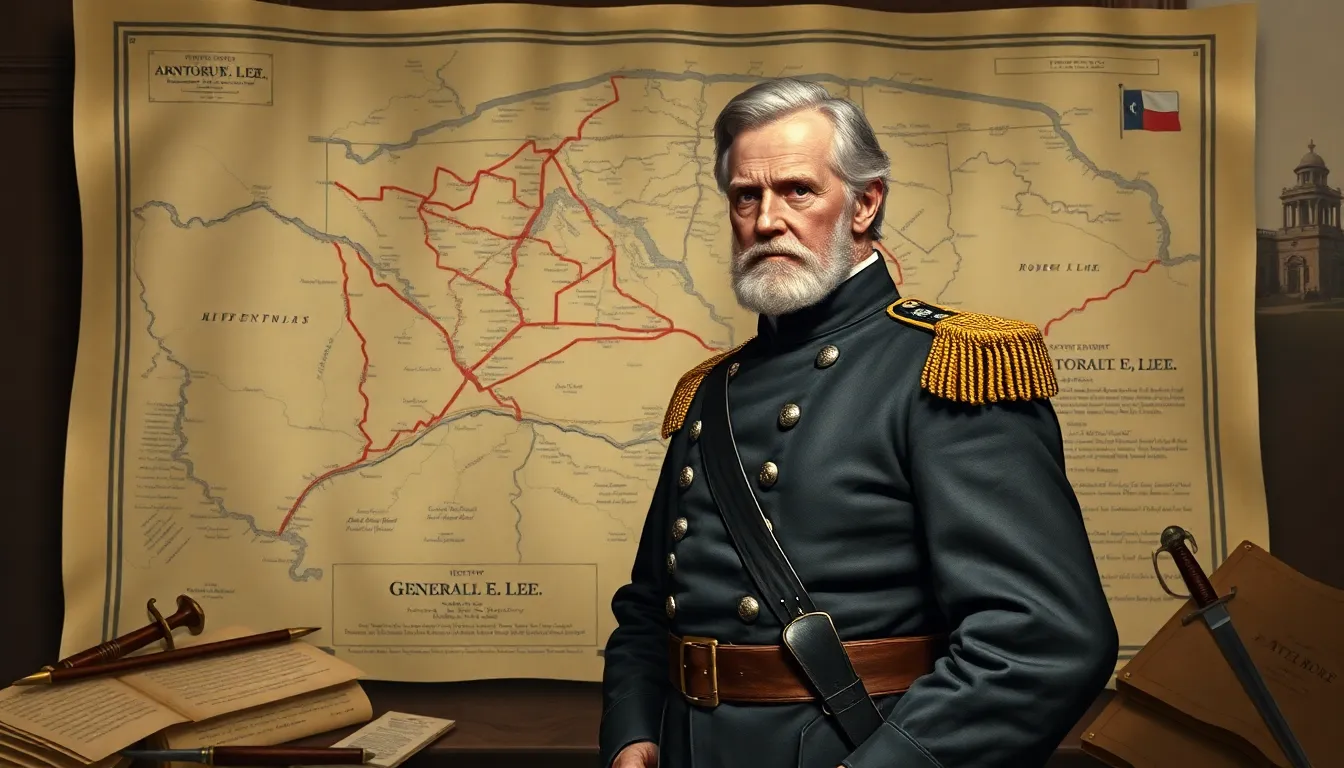
Early Life and Military Formation
Robert Edward Lee was born on January 19, 1807, at Stratford Hall Plantation in Westmoreland County, Virginia, the third son of Revolutionary War hero Henry “Light-Horse Harry” Lee and Anne Hill Carter Lee. The Lee family belonged to the Virginia gentry, a network of planter aristocracy that emphasized honor, education, and public service. After the death of his mother in 1818, the family faced financial difficulties, prompting a move to Alexandria, where Robert attended junior school.
In 1819, Lee entered the United States Military Academy at West Point, gaining admission through a congressional appointment. He excelled academically, ranking second in his class of 56 cadets upon graduation in 1829. West Point’s curriculum emphasized engineering, artillery, and the scientific study of warfare, shaping Lee’s methodical approach to command later in his career.
Commissioned as a brevet second lieutenant in the Corps of Engineers, Lee’s first assignment was the construction of coastal fortifications at Fort Monroe, Virginia. Over the next decade, he served at several engineering posts, including Fort Pulaski, Georgia, and in the survey of the Great Lakes region. His engineering work, notably on the Morris Island forts in South Carolina, earned him a reputation for technical competence and meticulous planning.
Lee married Mary Anna Randolph Custis, the great‑granddaughter of Martha Washington, in 1831. The couple settled at Arlington House, a plantation on the banks of the Potomac River, where they raised seven children. This marriage linked Lee to the Washington family and reinforced his status among Virginia’s elite.
Wartime Context and Role
When the American Civil War erupted in April 1861, the United States was divided between the industrialized, increasingly abolitionist North and the agrarian, slave‑holding South. Virginia’s secession on April 17, 1861, placed Lee at a crossroads. Though a career officer in the United States Army, his loyalty to his home state conflicted with his oath to the Union.
Lee formally resigned his United States commission on May 2, 1861, after being offered command of the Union forces defending fortifications at Alexandria—a proposal he declined. He accepted a commission as a major general in the Virginia militia and, shortly thereafter, as a lieutenant general in the newly formed Confederate States Army (CSA). Lee was placed in charge of the Department of Northern Virginia, a strategically crucial theater that encompassed the capital of Richmond, the Confederate capital of Virginia, and key rail and river routes.
Lee’s early responsibilities included organizing a hodgepodge of volunteer militias, regular Confederate troops, and armed civilians into a cohesive fighting force. He emphasized discipline, strict drill, and a strict adherence to Confederate military doctrine, which blended conventional Napoleonic tactics with emerging notions of total war.
Major Campaigns, Battles, and Decisions
First Bull Run (Manassas) – July 1861 – Although not yet in overall command, Lee’s coordinated artillery fire on the Union left flank contributed to the Confederate victory, boosting Southern morale and cementing Lee’s reputation as an adept artillery officer.
Seven Days Battles – June 25 – July 1, 1862 – As commander of the Army of Northern Virginia, Lee orchestrated a series of aggressive assaults against Union General George B. McClellan’s Peninsula Campaign. The battles forced the Union army to retreat from the outskirts of Richmond, preserving the Confederate capital.
Second Bull Run – August 28–30, 1862 – Lee, in conjunction with Stonewall Jackson, executed a coordinated flank attack that shattered Union forces under General John Pope. This victory opened the path for Lee’s first invasion of the North.
Antietam (Sharpsburg) – September 17, 1862 – Lee’s army engaged Union General McClellan’s forces in the bloodiest single day of the war. While tactically a Confederate retreat, Lee’s decision to cross the Potomac and fight in Maryland extended the war’s geographic scope. The battle’s outcome prompted President Abraham Lincoln to issue the Emancipation Proclamation.
Fredericksburg – December 11–15, 1862 – Lee’s defensive positioning on Marye’s Heights resulted in massive Union casualties, reinforcing his reputation for tactical acumen in defensive warfare.
Chancellorsville – April 30 – May 6, 1863 – Often cited as Lee’s greatest tactical victory, he split his forces in the face of a larger Union army, resulting in the defeat of General Joseph Hooker. However, the Confederate loss of Lieutenant General Thomas “Stonewall” Jackson in a friendly fire incident cast a long shadow over the triumph.
Gettysburg – July 1–3, 1863 – Lee’s second invasion of the North culminated in the three‑day battle at Gettysburg, Pennsylvania. The Confederate defeat ended Lee’s offensive capabilities and marked a turning point in the war. Controversial decisions, such as the assaults on Cemetery Ridge, have been widely debated by historians.
Overland Campaign – May–June 1864 – Facing Ulysses S. Grant’s relentless strategy, Lee adopted a defensive posture, engaging Union forces in battles at the Wilderness, Spotsylvania Court House, and Cold Harbor. Although outnumbered, Lee’s tactical skill delayed Union advances, but attrition began to erode Confederate manpower dramatically.
Siege of Petersburg – June 1864 – April 1865 – Lee’s army endured a prolonged siege with diminishing supplies. His decision to extend the defensive line to the far south of the city, while initially successful, ultimately overextended his forces, leading to the eventual fall of Richmond.
Appomattox Court House – April 9, 1865 – Recognizing the futility of continued resistance, Lee surrendered his army of about 28,000 men to Grant, effectively ending major Confederate military operations. Lee’s surrender terms were generous, allowing his men to return home with personal possessions, a decision that helped to facilitate a relatively peaceful transition for many former Confederate soldiers.
Leadership, Courage, and Controversies
Lee’s leadership style emphasized personal bravery, strict discipline, and an intense sense of duty. He was widely regarded by his troops as a charismatic commander who led from the front, often exposing himself to the same hazards as his soldiers. Contemporary accounts describe his calm demeanor under fire and his habit of personally inspecting the wounded on the battlefield.
Nonetheless, Lee’s career is not without controversy. His decision to fight for a government that sought to preserve slavery has provoked extensive moral scrutiny. While Lee publicly expressed personal ambivalence toward slavery—famously stating he “never could fully align with the institution”—he nonetheless remained loyal to Virginia’s decision to secede.
Critics also question Lee’s willingness to employ aggressive tactics that resulted in high casualty rates, particularly at battles such as Gettysburg and Pickett’s Charge. Some historians argue that his adherence to offensive doctrine, despite unfavorable odds, reflected a personal honor code that sometimes eclipsed strategic pragmatism.
Lee’s post‑war attitudes toward African Americans further complicate his legacy. In his 1865 “Farewell Address” to his troops, Lee urged reconciliation and urged the South to “be content that they have been delivered from destruction.” However, he opposed political equality for former slaves, supporting limited civil rights but resisting full suffrage.
The “Lost Cause” movement, emerging after the war, mythologized Lee as a noble, apolitical soldier devoted solely to states’ rights. This narrative minimized or ignored his role in defending a slave‑holding rebellion, influencing monuments, textbooks, and public memory for decades. Modern scholarship increasingly challenges this myth, emphasizing Lee’s agency within the Confederate hierarchy and the broader social consequences of his actions.
Later Life, Memory, and Legacy
Following the surrender, Lee retired to his family home at Arlington but found it confiscated by Union forces and later transformed into Arlington National Cemetery. He accepted a position as president of Washington College (now Washington and Lee University) in Lexington, Virginia, where he sought to heal the shattered South through education. Lee served in this role until his death on October 12, 1870, from a stroke.
Lee’s burial at Lee Chapel, adjacent to Washington College, became a pilgrimage site for veterans and admirers. Throughout the late 19th and early 20th centuries, monuments honoring Lee were erected across the Southern United States, most famously the massive marble statue on the Virginia State Capitol grounds (1919) and the Robert E. Lee Memorial at Arlington (1937, later removed in 2022).
Historical interpretation of Lee has evolved significantly. Early 20th‑century historians often reflected the “Lost Cause” perspective, portraying Lee as an idealized Southern gentleman. Mid‑20th‑century revisionists began to scrutinize his motivations and the Confederate cause’s links to slavery. In the 21st century, scholars such as James M. McPherson, Gary W. Gallagher, and Elizabeth Deane emphasize Lee’s military competence while critically assessing his moral choices.
Contemporary debates over Lee’s commemoration intensified after events such as the 2015 Charleston church shooting and the 2020 George Floyd protests. Several U.S. states and localities have removed or renamed institutions bearing his name, arguing that public honors should not celebrate figures who defended slavery. Conversely, some argue that Lee’s strategic genius and personal virtues merit preservation in historical, rather than celebratory, contexts.
Today, Robert E. Lee remains a polarizing figure. Military academies study his tactics for their instructional value, while historians examine his life to understand the complexities of loyalty, leadership, and the moral dimensions of war. In this manner, Lee’s legacy continues to inform broader conversations about memory, honor, and the ways societies reckon with contested pasts.