Early Life and Military Formation
Francisco Pizarro González was born around 1478 in Trujillo, a town in the Extremadura region of Castile (now Spain). His family belonged to the lower nobility; his father, Gonzalo Pizarro, was a farmer and minor landowner, and his mother, María Alonso, came from a family of modest means. The Pizarros could not afford a formal education for their children, and Francisco spent his youth in a rural environment, learning basic literacy, horseback riding, and the use of weapons common among the local militia.
In his early teens, Pizarro moved to the port city of Seville, where he worked as a swineherd and later as a clerk for a merchant house. The trade routes to the New World opened in 1492, and by the early 1500s Pizarro, like many young men of Extremadura, sought opportunities across the Atlantic. He enlisted as a foot soldier in the expedition of the Spanish Crown to the Caribbean, joining the forces that were consolidating Spanish control over Hispaniola and later Puerto Rico.
Military training in the early colonial forces was informal but rigorous. Pizarro learned the art of small‑unit tactics, the use of pikes, swords, and early firearms such as the arquebus. He also gained experience in the logistical challenges of overseas campaigns, including supply transport, camp sanitation, and interactions with indigenous peoples. By 1514, he had risen to the rank of sergeant in the Crown’s militia, participating in the suppression of a Taíno uprising on Hispaniola.
Wartime Context and Role
The early sixteenth century was a period of rapid Spanish expansion in the Americas. After the fall of the Aztec Empire (1521), the Crown turned its attention northward to the Andean plateau, where the Inca Empire—centered in Cusco—presented a wealthy but politically fragmented target. In 1524, a rival expedition led by Diego de Almagro and a younger Pizarro attempted to explore the Peruvian coast but was forced to retreat due to disease and hostile resistance.
By 1526, Pizarro had returned to Spain, where he secured a royal commission as a captain‑general of a small private force. He was granted a privateering license (the so‑called “capitulación”) permitting him to seek and claim new territories on behalf of the Crown. The expedition he led was modest: roughly 180 men, a few light cannons, and a limited supply of horses and mules. Pizarro’s official rank for the venture was “Alférez Mayor” (junior officer), but in practice he acted as the overall commander of the expedition.
Major Campaigns, Battles, and Decisions
In 1528 Pizarro embarked from Panama with a fleet of three ships, crossing the Pacific to the coast of present‑day Peru. His first major encounter was at the island of Tumbes, where his forces captured the local ruler, Túpac Yupanqui (not to be confused with the later Inca emperor). This early success provided both a foothold and a source of intelligence about the wider Inca political landscape.
After returning briefly to Panama in 1529, Pizarro organized a second, better‑supplied expedition. In 1530 he invaded the interior, marching south along the coast toward the Inca capital of Cusco. The journey was marked by harsh terrain, tropical diseases, and occasional skirmishes with local chieftains. Pizarro’s ability to secure alliances with disaffected Inca factions—most notably the son of the deposed Emperor Huáscar—proved pivotal.
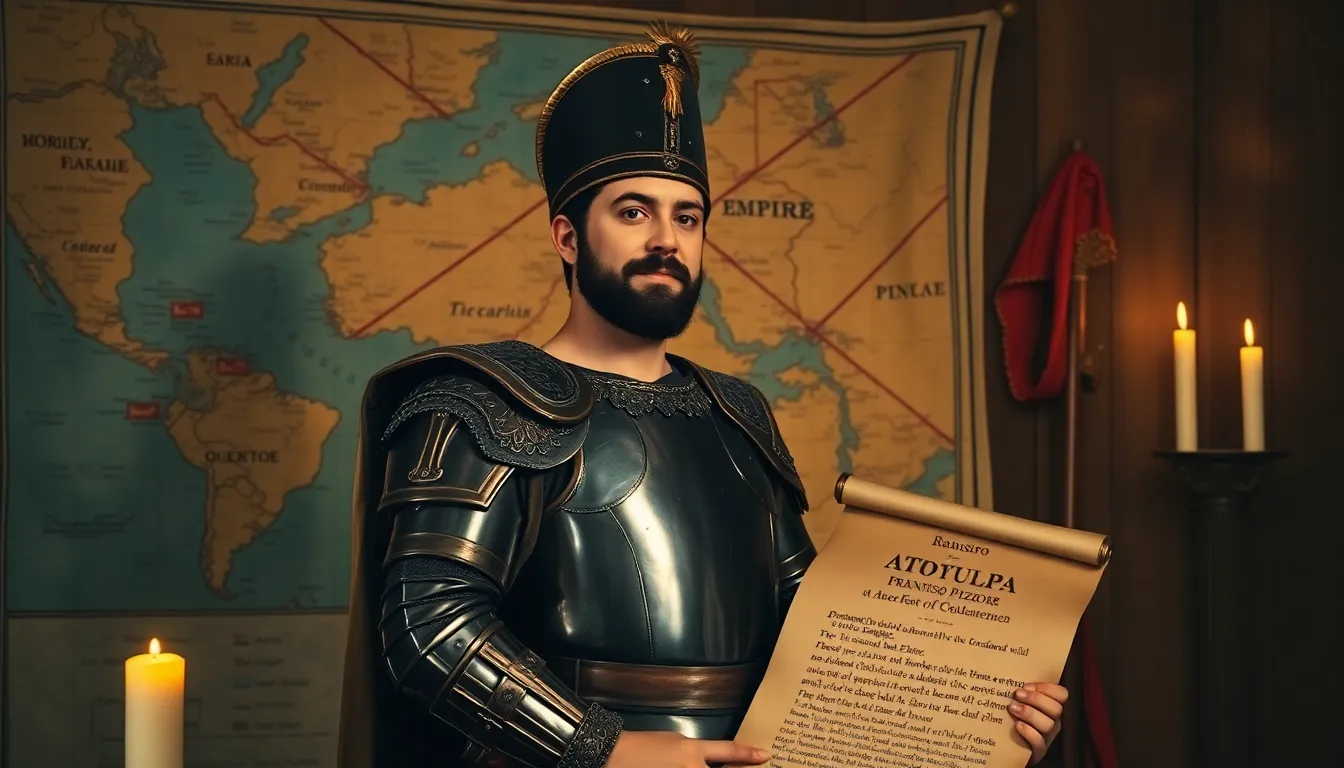
The decisive moment came on 16 November 1532 at the Battle of Cajamarca. Pizarro, with a force of roughly 180 men, including 30 cavalry and a few firearms, entered the Inca city under the pretense of a diplomatic visit. Using the element of surprise, superior firepower, and the psychological impact of horses and gunpowder, his troops captured the Inca emperor Atahualpa. The battle resulted in a minimal Spanish casualty count (fewer than 10 dead) while inflicting heavy losses on the Inca soldiers, many of whom were unarmed or poorly equipped.
Following the capture, Pizarro negotiated a massive ransom—the “golden room”—in which the Incas filled a large chamber with gold and silver to secure Atahualpa’s release. The ransom was paid in early 1533, but Pizarro ordered Atahualpa’s execution later that year, citing alleged conspiracies. The removal of the emperor destabilized the Inca political structure, allowing Pizarro to advance toward Cusco.
In 1533, Pizarro entered Cusco with a small contingent, encountering minimal resistance as local nobles fled or submitted. He installed a puppet ruler, Túpac Huallpa, and claimed the city for Spain. Over the next two years, Pizarro’s forces fought a series of guerrilla-style confrontations against resistant Inca forces led by the charismatic general Manco Inca Yupanqui. The most notable of these was the Siege of Sacsayhuamán (1536), a massive stone fortress near Cusco, where Inca forces attempted to retake the city. Pizarro’s troops, using artillery and disciplined infantry formations, repelled the siege, securing Spanish dominance.
Leadership, Courage, and Controversies
Pizarro’s leadership style combined aggressive boldness with pragmatic opportunism. His willingness to negotiate and form temporary alliances with rival Inca factions demonstrated political acumen, while his reliance on a small, well‑trained core of men illustrated confidence in elite troops. Contemporary chroniclers such as Pedro Cieza de León noted Pizarro’s “uncommon daring” in confronting vastly superior numbers.
Nevertheless, Pizarro’s actions have been subject to extensive moral scrutiny. The execution of Atahualpa, despite the ransom being fulfilled, is widely regarded as a breach of diplomatic ethics by modern standards. Moreover, his forces employed terror tactics—public executions, seizure of women and children, and forced labor (the early mita system)—that contributed to the rapid depopulation of indigenous communities. Estimates of indigenous mortality during the conquest vary, but scholars such as Victor Andrienko and John Hemming agree that disease, warfare, and forced labor caused a demographic collapse of up to 80 % in some Andean regions.
Politically, Pizarro’s rivalry with fellow conquistador Diego de Almagro escalated into open conflict. After the initial partnership in the discovery of Peru, Almagro claimed entitlement to the southern territories (present‑day Chile). The dispute culminated in the Battle of Las Salinas (1538), where Pizarro’s forces defeated Almagro’s army. Almagro was captured and executed in 1538, an act that further tarnished Pizarro’s reputation among contemporary Spaniards and later historians.
Despite these controversies, Pizarro was recognized by the Spanish Crown for his achievements. In 1541, King Charles I conferred upon him the title “Governor of New Castile,” granting him quasi‑royal authority over the former Inca lands. However, his rule was marked by constant challenges from indigenous uprisings, Spanish rivals, and internal dissent.
Later Life, Memory, and Legacy
Francisco Pizarro’s later years were dominated by attempts to consolidate his authority and defend his holdings against both local resistance and competing conquistadors. In 1541, while returning from a trip to Spain to seek the Crown’s reaffirmation of his titles, Pizarro was assassinated in Lima by a faction of Almagro supporters led by the mestizo Juan de la Sal. He was killed in his own home, an event that underscored the fragile nature of Spanish colonial power in the Andes.
After his death, Pizarro’s legacy was shaped by divergent narratives. Spanish colonial authorities portrayed him as a civilizing hero who opened the wealth of Peru to European civilization. In the eighteenth and nineteenth centuries, Spanish‑American historiography cast him as a foundational figure of the Hispanic world, while nationalist movements in Peru later emphasized his role as an oppressor who facilitated the destruction of the Inca civilization.
Modern scholarship treats Pizarro as a complex figure: a skilled commander who employed innovative tactics and diplomatic maneuvering, yet also a ruthless conqueror whose actions precipitated massive demographic and cultural loss. His campaigns are studied in military history for the effective use of a small disciplined force against a numerically superior opponent, demonstrating the impact of technology, surprise, and psychological warfare.
Physical commemorations of Pizarro are limited and often contested. In Trujillo, Spain, a modest plaque marks his birthplace, while in Lima, a 19th‑century statue stood briefly before being removed during the wave of anti‑colonial sentiment in the early 20th century. Academic institutions in Peru have debated the inclusion of his name in curricula, reflecting ongoing discussions about how to reconcile the colonial past with contemporary identities.
Overall, Francisco Pizarro remains a polarizing figure whose life encapsulates the violent encounters that defined the early modern Atlantic world. His biography serves as a reminder of the intertwined narratives of exploration, conquest, cultural exchange, and the profound human costs that accompanied the rise of the Spanish Empire in the Americas.