Early Life and Military Formation
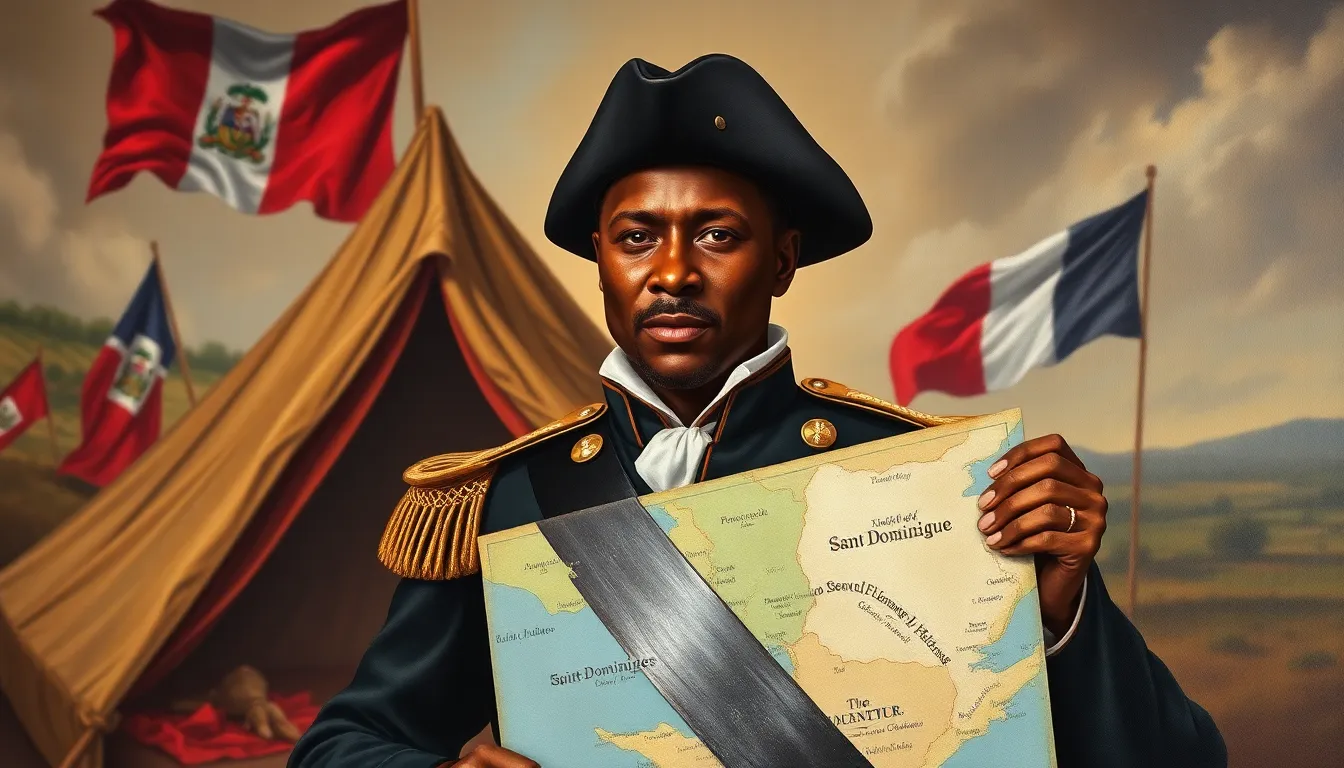
François‑Didier Toussaint Louverture was born on 20 May 1743 in the coastal town of Saint‑Claude (modern‑day Nord) in the French colony of Saint‑Domingue, the richest and most productive sugar colony in the Caribbean. He was the son of a slave named Gaou Guin and a free woman of color, though precise details of his parentage remain uncertain because colonial records for enslaved births were sporadic. Raised on the plantation of the wealthy de Limon, Louverture received a limited but notable education for a slave: he learned to read and write French, was instructed in basic arithmetic, and was exposed to Catholic catechism. This literacy set him apart from most of his peers and later facilitated his diplomatic and administrative work.
In his early twenties, Louverture was sold to a wealthy planter, Médard Claude, where he worked as a coachman and overseer. His competence earned him a degree of trust, allowing him to acquire a small plot of land and a modest house—a rare privilege for a slave. Around 1770, he married a free woman of color, Suzanne Simone Baptiste, and they would have several children together, most notably his son, Placide. Through his marriage, Louverture gained further exposure to the free‑colored elite of Saint‑Domingue, a class that would later play a pivotal role in the early stages of the revolution.
Unlike European officers, Louverture had no formal military academy training. His military formation was largely practical and self‑directed, forged during the chaotic years of the 1790s when Saint‑Domingue was plunged into uprisings, foreign invasions, and shifting allegiances. He learned tactics from the Caribbean plantation militias, the French Revolutionary army, and through interactions with Spanish and British officers who intermittently occupied parts of the island. By the time he entered the revolutionary struggle, he possessed a keen strategic mind, knowledge of both European linear warfare and guerrilla tactics suited to the mountainous interior of the colony.
Wartime Context and Role
The Haitian Revolution (1791‑1804) unfolded against the broader backdrop of the French Revolution, which dismantled the ancien régime and ignited debates over liberty, equality, and the rights of enslaved peoples. In August 1791, a massive slave revolt erupted in the North Province, led by figures such as Boukman Dutty. The insurgency quickly transformed into a multi‑factional conflict involving enslaved rebels, free people of color, white planters, and foreign powers (Spain and Britain) seeking to seize the lucrative colony.
Initially, the French National Assembly hesitated to overhaul the colony’s slave system, creating a political vacuum. In 1793, the French Commissioners Sonthonax and Polverel, under pressure, abolished slavery in Saint‑Domingue, a decision that re‑aligned many enslaved rebels with the French Republic. It was within this volatile environment that Toussaint Louverture emerged as a military commander. By 1793, he had organized a force of approximately 3,000 men, primarily former slaves, and was appointed colonel (later general) of the Saint‑Dominique militia by the French commissioners.
Louverture’s official rank within the French Revolutionary Army eventually rose to the level of Lieutenant‑General of the Army of the North. He commanded the “Armée de Saint‑Domingue” (Army of Saint‑Domingue), a composite force that blended regular French troops, free‑colored militia, and formerly enslaved soldiers. His responsibilities encompassed defending the colony against external invasion, suppressing internal dissent, and administering civil affairs in territories under his control.
Major Campaigns, Battles, and Decisions
1793–1794: Consolidation and the War against Spain – After the abolition of slavery, Louverture pledged allegiance to the French Republic and turned his attention to the Spanish forces occupying the eastern half of the island (the present‑day Dominican Republic). He organized a series of coordinated attacks that pushed the Spanish back to the border, securing the vital northern plains for the French. His use of mobile columns and fortified “camps‑forts” proved effective against the conventional Spanish formations.
1795: Defeat of the British Invasion – In 1795 the British, allied with French royalists, landed forces near Saint‑Marie and attempted to capture the port of Port‑au‑Prince. Louverture’s troops, employing a combination of artillery positioned on the high ground of the Montagne Noire and rapid infantry assaults, repelled the incursion. The British surrender at the Battle of Le Cap (February 1795) marked a turning point, preserving French dominance on the island.
1796–1798: Reorganization and Economic Restoration – Following military successes, Louverture turned to rebuilding the devastated plantation economy. He instituted a “forced labor” system (the Code Louverture) that compelled former slaves to work the fields under strict supervision, arguing that productivity was essential for the colony’s survival. While controversial, this policy stabilized sugar and coffee production, strengthening the economic base for the revolutionary government.
1798: The “crush of the Black Guard” and the Crusade against the “Babylonians” – A faction of radical enslaved leaders, known as the “Babylonians,” resisted the labor reforms and threatened to resume open rebellion. In a decisive campaign, Louverture’s forces captured the rebel stronghold at the Bois‑Miche, employing siege tactics and negotiated surrenders. The defeat quelled the most organized internal challenge to his authority.
1799–1800: The War with Britain and the Treaty of Amiens – With Britain temporarily at peace with France after the Treaty of Amiens (1802), British forces withdrew from Saint‑Domingue. However, the island remained under pressure from the French Directory, which grew increasingly suspicious of Louverture’s growing autonomy.
1801: Constitution of 1801 and the Declaration of Autonomy – Louverture drafted a constitution for the colony, proclaiming himself Governor‑General for life while affirming the abolition of slavery. The document established a semi‑autonomous government under French suzerainty but with full internal self‑rule. This move was welcomed by many Haitians but alarmed the French authorities, who viewed it as a step toward secession.
1802: The Saint‑Domingue Expedition and Capture – In response, Napoleon Bonaparte dispatched a massive expeditionary force (≈ 40,000 troops) under General Charles Leclerc to re‑assert French authority and reinstate slavery. Louverture’s strategic decision to avoid a frontal battle, instead attempting to wear down the French through attrition and fortifying key positions, ultimately failed. He was betrayed by one of his commanders, Jean‑Jacques Dessalines, who surrendered Alexandria in June 1802. Louverture was seized, shipped to France, and imprisoned at Fort de Joux, where he died on 7 April 1803.
Leadership, Courage, and Controversies
Louverture’s leadership combined military acumen with political pragmatism. His ability to transition rapidly between guerrilla tactics and conventional siege warfare allowed him to defeat foreign powers that outmatched the Haitian forces numerically. He demonstrated personal courage, famously leading troops from the front during the Battle of Le Cap, where he sustained a leg wound yet continued to command.
Nevertheless, his legacy is contested. Critics argue that his labor policies re‑imposed bondage under a different name, creating a “forced apprenticeship” that many former slaves viewed as a betrayal of the revolutionary ideals. The imposition of strict discipline, the use of capital punishment against dissenters, and the suppression of rival revolutionary leaders such as André Rigaud have fueled scholarly debate about the nature of his authoritarianism.
Louverture also navigated complex diplomatic relations. He negotiated treaties with the United States (the 1795 trade agreement) and attempted to secure recognition from Britain and Spain, demonstrating a sophisticated grasp of international politics. His willingness to cooperate with the French Republic while simultaneously protecting Haitian autonomy placed him in a precarious position that ultimately led to his downfall when Napoleon pursued imperial ambitions.
Later Life, Memory, and Legacy
After his death in April 1803, Toussaint Louverture became a martyr for Haitian independence. His son, Placide, died shortly after the French withdrawal, while his other progeny were either exiled or integrated into the new Haitian state. The revolution continued under leaders like Jean‑Jacques Dessalines and Henri Christophe, culminating in the declaration of independence on 1 January 1804.
Louverture’s memory has been invoked by various political movements. In the 19th century, Haitian governments celebrated him as the “Father of the Nation,” erecting statues and naming streets after him. During the 20th‑century Pan‑African and anti‑colonial struggles, activists cited his strategic brilliance and anti‑slavery stance as inspirational. Academically, historians have re‑evaluated his policies, recognizing both his role in achieving emancipation and the authoritarian dimensions of his governance.
Modern Haiti commemorates him annually on the “Toussaint Louverture Memorial Day.” Internationally, his portrait appears on Haitian banknotes, and his name graces military academies, such as the École Militaire Toussaint Louverture in Port‑au‑Prince. Scholarly works continue to debate the balance between his revolutionary zeal and pragmatic authoritarianism, positioning Louverture as a complex figure whose actions reshaped global notions of freedom, race, and colonial power.