Historical Context
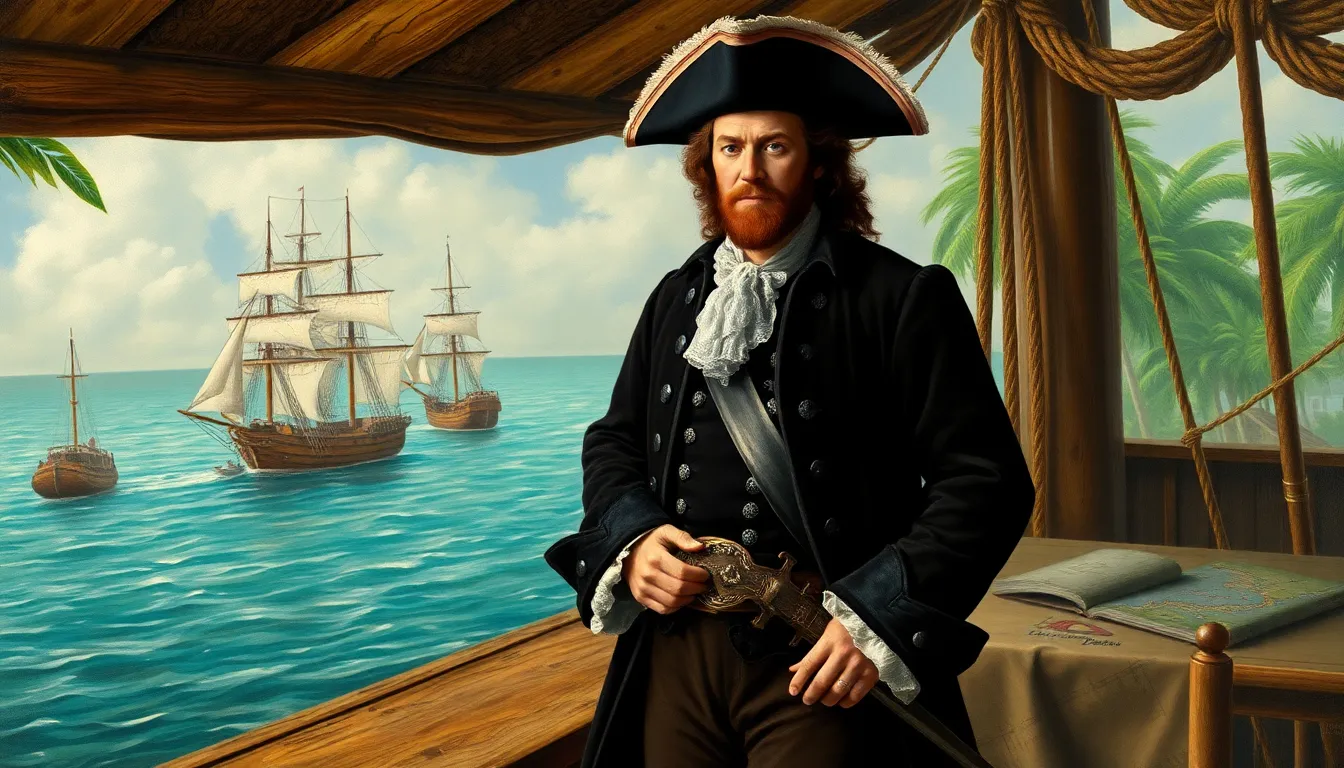
Henry Morgan lived during the height of European colonial rivalry in the Caribbean, a region contested by Spain, England, France, and the Netherlands. The mid‑17th century was marked by intermittent wars—most notably the Anglo‑Spanish War (1654–1660) and the later War of the Grand Alliance (1688–1697)—which created a legal gray area for privateering. Privateers were privately owned vessels authorized by a sovereign via a *letter of marque* to attack enemy shipping, a practice that blurred the line between state‑sanctioned warfare and outright piracy. The English Crown, seeking to weaken Spanish dominance without committing regular naval forces, frequently employed privateers like Morgan to raid Spanish settlements, ports, and treasure convoys in the Caribbean and Central America.
Early Life and Formation
Henry Morgan was born around 1635 in Llanrumney, a suburb of Cardiff, in the Principality of Wales, then part of the Kingdom of England. Primary sources for his early years are sparse; most information derives from later colonial records and contemporary correspondence. His father, Robert Morgan, was a modest‑income farmer who died when Henry was still a child, leaving the family in relative poverty. Morgan likely received only a basic education, typical for a Welsh peasant’s son, but he did acquire literacy sufficient for later dealings with English officials and for handling complex financial transactions.
In his teenage years, Morgan migrated to the English colony of Barbados, a common destination for displaced Welsh youths seeking economic opportunity. Barbados in the 1650s was a booming sugar economy, reliant on slave labor, and it served as a launch point for seafaring ventures. Morgan entered the service of the island’s merchant community, where he quickly learned navigation, seamanship, and the trade routes linking the Caribbean islands to the Spanish Main. Although documentation of his apprenticeship is limited, the pattern of Welsh migrants entering maritime trades in Barbados is well established, suggesting Morgan’s formative maritime experience began there.
Role in Major Events
Privateering Beginnings (1658–1664) – Morgan first appears in official records in 1658 when he received a *letter of marque* from the English Commonwealth, authorizing him to attack Spanish ships. His crew captured several Spanish vessels, seizing cargoes of gold, silver, and goods. By 1660, following the Restoration of Charles II, Morgan secured renewed letters, demonstrating his adaptability to changing political regimes.
Attack on Portobelo (1668) – One of Morgan’s most celebrated raids occurred in 1668 when he led a force of about 800 men—comprising English privateers, French buccaneers, and Jamaican militia—against the fortified Spanish town of Portobelo (present‑day Panama). Contemporary accounts, such as those of the Spanish chronicler José de la Torre y Gorreto, describe a surprise night assault that secured a vast amount of treasure. Morgan’s victory solidified his reputation and earned him a substantial personal share of the loot, although exact figures vary among sources.
Raid on Panama City (1670–1671) – The most audacious of Morgan’s campaigns was the overland expedition against Panama City in 1670‑71. Over a winter crossing through dense jungle and hostile terrain, Morgan’s force—estimated at 1,200 men—reached the city in January 1671. The raid, recounted in the English pamphlet *A Relation of the Late Successful Expedition Against Panama* (1671), resulted in the destruction of the city and the capture of a vast quantity of silver. Although the English Crown initially disavowed the attack to avoid diplomatic fallout with Spain, Morgan was eventually pardoned and even knighted by King Charles II in 1674, an extraordinary turn that reflected the era’s pragmatic view of privateering.
Governor and Lieutenant Governor of Jamaica (1675–1688) – In the aftermath of his raids, Morgan settled on the island of Jamaica, where he acquired large estates, most notably at the parish of St. Ann, and married Joanna Brent, a wealthy planter’s daughter. In 1675, the English Crown appointed him Lieutenant Governor of Jamaica, a role he fulfilled until his death. As an official, Morgan oversaw the colony’s defense, regulated shipping, and suppressed illegal piracy, paradoxically transitioning from a sanctioned pirate to a colonial administrator. His tenure is documented in the Jamaica Assembly records, which show his involvement in the enactment of the 1683 *Piracy Act* that sought to curb unlicensed buccaneering.
Death and Estate (1688) – Henry Morgan died on 25 August 1688 at his estate, “Ditchley” (also known as “Nutt’s River”), near Spanish Town, Jamaica. He was interred in the churchyard of St. Catherine’s Parish. His will, filed with the Jamaican Court of Chancery, enumerated an estate valued at approximately £32,000—a considerable fortune for the period, equivalent to several million pounds today when adjusted for inflation and purchasing power. The exact net worth, however, remains a matter of scholarly estimation due to incomplete records of his Caribbean holdings.
Allies, Opponents, and Debate
Throughout his career, Morgan navigated a complex network of alliances and enmities. His primary allies were fellow English privateers and the French buccaneers who operated out of Tortuga and Saint‑Dominique. Figures such as François l’Olonnais and Nicholas van Hoorn occasionally cooperated with Morgan in joint raids, though they also competed for spoils, leading to occasional friction documented in French privateering logs.
Spain was Morgan’s principal opponent, and Spanish officials repeatedly condemned his raids as acts of piracy rather than legitimate warfare. The 1671 *Treaty of Madrid* attempted to curb privateering, but enforcement was weak, and Morgan continued to benefit from English toleration. Within England, political opponents—particularly those aligned with the Royal Navy—criticized the Crown’s reliance on privateers, arguing that it undermined legitimate naval power. A notable debate appears in the parliamentary debates of 1672, where MPs questioned the moral and legal status of men like Morgan.
Modern historians have debated Morgan’s legacy. Some, such as James F. Crouch in *The Buccaneer: Henry Morgan 1635‑1688* (1964), portray him as a shrewd entrepreneur who helped establish British dominance in the Caribbean. Others, like Peter Earle in *The Pirate Wars* (2005), emphasize the brutality of his raids and the suffering inflicted on Spanish civilians, arguing that celebrating Morgan perpetuates an overly romanticized view of piracy.
Legacy and Interpretation
Immediately after his death, Morgan’s reputation in the English colonies was that of a successful defender of English interests and a wealthy patriarch. His estates continued to be managed by his descendants, and the “Morgan Treasure” became part of Jamaican folklore. In the 18th and 19th centuries, romantic literature and adventure novels—most notably Robert Louis Stevenson’s *Treasure Island*—borrowed elements from Morgan’s life, contributing to the popular image of the charismatic pirate captain.
In the 20th century, archaeological investigations at the sites of his raids (Portobelo, Panama) have provided material evidence of the scale of destruction and the quantity of loot, corroborating contemporary accounts while also revealing the broader socioeconomic impact on local populations. Scholars now view Morgan within the larger context of imperial competition, colonial expansion, and the transition from privateering to formal naval warfare.
Today, Henry Morgan is commemorated in various ways: a street named “Morgan Road” in Kingston, Jamaica; a tavern in London that claims to be the “original meeting place of the pirates of the Caribbean”; and scholarly conferences that discuss his role in early modern Atlantic history. Nevertheless, his legacy remains contested, balancing between the image of a daring adventurer and that of a ruthless agent of imperial plunder.