Historical Context
Harriet Beecher Stowe lived during a period of profound transformation in United States history. Born in the early nineteenth century, she witnessed the rapid expansion of the nation, the intensifying sectional conflict over slavery, the Civil War (1861–1865), and Reconstruction. The antebellum era was marked by vigorous debates about the moral, economic, and constitutional dimensions of slavery. Abolitionist societies, newspapers, and pamphleteering created a vibrant public sphere in which religious, literary, and political arguments intertwined. The Second Great Awakening (c. 1790–1840) fostered a moral earnestness that animated many reform movements, including temperance, women’s education, and the push to end slavery. It was within this crucible of religious fervor, expanding literacy, and political polarization that Stowe’s voice emerged and resonated across the Atlantic.
Early Life and Formation
Harriet Elisabeth Beecher was born on June 14, 1811, in Litchfield, Connecticut, into a family whose intellectual and religious commitments would shape her worldview. Her father, Lyman Beecher, was a prominent Congregationalist minister and a leading figure in the temperance and evangelical movements; her mother, Roxana Foote Beecher, managed a large household and instilled a love of reading. The Beecher household was a nexus of New England intellectual life: Harriet’s brothers included the famed minister Henry Ward Beecher, writer and minister Charles Beecher, and the social reformer Edward Beecher. The family’s connections to the American Board of Commissioners for Foreign Missions and the American Anti‑Slavery Society placed Harriet in direct contact with contemporary reformist ideas.
Education for women in early nineteenth‑century New England was limited, but Harriet received a solid grounding. She attended Litchfield Female Academy, where she studied literature, languages, and moral philosophy under the tutelage of Sarah Porter. The academy emphasized the development of a woman’s moral character and her capacity to influence society through the domestic sphere, a theme that would later permeate Stowe’s writings. While formal higher education for women was rare, Harriet continued her studies independently, reading extensively from the Bible, classical authors, and the burgeoning body of American literature.
In 1832, Harriet married Calvin Ellis Stowe, a scholar of Hebrew and a professor at Lane Theological Seminary in Cincinnati, Ohio. The marriage was both a partnership of intellect and a strategic move that brought Harriet into the heart of the Western frontier’s anti‑slavery activism. Cincinnati, situated on the border between free and slave states, was a hotbed of fugitive‑slave activity and abolitionist publishing. The Stowes’ home became a stop on the Underground Railroad, and Harriet’s exposure to escaped slaves and abolitionist pamphlets deepened her conviction that slavery was a moral evil demanding urgent redress.
Role in Major Events
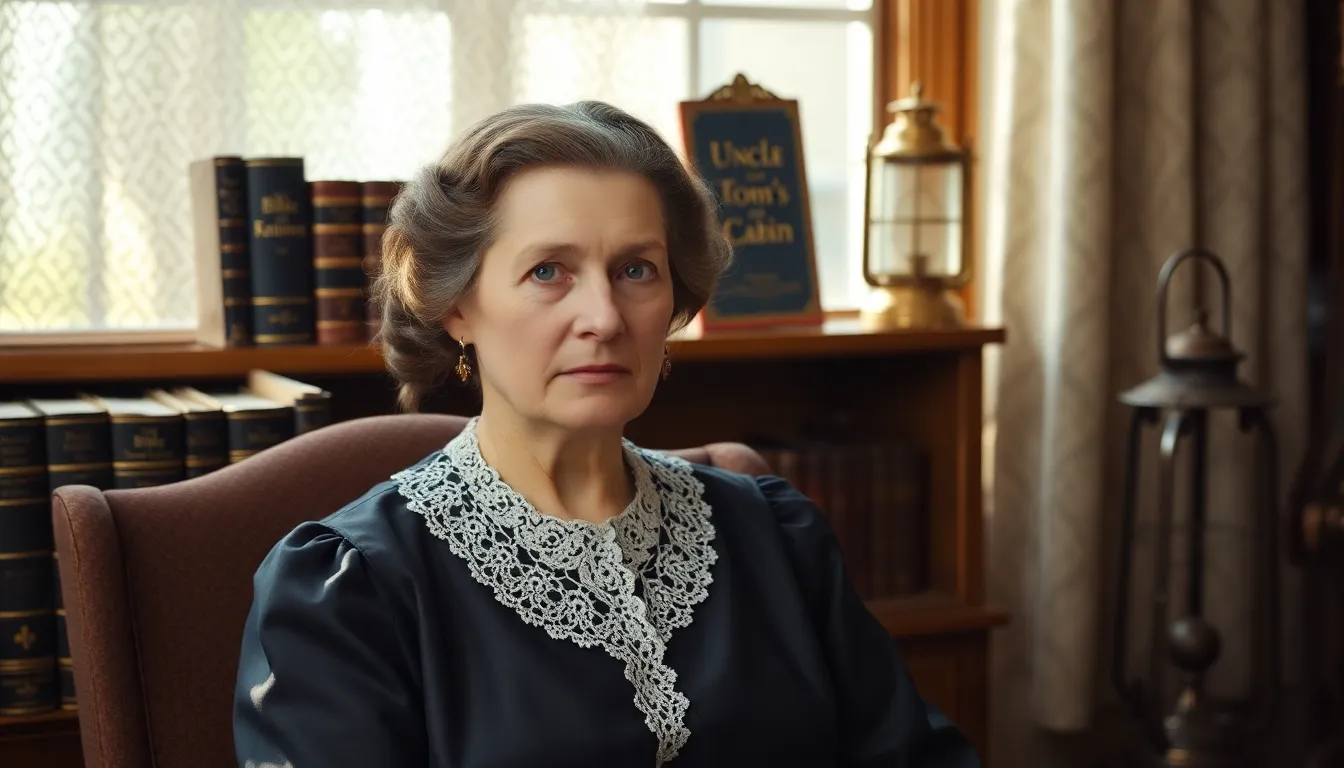
Stowe’s most consequential contribution to American public life arrived in 1852 with the publication of Uncle Tom’s Cabin; or, Life Among the American Slaves. Prompted by the 1850 Fugitive Slave Act and an appeal from her brother-in‑law, the acclaimed minister Henry Ward Beecher, Harriet set out to write a work that would render the horrors of slavery palpable to a northern audience. Drawing on personal testimonies, newspaper reports, and enslaved narratives such as those of Solomon Northup, she crafted a sentimental novel that combined melodrama with stark moral indictment.
The novel’s immediate impact was staggering. Within a year, it sold over 300,000 copies in the United States and was translated into multiple languages, influencing public opinion worldwide. Contemporary newspapers reported that Stowe’s portrayal of enslaved characters—particularly the dignified but tragic figure of Uncle Tom—triggered emotional responses that spurred anti‑slavery petitions, fundraising for the Underground Railroad, and heightened tensions between North and South. Abraham Lincoln reportedly referred to Stowe as “the woman who started this great war.” While the claim is apocryphal, it underscores the perceived political potency of her work.
Following the novel’s success, Stowe continued to write and speak. She published a sequel, The Minister’s Wooing (1859), and a collection of anti‑slavery essays, A Key to Uncle Tom’s Cabin (1853), which documented the factual basis for the novel’s episodes. During the Civil War, Stowe served as president of the United States Sanitary Commission, organizing aid for Union soldiers. After the war, she turned her attention to Reconstruction, publishing works such as Oldtown Folks (1869), which explored racial tensions in the post‑war South, and The Gospel of the Weak (1885), reflecting her continued religious concerns.
In addition to her literary output, Stowe engaged in public advocacy. She delivered lectures across the North, testified before congressional committees, and corresponded with political leaders. Her involvement with the American Anti‑Slavery Society and later with women’s suffrage organizations placed her within broader reform networks.
Allies, Opponents, and Debate
Stowe’s work garnered a vast array of supporters. Abolitionist leaders such as William Lloyd Garrison praised the novel for stirring the conscience of ordinary Americans. The northern press lauded her as a moral heroine, and publishers quickly capitalized on her popularity, cementing her status as one of the era’s most widely read authors.
Conversely, the novel provoked fierce opposition from pro‑slavery forces. Southern newspapers denounced Stowe as a “Northern agitator” and accused her of misrepresenting Southern life. In an 1852 editorial, the Southern Literary Messenger dismissed the novel as “a gross misstatement of Southern domesticity.” Pro‑slavery advocates also criticized the sentimental style, arguing that emotional manipulation obscured rational debate. Some contemporary critics—both Northern and Southern—questioned Stowe’s research methods, suggesting that she relied heavily on anecdotal sources and lacked direct experience of plantation life.
Scholars continue to debate Stowe’s portrayal of African‑American characters. While many acknowledge that Uncle Tom’s Cabin humanized enslaved people for a white audience, others point out that the novel nonetheless reinforces paternalistic stereotypes and fails to grant enslaved characters agency beyond suffering and moral instruction. The depiction of the eponymous Uncle Tom as a passive martyr has been re‑examined in African‑American literary criticism, where “Uncle Tom” has become a pejorative term for perceived subservience.
Stowe also faced criticism from early feminists who argued that her emphasis on domestic virtue reinforced the “cult of true womanhood,” limiting women’s public roles to moral guardianship within the home. Nonetheless, Stowe herself supported expanding women’s education and suffrage, illustrating the complex interplay of her reformist positions.
Legacy and Interpretation
Harriet Beecher Stowe died on July 1, 1896, in Hartford, Connecticut, at the age of 85. At the time of her death, her net worth was modest; she left an estate valued at approximately $30,000 (equivalent to roughly $950,000 in today’s dollars). While she never amassed great personal wealth, her cultural and political influence far outstripped her financial standing.
In the decades following her death, Stowe’s reputation experienced fluctuations. The early twentieth century saw a decline in the novel’s popularity, as critics labeled it melodramatic and overly sentimental. However, the civil‑rights era revived scholarly interest in the novel’s role in shaping public opinion on slavery. Modern historiography situates Stowe as a pivotal figure in the “cult of domestic sentiment,” a literary tradition that mobilized women’s moral authority for political ends.
Contemporary scholarship emphasizes both the emancipatory and problematic aspects of her work. Historians such as Hilary Clayton and Michael Tadros argue that Stowe’s narrative contributed to a shift in national consciousness that made the moral case against slavery unavoidable, even as it perpetuated certain racial hierarchies. Literary critics have re‑examined her lesser‑known works, recognizing her nuanced engagement with post‑war racial dynamics.
Monuments to Stowe include a bronze statue in Hartford’s Bushnell Park (installed 1920) and her former residence, the Harriet Beecher Stowe House, which operates as a museum and National Historic Landmark. Her portrait appears on the commemorative 1975 United States postage series celebrating “Women of Achievement.”
Overall, Harriet Beecher Stowe remains a complex figure: a prolific writer, a determined abolitionist, a woman navigating the constraints of her era, and a cultural catalyst whose work continues to inform debates about literature’s power to shape public morality.