Early Life and Formation
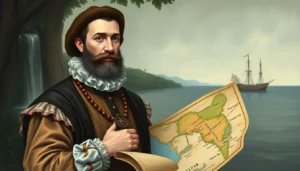
Amerigo Vespucci was born on 9 March 1454 in the Florentine Republic, in the town of Florence, into a well‑established merchant family. His father, Nastagio Vespucci, was a notary and a member of the Florentine guild of merchants, which gave young Amerigo early exposure to commercial networks across the Mediterranean. The Vespucci household prized education; Amerigo received a humanist education at the local grammar school, where he studied Latin, rhetoric, and basic arithmetic. By his teenage years he was fluent in Latin and familiar with the works of Ptolemy, which later informed his geographical thinking.
In 1478, after the death of his elder brother, Vespucci entered the service of the powerful Medici family, working as a clerk in the household of Lorenzo de’ Medici. This position introduced him to the world of finance, maritime insurance, and the emerging trade routes to the east. He also encountered influential scholars such as Niccolò Machiavelli, who later referenced Vespucci in his writings. The combination of mercantile experience, humanist learning, and exposure to the Medici’s maritime ambitions equipped Vespucci with the skills – navigation basics, accounting, and diplomatic correspondence – essential for a future explorer.
In 1492 Vespucci travelled to Seville, the principal port of the Spanish Crown, to work as a factor for the Medici banking house. This move placed him at the center of Spain’s overseas empire, where he learned Spanish, Portuguese, and the rudiments of celestial navigation. His role involved evaluating cargoes, arranging credit, and handling contracts for ships bound for the Atlantic, giving him practical insight into the logistics of long‑distance voyages.
Exploration Context and Ambitions
The late fifteenth century was defined by the Age of Exploration, a period in which European monarchs financed voyages to find new trade routes to Asia and to claim wealth in the name of Christendom. Following Christopher Columbus’s 1492 landing on islands in the Caribbean, the Spanish Crown sought further information about the size and nature of the lands beyond the Atlantic. The Casa de Contratación in Seville coordinated these efforts, commissioning navigators to undertake voyages of discovery, mapping, and resource assessment.
Vespucci’s personal ambition grew from his commercial background and his intellectual curiosity. He recognised that the existing maps, based largely on Ptolemaic geography, placed Asia’s eastern extremities far to the east of the newly discovered islands. By participating in expeditions, he hoped to resolve this discrepancy and to secure a reputation as a discoverer, potentially opening new opportunities for trade and patronage. Moreover, the Medici saw in the New World a chance to expand their financial networks beyond Europe, and Vespucci’s connections made him a natural candidate to act as their representative on Spanish voyages.
Major Expeditions and Journeys
Vespucci participated in at least three voyages to the New World between 1499 and 1503. The primary sources for these trips are the letters attributed to him – the Letter to Soderini (often called the Letter of 1500) and the Letter to the French King (the Letter of 1503) – as well as contemporary accounts from the Spanish and Portuguese courts. While scholarly debate persists about the exact number and details of his voyages, the consensus acknowledges three distinct expeditions.
First Voyage (1499–1500)
In early 1499, the Spanish Crown, under the direction of the royal secretary Luis de Santángel, commissioned a fleet to explore the South American coast. Vespucci joined the expedition led by Alonso de Ojeda as a senior navigator and pilot. The fleet sailed from Sanlúcar de Barrameda aboard the Santa María and the La Marigalante, reaching the Gulf of Paria in present‑day Venezuela in August 1499. Over the next months, the expedition charted the Orinoco River delta and explored the coastline between present‑day Trinidad and the mouth of the Amazon.
During this voyage Vespucci made detailed observations of the coastal geography, noting the vast river systems, the dense mangrove forests, and the presence of Indigenous peoples such as the Carib and Arawak. His logs recorded the latitude and longitude of key points using the astrolabe, and he compared these data to Ptolemy’s maps, concluding that the landmass extended far beyond the narrow strip of Asia presumed by earlier geographers.
Second Voyage (1501–1502)
In May 1501, Vespucci sailed again, this time under the Portuguese flag, after being recruited by the influential cartographer and explorer João Fernandes de Leão. The Portuguese Crown, eager to assert its own claims in the Atlantic, financed an expedition to the coast of Brazil. Vespucci served as chief pilot aboard the São Gabriel and the São Rafael. The fleet landed near present‑day Rio de Janeiro in August 1501, making the first documented European contact with the region’s coast.
The expedition proceeded southward, mapping over 1,500 kilometres of shoreline and noting the distinctive white sand beaches, the presence of the Brazilwood tree (which gave the country its name), and the abundant wildlife. Vespucci’s reports emphasized that the land was not a mere extension of the Caribbean islands but rather a vast, previously uncharted continent. His observations of the Indigenous Tupi people and their agricultural practices provided valuable ethnographic data for European audiences.
Third Voyage (1503)
The final documented voyage took place in 1503, organized jointly by the Spanish and Portuguese courts as a diplomatic effort to resolve overlapping claims after the signing of the Treaty of Tordesillas (1494). Vespucci was appointed chief navigator on a fleet commanded by the Portuguese explorer Gonçalo Coelho. The fleet’s mission was to explore the coast of present‑day Brazil from north to south, further delineating the demarcation line.
The expedition reached the Bay of All Saints (Bahia) in early 1503, where they conducted extensive coastal surveys and collected specimens of local flora and fauna. Vespucci’s journals from this voyage contain the earliest European descriptions of the tropical rainforest ecosystem, including detailed sketches of the kapok tree and the mithrakus (a large river otter). The expedition returned to Seville in late 1503, bringing back hundreds of kilograms of Brazilwood, spices, and a trove of cartographic data.
Risks, Companions, and Controversies
Vespucci’s voyages were fraught with hazards typical of early Atlantic navigation. Storms in the Caribbean often damaged the rigging of the caravels, while the heat and humidity of the South American coast caused scurvy and dysentery among crews. Indigenous resistance was occasional; during the 1499 voyage, the expedition’s attempt to trade for gold with a Carib tribe resulted in a violent skirmish that left several crew members dead.
Companions on the voyages included noted mariners such as Alonso de Ojeda, the ambitious Spanish conquistador; Ginés de Tolosa, a skilled pilot; and the Portuguese cartographer João de Lisboa, who later contributed to the Portuguese School of Navigation. The expeditions were funded by separate sponsors: the first by the Spanish Crown, the second by the Portuguese Crown, and the third by a joint venture overseen by the Casa de Contratación, reflecting the complex political environment of early seventeenth‑century Iberian competition.
Controversy surrounds the authenticity of Vespucci’s letters. The 1504 Letter to Soderini and the 1505 Letter to the French King were published in a series of pamphlets known as the “Letters of Amerigo” and quickly circulated throughout Europe. Some scholars argue that the letters were edited – or even partially fabricated – by the Italian humanist Lorenzo al Finnuccio, who sought to promote Vespucci’s reputation. Modern textual analysis shows stylistic differences between the two letters, suggesting multiple authorship or later interpolations. Nevertheless, the core content – Vespucci’s claim that the lands were a new continent distinct from Asia – is widely accepted as reflecting his genuine observations.
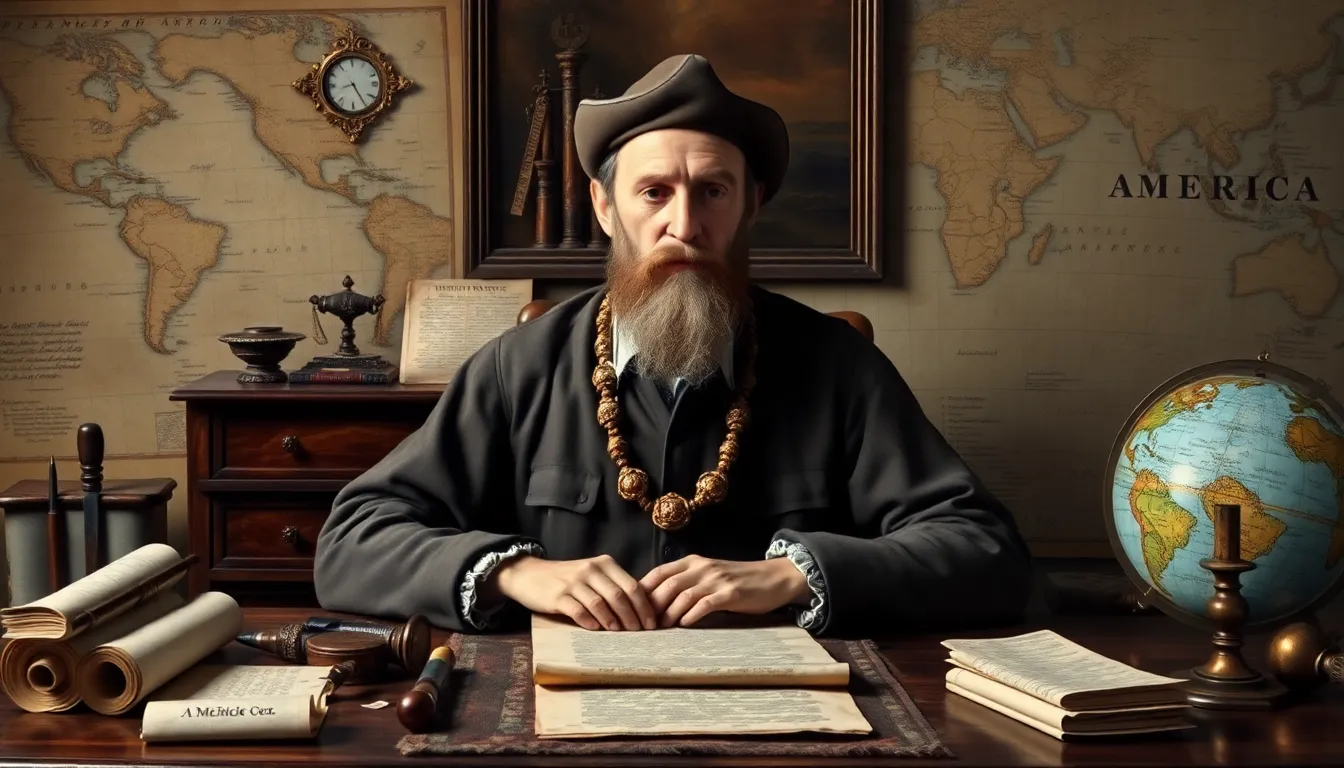
The naming of the continent after Vespucci was not immediate. In 1507, the German cartographer Martin Waldseemüller produced a world map (the Universalis Cosmographia) that for the first time labeled the new continent “America” in honor of Vespucci’s published accounts. Waldseemüller’s accompanying text, the Cosmographiae Introductio, explicitly states that the name is derived from the Latin feminine form of Amerigo. While some contemporary mapmakers later reverted to “New World” or used “Terra Incognita,” the name “America” persisted, ultimately becoming the standard designation for both North and South America.
Legacy and Historical Impact
Amerigo Vespucci’s greatest legacy lies in his contribution to the European understanding that the lands discovered by Columbus comprised a separate continent. His cartographic and ethnographic notes helped shape the paradigm shift from a Ptolemaic worldview to a modern concept of a New World. The Waldseemüller map, reproduced in limited copies, circulated widely among scholars and navigators, reinforcing the notion of “America” as a distinct landmass.
Vespucci’s reports also aided the Spanish and Portuguese crown in negotiating the Treaty of Tordesillas’ demarcation line. By providing concrete latitude measurements of the South American coast, his data allowed both powers to claim specific territories, influencing the later colonial borders of Brazil, Spanish South America, and the Caribbean.
In historiography, Vespucci has been both celebrated and critiqued. Early modern chroniclers, such as Peter Martyr d’Anghiera, depicted him as a visionary explorer who “opened the eyes of Europe.” Later scholars in the nineteenth and twentieth centuries examined the political motivations behind the naming, arguing that the European desire for new commercial routes and the promotion of Italian humanist achievements contributed to the elevation of his name.
Modern scholarship continues to investigate Vespucci’s role. Archaeological evidence has confirmed the presence of European objects in the locations he described, supporting the authenticity of at least part of his reports. The International Astronomical Union named a minor planet, 4744 Vespucci, in his honor, reflecting his lasting impact beyond terrestrial geography.
In contemporary education, Vespucci remains a figure through whom students learn about the complexities of exploration: the interplay of scientific observation, commercial ambition, colonial competition, and the contested narratives of discovery. His life exemplifies how a single individual’s written word can shape continental identity for centuries.