Early Life and Formation
David Livingstone was born on 19 March 1813 in the small weaving village of Blantyre, Lanarkshire, Scotland, to a modest family of weavers. His father, Neil Livingstone, died when David was eight, leaving the family in poverty. Livingstone’s formal education was limited; he attended the local parish school and later the Andersonian Institution in Glasgow, where he studied natural philosophy and medicine. In 1835 he qualified as a physician and joined the Royal Navy as an assistant surgeon, a position that provided his first exposure to long sea voyages and disciplined logistical planning.
The pivotal moment for Livingstone’s future expeditions came in 1836 when he was recruited by the London Missionary Society (LMS) to serve as a missionary physician in southern Africa. The LMS required candidates with medical training to improve their standing with local communities, and Livingstone’s scientific curiosity aligned with the society’s evangelical ambitions. He spent two years in the Cape Colony acquiring an understanding of tropical diseases and a rudimentary knowledge of African languages, most notably Setswana.
Livingstone’s early training combined practical medical skills, a disciplined approach to record‑keeping, and a growing interest in geography. He was influenced by earlier British travelers such as James Bruce and the Royal Geographical Society’s emerging emphasis on systematic observation. These formative experiences equipped him with the physical endurance, scientific rigor, and cross‑cultural communication abilities essential for the arduous journeys that would define his career.
Exploration Context and Ambitions
By the mid‑19th century, European powers were intensifying their interest in Africa, driven by commercial, missionary, and geopolitical motives. The continent was still largely unmapped in its interior, and the prevailing view in Britain was that the source of the Nile—an enduring geographical mystery—lay somewhere within the central African plateau. Livingstone’s ambitions were shaped by this context. He sought to combine missionary work with scientific exploration, hoping that knowledge of the land would facilitate both Christian evangelism and commercial development, which he believed could help end the slave trade.
Livingstone’s personal motivations were also spiritual. He believed that revealing the “belly of Africa” would demonstrate the emancipatory power of Christianity and Britain’s moral responsibility to the continent’s peoples. He wrote extensively about the “Christianizing of the dark continent,” envisioning a network of missions linked by trade and transportation routes that would supplant the slave economy. At the same time, his scientific interests—particularly in botany, zoology, and geology—aligned with the Royal Geographical Society’s quest for accurate cartography and natural history documentation.
Major Expeditions and Journeys
First Missionary Posting (1841–1845) – After being ordained for missionary service, Livingstone arrived at the Cape of Good Hope in 1841 and soon moved inland to the mission station at Kuruman, in present‑day South Africa. Here he learned Setswana and began detailed observations of local flora and fauna. In 1845 he embarked on a three‑month pilgrimage across the Kalahari Desert to Lake Ngami, then considered a remote and largely unknown body of water. Livingstone’s accounts of the lake, published in The Times, sparked European fascination and marked his first major contribution to African geography.
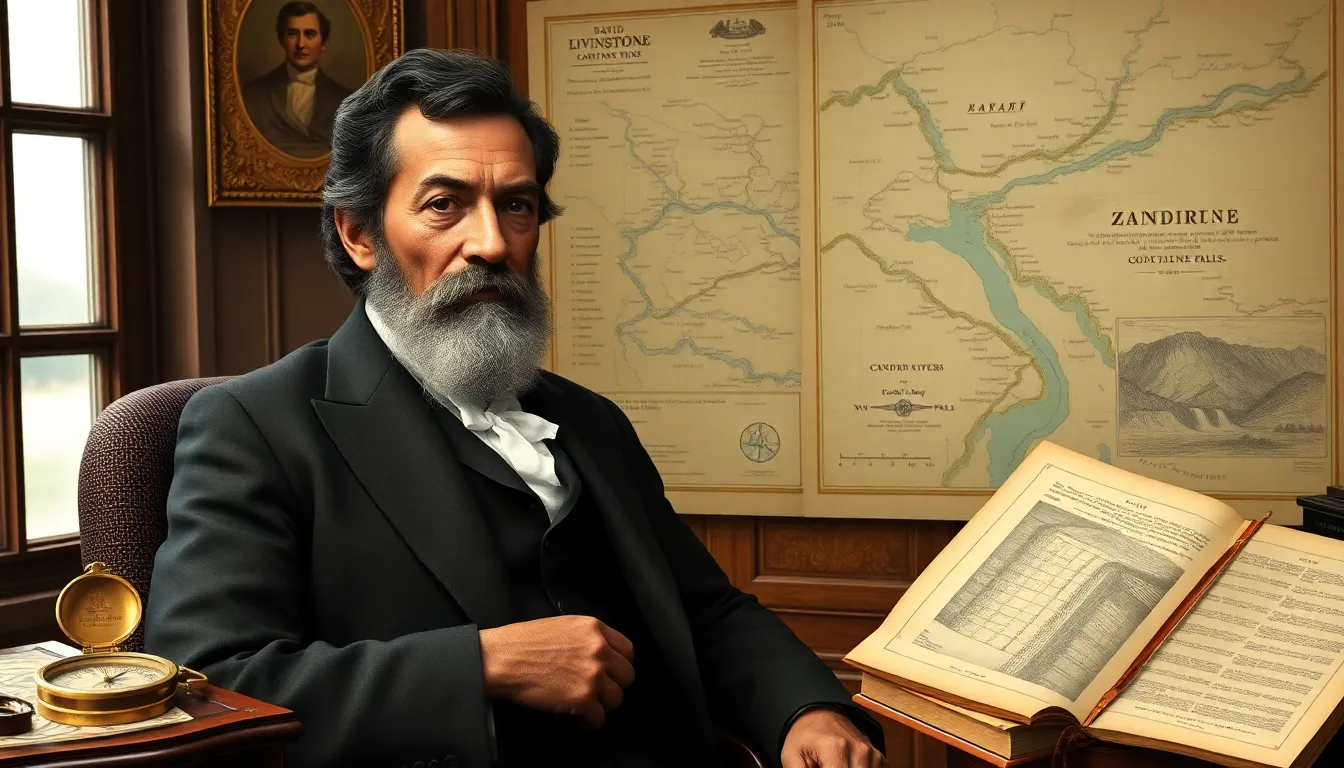
Zambezi Expedition (1852–1856) – Sponsored by the LMS and the Royal Geographical Society, this four‑year venture aimed to trace the Zambezi River from its source to the Indian Ocean. Livingstone travelled with a small team, including the Irish botanist Dr. John Johnston and African guides such as Kamba Malu. He faced extreme heat, malaria, and hostile encounters with local chiefdoms. Mapping the river’s course, he documented the spectacular Victoria Falls, which he named after Queen Victoria. His published work, Missionary Travels and Researches in South Africa (1857), provided Europe with its first systematic description of the Zambezi basin.
Exploration of Central Africa (1858–1864) – Pressed by the Society’s desire to locate the Nile’s source, Livingstone embarked on a second major venture, venturing northward from the Zambezi’s middle course. He charted the Lualaba River, later identified as one of the Congo’s headwaters, and traveled through the territories of the Lunda and Lozi peoples. In August 1862 he reached the southern tip of Lake Tanganyika, where he met the Portuguese explorer Alexandre de Serpa Pinto. Although he did not locate the Nile’s source, his detailed maps of the Congo and Luapula rivers greatly expanded European geographic knowledge.
Final Expedition and the “Search for Livingstone” (1866–1873) – Returning to Britain in 1864, Livingstone continued to advocate for a trans‑African railway linking the Atlantic and Indian oceans. In 1866 he set out again, this time focusing on charting a possible route across the Congo Basin. He founded the town of Victoria Falls (later renamed Livingstone) in present‑day Zambia and established a mission station at Kalungwishi. His health deteriorated, and by 1871 he was severely ill with malaria and dysentery. The New York Herald commissioned journalist Henry Morton Stanley to locate him; Stanley famously greeted Livingstone with “Dr. Livingstone, I presume?” When they met in Ujiji on the shores of Lake Tanganyika in 1871, Livingstone was near death. He returned to Britain in 1872, where he died on 1 May 1873 at the home of his former wife, Mary Moffat, in Barkly House, London.
Risks, Companions, and Controversies
Livingstone’s expeditions were fraught with life‑threatening hazards. Malaria, cholera, dysentery, and severe heatstroke were constant threats; he lost several members of his party to disease, including Dr. Johnston (who died of fever in 1856) and his own son, Thomas (who died of fever in 1859). Navigation over uncharted rivers required building makeshift boats and rafts, often with limited supplies. The logistical challenges of transporting provisions over hundreds of miles of savanna, desert, and dense forest demanded meticulous planning and improvisation.
Companions and local guides were indispensable. African porters such as the Kamba and Yao provided crucial knowledge of seasonal water sources, safe crossing points, and diplomatic contacts with chiefdoms. The role of African intermediaries has sometimes been downplayed in Victorian narratives, but contemporary scholarship emphasizes their agency and expertise. Livingstone’s reliance on these guides also exposed him to accusations of “exploiting” indigenous labor, a criticism that reflects broader colonial ethical debates.
Controversies surround Livingstone’s approach to the slave trade. While he condemned slavery and sought to promote “legitimate commerce,” his advocacy for commercial routes sometimes aligned with British imperial interests. Critics argue that his vision of missionary‑driven development facilitated later colonial penetration. Moreover, his claims of “discovering” geographical features such as Victoria Falls overlook the knowledge of local peoples who had long known the site. Indigenous names, such as “Mosi‑oa‑Tunya” (the Smoke That Thunders), were supplanted by European labels, a practice typical of the era’s Eurocentric cartography.
Livingstone’s relationship with sponsors was also complex. The LMS provided financial backing but grew impatient with the limited evangelical results of his missions, while the Royal Geographical Society demanded rigorous scientific data. Livingstone’s outspoken reports on the slave trade sometimes strained relations with British merchants who benefited from the trade, leading to fluctuating support throughout his career.
Legacy and Historical Impact
David Livingstone’s legacy is multifaceted. Cartographically, his detailed maps of the Zambezi, Congo, and Luapula river systems were incorporated into the Royal Geographical Society’s official charts and remained authoritative for decades. His botanical specimens, sent to Kew Gardens, contributed to the scientific description of numerous African plant species, several of which bear the epithet *livingstonianus* in his honor.
Culturally, Livingstone became an iconic figure in Victorian Britain, embodying the “civilizing mission” narrative. His journals were serialized in popular newspapers, and his public lectures attracted large audiences, cementing his status as a household name. The phrase “Dr. Livingstone, I presume?” entered the popular lexicon, reinforcing his mythic status even as historians today disentangle fact from Victorian propaganda.
In Africa, Livingstone’s legacy is contested. While some view him as a pioneering humanitarian who exposed the horrors of the slave trade, others critique his role in paving the way for subsequent colonial exploitation. Modern African scholars highlight the contributions of his African companions and the fact that he often relied on pre‑existing trade routes and local knowledge rather than “discovering” uncharted territory.
Institutions bearing his name—such as Livingstone College in Zambia, the Livingstone Museum in Scotland, and numerous schools and streets across former British colonies—reflect both reverence and the complex inheritance of his work. The Livingstone Centre at the University of Edinburgh preserves his manuscripts and provides a resource for researchers examining 19th‑century exploration.
Overall, Livingstone’s life illustrates the intertwined motives of religious zeal, scientific inquiry, and imperial ambition that characterized much of 19th‑century European exploration. His meticulous observations, extensive travels, and public advocacy advanced geographical knowledge of central Africa, while also raising enduring ethical questions about the role of explorers in colonial contexts.