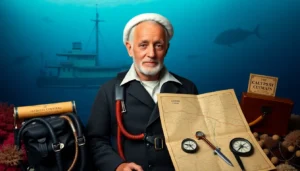
Early Life and Formation
James Cook was born on 7 November 1728 in the small village of Marton, in the County of Yorkshire, England. He was the second of eight children of James Cook Sr., a labourer who later became a farm steward, and his wife, Grace (née Hindle). The family moved to the nearby village of Great Ayton when Cook was a child, and it was there that his early education began.
Cook received a basic elementary education at the village school, where he learned reading, writing, and arithmetic, but he showed an early aptitude for mathematics and navigation. At age 17, he was apprenticed to a local shipowner, John Walker, and quickly progressed to a position as a deckhand on merchant vessels trading along the east coast of England and the Baltic Sea. These early voyages exposed him to the practicalities of seamanship, navigation by dead reckoning, and the use of the sextant, which was then becoming the standard instrument for determining latitude.
In 1755, amid the escalation of the Seven Years’ War, Cook joined the Royal Navy as an apprentice, reportedly after impressment—a common practice of the era. His natural aptitude for navigation earned him a place in the Navy School of Navigation at Deptford under the tutelage of the renowned astronomer and mathematician Dr. John Campbell. Cook excelled, passing the rigorous examination for Master and eventually becoming a Master’s Mate, a rank that combined duties of navigation, chart‑making, and supervising the ship’s boat crews.
The combination of formal naval training, practical merchant experience, and a rigorous self‑study of astronomy and hydrography equipped Cook with a unique skill set that would later be indispensable for long-range exploration. His early career also fostered contacts with senior officers such as Captain John Carteret, who recognized Cook’s talents and would later recommend him for more ambitious assignments.
Exploration Context and Ambitions
The mid‑18th century was a period of intense scientific curiosity and imperial competition. The Royal Society, the leading scientific body in Britain, had begun to promote voyages of discovery that combined geographic exploration with systematic observation of natural phenomena. Simultaneously, the British Admiralty sought new routes for trade, especially after the loss of the French monopoly on North American fur trade following the Seven Years’ War.
Two overlapping motives framed Britain’s interest in the Pacific: the strategic desire to locate the fabled “Terra Australis Incognita,” a massive southern continent hypothesised by European geographers, and the commercial aim of securing whaling and sealing grounds as well as potential sources of valuable commodities such as timber, spices, and later, sandalwood. The Pacific also represented a stage for scientific inquiry—astronomy, botany, zoology, and ethnography—areas where the Royal Society and the newly formed Royal Academy of Sciences in Paris vied for pre‑eminence.
Cook’s personal ambition dovetailed with these national objectives. By the early 1760s, he had garnered a reputation for precise charting and reliable leadership. When the Admiralty resolved to dispatch a scientific expedition to observe the Transit of Venus in 1769 (a crucial astronomical event for refining the astronomical unit), Cook was selected to command the newly built H.M. Bark Endeavour. His appointment reflected a convergence of skill, reliability, and a willingness to undertake extended voyages into uncharted waters.
Major Expeditions and Journeys
First Voyage (1768–1771): The Endeavour and the Transit of Venus
The first voyage set sail from Portsmouth on 26 August 1768, bound for Tahiti. The Endeavour, a former coal transport repurposed for scientific work, carried a distinguished scientific contingent, including astronomer Charles Green, botanist Joseph Banks, and naturalist Daniel Solander. Their primary objective was to observe the December 1769 Transit of Venus from a pre‑selected site on the island of Tahiti, then known as Otaheite.
After a five‑month passage marked by meticulous surveys of Cape Verde, Rio de la Plata, and the Cape of Good Hope, the fleet reached Tahiti on 13 April 1769. Cook’s observations contributed to a more accurate determination of the Earth‑Sun distance, although the data were later found to be compromised by inadequate timing methods.
Having completed the astronomical task, Cook turned westward, pioneering the first European contact with the eastern coastline of New Zealand. He charted the complete coastline, noting the existence of two main islands—North and South—and providing the first Pacific maps that accurately displayed these landmasses. His engagement with Māori communities was recorded with a mixture of cultural curiosity and colonial caution; he noted the lack of firearms but praised the navigational skills of the indigenous people.
From New Zealand, Cook sailed to the eastern coast of Australia, which he named New South Wales after claiming it for Britain on 29 April 1770 at Possession Island. Over the following months, he mapped an extensive stretch of coastline from Cape York to Botany Bay, noting rich soils and abundant wildlife, information that would later facilitate British colonisation.
The return journey took Cook northward to the North Pacific, where he explored the coast of modern‑day California, made a brief foray into the Hawaiian archipelago (then unknown to Europeans), and finally returned to England via Cape Horn, arriving on 12 July 1771. The voyage produced over 100 charts, a wealth of botanical specimens, and a journal that set new standards for scientific reporting.
Second Voyage (1772–1775): The Quest for Terra Australis
Encouraged by the success of his first expedition, Cook was tasked with a second, more ambitious voyage aimed at discovering the hypothesised southern continent. He was given command of two ships, the Resolution and the Adventure, and set sail from Plymouth on 13 July 1772. The expedition’s primary mission was to sail far enough south to determine whether a massive southern landmass existed.
Cook’s navigation took him well into the Antarctic Circle, reaching a latitude of 71°10′ S on 30 January 1774, the furthest south any European had ventured at that time. The expedition encountered massive ice floes and severe weather, but Cook’s disciplined crew and his insistence on rigorous observation allowed the voyage to survive.
Although the ships failed to sight a continent, they proved that if Terra Australis existed, it was not a continuous, habitable landmass extending far into the southern latitudes. The journey also produced valuable cartographic data of the South Atlantic, the southern Indian Ocean, and the southern Pacific, as well as extensive zoological and botanical collections.
Cook also revisited the Pacific islands visited on his first voyage, making additional contacts with Polynesian societies, and refined earlier charts of New Zealand and the east coast of Australia. He returned to England in July 1775, having completed a circumpolar voyage that reshaped European understanding of the Southern Hemisphere.
Third Voyage (1776–1779): The Search for the Northwest Passage and Final Pacific Exploration
The third voyage, launched on 13 July 1776 from Plymouth aboard the Resolution (accompanied by the smaller HMS Discovery), had a dual purpose: to locate a navigable Northwest Passage connecting the Atlantic and Pacific Oceans, and to continue scientific exploration of the Pacific. The expedition was also motivated by commercial interests, particularly the fur trade.
Cook first sailed to the western coasts of North America, exploring the complex inlets of present‑day British Columbia and Alaska. He charted the coast from Cape Foulweather (around present‑day Oregon) northward to the Bering Strait, making detailed observations of the complex shoreline, tidal patterns, and native societies such as the Nuu-chah‑nulth.
After failing to locate a continuous passage, Cook crossed the Pacific, revisiting the Hawaiian Islands, which he named the Sandwich Islands after the Earl of Sandwich, First Lord of the Admiralty. Unlike his earlier brief stop, Cook now spent a winter in the islands, using them as a base for repairs and resupply. Relations with Hawaiians were initially amicable; however, cultural misunderstandings and increasing demands for provisions culminated in a violent confrontation on 14 February 1779, during which Cook was killed on the beach of Kealakekua Bay.
Cook’s death marked the end of his direct contributions, but his expedition’s extensive journals, maps, and scientific specimens continued to influence European knowledge for decades. The voyage’s legacy includes the first accurate chart of the North Pacific coast, observations that helped later explorers such as George Vancouver, and an extensive ethnographic record of Pacific peoples.
Risks, Companions, and Controversies
Cook’s voyages were fraught with maritime hazards—storms, scurvy, shipwreck, and hostile engagements. Scurvy, a disease caused by vitamin C deficiency, had decimated earlier crews. Cook mitigated this risk by introducing a diet that included fresh citrus fruits and sauerkraut, a practice that dramatically reduced mortality rates on his ships and influenced naval health policies thereafter.
His crews included notable companions: botanist Joseph Banks, who later founded the Royal Botanic Gardens, Kew; navigators such as Charles Clerke and James King, who would later command voyages in their own right; and numerous Indigenous guides and translators, including the Māori chief Tupaia, who accompanied Cook on the Endeavour and provided invaluable knowledge of Pacific navigation and geography.
Controversially, Cook’s voyages also served imperial interests. While his journals often expressed admiration for Indigenous cultures, they simultaneously recorded assessments of land suitability for British settlement and resource extraction. The claim of possession of New South Wales, for instance, ignored existing Aboriginal occupancy and set a precedent for colonial dispossession.
The circumstances of Cook’s death have been subject to extensive debate. Contemporary accounts suggest that a dispute over a stolen shirt escalated into violence; however, modern historians point to broader tensions derived from cultural misunderstandings and the increasingly exploitative demands of the crew for food and supplies. This episode exemplifies the ethical complexities surrounding European exploration in the age of empire.
Legacy and Historical Impact
James Cook’s cartographic achievements are among his most enduring contributions. His maps of the Pacific, New Zealand, and the east coast of Australia remained authoritative for decades, guiding subsequent explorers and colonisers. The Cook Strait, for example, bears his name as a testament to his accurate charting of the narrow passage separating New Zealand’s islands.
Scientifically, Cook’s voyages pioneered interdisciplinary collaboration. The integration of astronomy (Transit of Venus observations), botany (Banks and Solander’s collections), zoology, and ethnography set a template for later scientific expeditions, including the voyages of Charles Darwin on HMS Beagle.
In popular memory, Cook occupies a complex position. In Britain, he became an emblem of the Enlightenment spirit—rational, methodical, and heroic. In former colonies, his legacy is re‑examined as a symbol of the onset of European colonisation, with increasing recognition of the Indigenous perspectives that were often marginalized in his narratives.
Institutions such as the Royal Society commemorate Cook through lectures and awards, while geographic features worldwide—rivers, islands, and mountain ranges—continue to bear his name. Modern scholarship, however, strives for a balanced assessment that recognises both his contributions to science and navigation and the colonial consequences of his expeditions.
Ultimately, Captain James Cook reshaped European understanding of the Pacific and southern worlds, establishing methodological standards for exploration that endure in contemporary scientific research, maritime navigation, and cross‑cultural study.