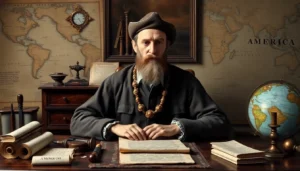
Early Life and Formation
Ferdinand Magellan was born around 1480 in the coastal town of Sabrosa, in the kingdom of Portugal. He was the son of Gonçalo Magalhães, a minor nobleman, and Catarina Sarria, both members of the lower aristocracy. Little is recorded about his childhood, but contemporary documents confirm that he received a basic education suitable for a young man of his status, including instruction in reading, writing, and arithmetic, as well as exposure to the maritime culture that dominated Portugal’s Atlantic coast.
In his teenage years Magellan entered the service of the Portuguese crown, first as a page in the household of Prince Manuel I and later as a squire in the household of Prince Infante Dom Manuel (later King Manuel I). This proximity to the royal court gave him access to the elite circles that organized Portugal’s early voyages of discovery. He is recorded as having taken part in the 1499 expedition to India under the command of João Almeida, where he served as a standard‑bearer and acquired practical knowledge of long‑distance navigation, ship handling, and the use of the astrolabe.
Magellan’s experience in the Indian Ocean exposed him to the complexities of international trade, the requirements of royal patronage, and the political rivalries that shaped early modern exploration. He also married Beatriz Alvares de Torres, a woman of modest means, thereby securing a small domestic base that would later support his own ventures.
Exploration Context and Ambitions
The early sixteenth century was defined by fierce competition between the maritime powers of Portugal and Spain. The 1494 Treaty of Tordesillas had divided the non‑European world between the two crowns, drawing an imaginary meridian 370 leagues west of the Cape Verde islands. Portuguese navigators, following the Cape of Good Hope, were seeking a sea route to the lucrative spice islands of the Moluccas. Spanish monarchs, under Ferdinand II of Aragon and Isabella I of Castile, were likewise eager to find a western passage that would grant them direct access to Asian markets while bypassing the Portuguese monopoly.
Magellan, although Portuguese by birth, became disillusioned after a dispute with King Manuel I that resulted in his temporary imprisonment and loss of royal favor. In 1517, he traveled to the Spanish court, presenting a detailed plan for a westward voyage to reach the Moluccas. The Spanish monarchs, newly interested in securing a western route after the unsuccessful expedition of Núñez de Balboa in the Pacific, granted him a royal charter, the Capitulación, which promised him the titles of Adelantado, governor of the new lands, and a share of the riches to be found.
Magellan’s ambition rested on two interlinked premises: that a strait existed at the southern tip of the Americas (later proven true as the Strait of Magellan), and that an uncharted ocean—later named the Pacific—lay beyond it. His proposal also reflected the growing European appreciation for cartographic data, compass technology, and the nascent science of celestial navigation, all of which would be vital to sustain a voyage of unprecedented length.
Major Expeditions and Journeys
1519 – The Royal Expedition
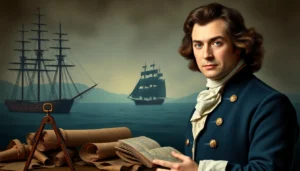
In September 1519, Magellan set sail from Seville with five ships—Trinidad, San Antonio, Concepción, Victoria, and Santiago—and a crew of roughly 270 men drawn from Spain, Portugal, Italy, and the Low Countries. The fleet first stopped at the Canary Islands for supplies and then crossed the Atlantic, reaching present‑day Brazil in December 1519. There, Magellan executed a strategic split: the San Antonio returned to Spain (later wrecked off the Spanish coast), while the remaining vessels continued southward along the South American coast.
For nearly a year the fleet navigated the treacherous coastline, searching for a passage through the continent’s southern extremity. In October 1520, after numerous false starts and extensive scouting, Magellan’s fleet entered what is now known as the Strait of Magellan, a convoluted network of channels that stretched over 350 km. Over a period of 48 days the ships endured harsh weather, supply shortages, and mutinies. Upon emerging on 28 November 1520 into a calm sea, Magellan named the expanse “Mar Pacífico” (Peaceful Sea), later shortened to Pacific Ocean.
Voyage across the Pacific
The crossing of the Pacific proved to be the most grueling leg. With a crew of 150 men and provisions for only 90 days, the fleet endured 98 days at sea without sight of land, suffering severe scurvy, dehydration, and starvation. Only 18 men survived to reach the island of Guam in March 1521, where they were able to restock, repair the ships, and receive medical aid from the Chamorro people.
Continuing westward, the fleet made landfall on the Philippine archipelago in early April 1521. Magellan sought to convert the local chiefs to Christianity and to secure supplies. On 27 April 1521, during the Battle of Mactan, Magellan was killed in combat with warriors led by the chieftain Lapu‑Lapu, a loss that altered the expedition’s command structure.
Completion of the circumnavigation
After Magellan’s death, the remaining officers—most notably Juan Sebastián El CANO—reorganized the fleet. By August 1521, only two ships, Victoria and Concepción, remained seaworthy. The Concepción was lost in a storm in the Philippines, leaving only the Victoria to complete the circumnavigation. Under El CANO’s command, the Victoria crossed the Indian Ocean, rounding the Cape of Good Hope in 1522, and returned to Seville on 6 September 1522 with just 18 surviving crew members, carrying a modest cargo of spices and other goods.
Risks, Companions, and Controversies
The expedition faced numerous hazards: uncharted waters, extreme weather, disease, mutinies, and violent encounters with Indigenous peoples. Scarcities of food and fresh water led to scurvy, a disease that claimed many lives. Mutinies erupted early in 1520 when a faction of the crew, dissatisfied with supplies and leadership, demanded a return to Spain. Magellan quelled the revolt by executing the ringleaders, an act that has been debated by historians as both necessary for discipline and indicative of authoritarian command.
Among the crew were notable companions: the chronicler Antonio de Herrera, who later compiled a detailed account; the Portuguese pilot João Sá Rosa; the captain‑general Duarte Álvarez de Lete; and the German navigator Georg Bénard. Indigenous guides, especially the Mapuche‑like “Elcano’s pilots” from the Philippines and the Chamorro from Guam, provided crucial knowledge of local currents, tides, and edible plants. Their contributions are often understated in early European narratives, yet modern scholarship acknowledges their indispensable role.
Contemporary accounts highlight ethical controversies: the forced conversion attempts, the violent suppression of resistance (including the killing of Indigenous leaders), and the seizure of local goods. Moreover, Magellan’s claim to “discover” the Pacific Ocean and the strait overlooks the presence of Indigenous peoples who had traversed these waters for centuries. The expedition also operated within the broader context of European imperial expansion, a factor that scholars now scrutinize for its impact on native societies.
Legacy and Historical Impact
Magellan’s voyage, though completed under El CANO’s command, secured his place in the annals of exploration. The successful navigation of the Strait of Magellan proved that the Americas were not a contiguous landmass, reshaping European geographic conceptions. The return of the Victoria with a cargo of cloves and other spices provided empirical proof that a western route to Asia was possible, even if not yet profitable.
The expedition contributed significantly to cartography. Portuguese and Spanish maps of the early sixteenth century began to incorporate the new strait, the expanse of the Pacific, and the archipelagic geography of the Philippines. The journey also advanced nautical science: the use of the cross‑staff and early marine chronometers (though crude) improved longitude estimation, while systematic observations of wind patterns across the Pacific informed later circumnavigators.
Magellan’s death in the Philippines has made him a figure of both admiration and controversy. In Spain he was hailed as a heroic pioneer; in the Philippines, he is remembered as an early agent of colonial intrusion. Modern historiography treats his legacy with nuance, recognizing both his navigational achievements and the violent consequences of European expansion.
His expedition inspired subsequent explorers, including Hernando de Soto, Francis Drake, and James Cook, who benefited from the routes first charted by Magellan’s fleet. The Strait of Magellan remains a vital navigational channel, especially before the construction of the Panama Canal, illustrating the enduring practical value of his discovery.
In cultural memory, Magellan’s name appears in geographic features, institutions, and even modern space exploration metaphors, symbolizing the human impulse to venture beyond known horizons.