Early Life and Formation
Thor Waldemar Høyer‑Heyerdahl was born on 6 October 1914 in the coastal town of Larvik, Norway, to a well‑to‑do family involved in shipping and banking. His father, Hjalmar Heyerdahl, owned a successful shipping line, giving young Thor early exposure to maritime life and navigation. He attended the prestigious University of Oslo, where he initially studied zoology, graduating with a cand.real. (equivalent to a Master of Science) in 1939. While at university he joined the Norwegian Student Society and participated in amateur sailing clubs, learning traditional boat‑building techniques and developing a fascination for the Pacific islands, which he first visited on a research trip to the Galápagos in 1939. The outbreak of World War II interrupted his scientific career, but his service as a naval officer deepened his practical seamanship, survival skills and understanding of cross‑cultural interactions.
After the war, Heyerdahl returned to academia as a lecturer at the university, but his interests increasingly turned toward experimental archaeology—testing hypotheses by recreating ancient technologies. Influenced by earlier diffusionist thinkers such as Thomas Huxley and the German geographer Carl O. Sauer, Heyerdahl began to question the prevailing Euro‑centric view that complex societies in the Americas could not have been influenced by Old World cultures. This intellectual climate, combined with his practical sailing experience, laid the groundwork for the bold expeditions that would soon follow.
Exploration Context and Ambitions
In the late 1940s, the scientific community was engaged in heated debate over the origins of the Polynesian peoples. The dominant “out‑of‑Asia” model posited a gradual migration of Austronesian speakers from Southeast Asia through Melanesia into the distant Pacific islands. Heyerdahl, however, hypothesised that contacts might have been made across the vast Pacific from South America, specifically that ancient peoples could have crossed the ocean on simple rafts using prevailing winds and currents. His theory was partly inspired by the diffusion of the sweet potato (a South American plant) into Polynesia before European contact, and by oral traditions among South American coastal cultures describing sea voyages.
Beyond scholarly motivation, Heyerdahl was driven by a desire to make archaeology accessible to the public. He believed that a spectacular, verifiable voyage could challenge entrenched academic positions and inspire a broader appreciation for human ingenuity. Funding was therefore sought not only from scientific institutions but also from private sponsors and the emerging mass media. The Norwegian ship‑building firm A. S. Mæhre provided timber, and the Norwegian government’s Ministry of Trade and Industry offered a modest grant, while newspapers such as Aftenposten offered extensive coverage, turning Heyerdahl’s expedition into a worldwide publicity event.
Major Expeditions and Journeys
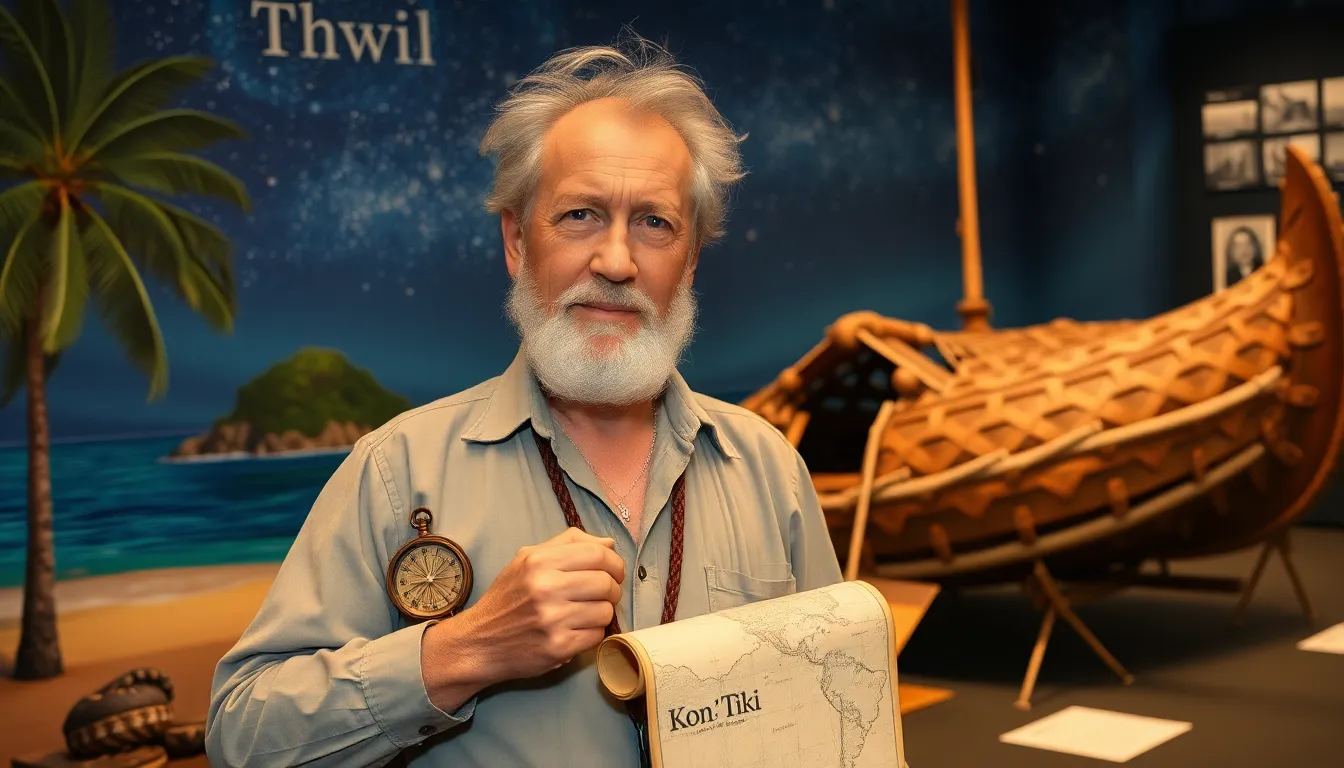
Kon‑Tiki (1947‑1948) – The most famous of Heyerdahl’s undertakings was the Kon‑Tiki raft voyage. Constructed from nine balsa logs, sealed with hemp rope, and equipped with a triangular sail modeled on ancient South American designs, the raft measured 15 m in length and 5 m in beam. On 28 April 1947, Heyerdahl and a four‑member crew—Knut Haugland (radio operator), Bengt Danielsson (anthropologist), Herman Wendt (photographer) and Torstein Berge (sailor)—departed from Raroia, an atoll in the Tuamotu Archipelago, aiming to reach the Polynesian island of Tokelau, a distance of roughly 4 500 km. Over 101 days and 4 300 km they navigated the South Equatorial Current and trade winds, surviving a near‑capsize, a severe storm, and a fungus outbreak that threatened the raft’s structural integrity. Their arrival at the Tuamotu atoll of Papeete (Tahiti) on 7 August 1947 demonstrated the technical feasibility of a trans‑Pacific drift on a primitive raft.
Rapa Nui (1955‑1956) – After the Kon‑Tiki success, Heyerdahl turned his attention to Easter Island (Rapa Nui). He led an archaeological expedition funded by the Norwegian Academy of Science and Letters and the Norwegian Museum of Cultural History. The team conducted extensive surveys of the island’s moai statues, ceremonial platforms (ahu), and ancient agricultural terraces, proposing that the island’s deforestation was primarily the result of external European exploitation rather than internal societal collapse. Though many of his conclusions have been contested, the expedition produced a comprehensive photographic archive and several seminal publications, most notably “The Viking Image” (1960) and “The Peoples of the Pacific” (1966).
Ra II (1970‑1972) – Seeking to test the reverse hypothesis—that ancient peoples could have travelled from the Polynesian islands to South America—Heyerdahl built Ra II, a reed‑boat modeled on Egyptian‑style vessels described by Herodotus. The 64‑member crew set sail from Safi, Morocco in July 1970, crossing the Atlantic to Barbados in 57 days. While the voyage demonstrated the seaworthiness of papyrus‑type construction, modern scholarship generally regards the trans‑Atlantic hypothesis as unlikely for pre‑Columbian times.
Later Work – Heyerdahl continued to explore natural and cultural frontiers, including a 1977–1978 expedition to the Amazon’s source region, and a 1988 “Future World” cruise to promote environmental awareness. He authored more than 80 books, many of which were translated into dozens of languages, cementing his role as a public intellectual.
Risks, Companions, and Controversies
The Kon‑Tiki expedition was fraught with physical danger. The raft’s balsa logs were prone to water absorption; after two weeks a severe rainstorm caused the hull to swell, threatening leakage. The crew endured scurvy-like symptoms due to limited vitamin C, a problem they mitigated by hunting local fish and gathering wild plants. Navigation relied on a simple magnetic compass and celestial observation, with no modern GPS or weather forecasting. The crew’s health was also jeopardised by a bout of meningitis suffered by Heyerdahl after a mosquito bite, which required immediate treatment with the limited medical supplies aboard.
Companions played crucial roles. Radio operator Knut Haugland sent regular dispatches to Norway, turning the voyage into a live news event that captivated millions. Anthropologist Bengt Danielsson kept detailed journals that later served as primary source material for historians. Photographer Herman Wendt documented the journey, providing the iconic images that remain central to the expedition’s legacy.
Controversy surrounded Heyerdahl’s diffusionist theories. Critics argued that his experimental voyages, while technically impressive, did not constitute proof of historical migration. Archaeologists such as William Mulloy and Robert G. Thomas highlighted the lack of linguistic, genetic, and material culture evidence linking South America to Polynesia. Moreover, Heyerdahl’s portrayal of Indigenous peoples as “primitive sailors” was viewed by some scholars as a Eurocentric simplification that ignored the complexity of Polynesian navigation, which relied on sophisticated knowledge of stars, winds, swells, and bird flight patterns.
Ethical concerns also emerged regarding the expedition’s impact on local communities. The crew used local resources—fresh water, fish, and firewood—without extensive consultation, a practice later re‑examined under modern standards of indigenous consent. Nevertheless, Heyerdahl maintained positive relationships with many island inhabitants, often inviting them aboard the raft to share meals.
Legacy and Historical Impact
Heyerdahl’s most enduring contribution is his demonstration that ancient peoples could have undertaken long‑distance sea voyages with modest technology. The Kon‑Tiki expedition inspired subsequent experimental archaeology projects, such as the build and sailing of the “Viking ship Oseberg” replica and the “Suluk” Polynesian voyaging canoe. His work also spurred interest in maritime archaeology, leading to increased funding for underwater excavations across the Pacific and Atlantic.
In popular culture, Heyerdahl became a media celebrity. The 1950 documentary film “Kon‑Tiki” won the Academy Award for Best Documentary Feature, and his books sold millions of copies worldwide. Museums dedicated sections to his voyages; the Kon‑Tiki Museum in Oslo, opened in 1957, houses the original raft, tools, and artifacts, attracting over 200 000 visitors annually.
Scientifically, the majority of Heyerdahl’s migration hypotheses have been superseded by genetic studies indicating that Polynesian ancestry derives primarily from Southeast Asian and Melanesian populations, with a small but measurable Native South American contribution dating to the post‑Columbian era. Nonetheless, his willingness to test theoretical models through practical experimentation created a methodological precedent that continues to influence interdisciplinary research.
Thor Heyerdahl died on 18 April 2002 in Oslo, leaving behind a complex legacy: a charismatic explorer who broadened public imagination about humanity’s capacity to navigate the globe, and a controversial figure whose theories often outpaced the archaeological evidence of his time. His life illustrates the intersection of adventure, scientific curiosity, media, and the evolving standards of ethical research.