Early Life and Military Formation
Edward Vincent “Eddie” Rickenbacker was born on March 8, 1890, in Columbus, Ohio, to a German‑American family. His father, Adolphus Rickenback, had immigrated from Germany, and his mother, Louise (née Lomb) Rickenback, was a native of Ohio. The family moved to a farm near Columbus when Eddie was six, where he learned practical mechanics by repairing farm equipment. In 1903, the Rickenbackers settled in Dayton, Ohio, a burgeoning center of the nascent automotive industry.
Rickenbacker left high school at the age of 14 to work for the Dayton Motor Car Company, where he quickly became a skilled mechanic. His early exposure to gasoline engines and racing cars laid the foundation for his later reputation as a daring stunt driver and, eventually, as an aviator. In 1909, Rickenbacker joined the burgeoning automobile racing circuit, competing in events such as the Indianapolis 500, where he placed second in 1910.
When the United States entered World War I, Rickenbacker attempted to enlist in the Army Air Service but was initially rejected for being underweight. He subsequently enlisted in the United States Army in May 1917, joining the Motor Transport Corps, where his mechanical expertise was put to use in maintaining motor vehicles for the war effort. Determined to fly, Rickenbacker pursued officer training at the School of Military Aeronautics at Cornell University, graduating in 1917. He was commissioned as a second lieutenant in the United States Army Air Service and sent to France for advanced flight training at the French École de Pilotage No. 2 in Tours.
Wartime Context and Role
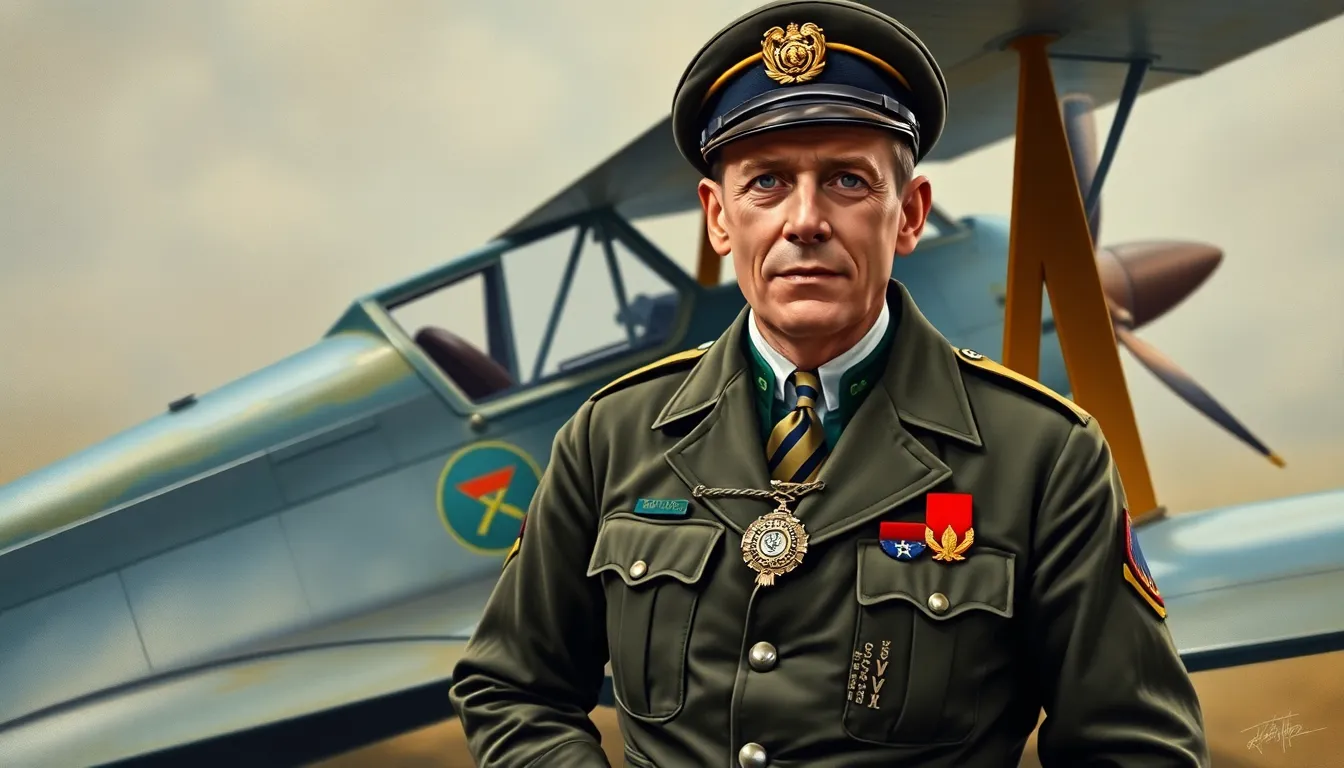
Rickenbacker entered combat during the final year of World War I, a conflict that saw the rapid evolution of aerial warfare from reconnaissance to air superiority missions. By 1918, the United States Air Service was integrated into the American Expeditionary Forces (AEF) and tasked with supporting Allied ground operations on the Western Front. Assigned to the 94th Aero Squadron, known as the “Hat in the Ring” squadron, Rickenbacker flew the French SPAD VII and later the faster SPAD XIII. His squadron operated out of the Toul, France sector, a region that witnessed intense German aerial activity as the Germans attempted to stem the Allied advance.
As a fighter pilot, Rickenbacker’s role was to engage enemy aircraft, protect Allied observation balloons, and escort reconnaissance planes. The tactical doctrine of the time emphasized aggressive dogfighting, in‑flight coordination among squadron elements, and the pursuit of individual victories that contributed to overall air superiority. Rickenbacker’s rank progressed from second lieutenant to captain by war’s end, reflecting both his combat success and leadership within the squadron.

Major Campaigns, Battles, and Decisions
Rickenbacker’s combat record is closely tied to the larger Allied offensives of 1918, especially the Meuse‑Argonne offensive (September–November 1918). His first confirmed aerial victory came on July 27, 1918, when he downed a German Rumpler reconnaissance aircraft over France’s Champagne region. Over the next several months, Rickenbacker accumulated a total of 26 confirmed victories, making him the United States’ leading ace of the war.
One of his most cited engagements took place on September 12, 1918. While on patrol, Rickenbacker and his wingman were attacked by a formation of ten German Fokker D.VIIs. Rickenbacker’s aircraft sustained severe damage; his left wing was nearly torn off, and his engine sputtered. Demonstrating exceptional airmanship, he managed to regain control, pilot the crippled aircraft back over Allied lines, and subsequently shot down three enemy fighters during the engagement, a feat that earned him the Distinguished Service Cross.
During the Meuse‑Argonne offensive, Rickenbacker’s squadron provided critical air cover for infantry advances. On October 5, 1918, he led a small flight that intercepted a German patrol attempting to attack a reconnaissance balloon. Rickenbacker personally destroyed the balloon and downed two Fokker fighters, an action that further solidified his reputation for aggressive tactics and decisive leadership.
Rickenbacker’s final credited victory occurred on November 9, 1918, two days after the Armistice, when he shot down a German aircraft that had strayed into Allied airspace. While this sortie was technically after hostilities ceased, it reflects the chaotic nature of the war’s concluding days and the continued need for vigilance.
Leadership, Courage, and Controversies
Rickenbacker’s decorations include two Distinguished Service Crosses, the French Croix de Guerre with Palm, and the Distinguished Service Medal. The citations for his DSCs emphasize his “extraordinary heroism” and “coolness under fire.” Historians note that while his personal bravery is well documented, some of the post‑war narratives surrounding his exploits were amplified in popular media and his own memoir, Flying at Dawn (1919).
Critics have examined the discrepancy between official combat reports and after‑war accounts, suggesting that Rickenbacker may have unintentionally embellished certain details. However, contemporary squadron logs and German loss records support the majority of his claimed victories. No substantive allegations of misconduct or illegal conduct have been substantiated.
Rickenbacker’s leadership style was characterized as direct and charismatic. He often led by example, frequently flying the most dangerous missions and encouraging his pilots to adopt offensive tactics. He also advocated for improved pilot training and the standardization of aircraft maintenance procedures—a reflection of his mechanical background.
Beyond combat, Rickenbacker’s wartime contributions included participation in the development of aerial reconnaissance techniques and providing input on the future organization of the United States Air Service, which would later become the United States Army Air Corps.
Later Life, Memory, and Legacy
After the war, Rickenbacker returned to civilian life as a celebrated national hero. He leveraged his fame to embark on a series of business ventures, most notably as the president of Eastern Air Lines (originally Inter-Continental Air Transport). Under his leadership, the airline expanded dramatically, introducing transcontinental routes and pioneering safety standards. He also served as a director of the United States Army Air Forces during World War II, advising on pilot training and aircraft procurement.
Rickenbacker authored several books, including his autobiography, Rickenbacker: My Story (1934), and a memoir of his 1935 crash‑landing in the Pacific Ocean after his plane ran out of fuel. He survived 16 days adrift on a life raft before rescue—a story that further cemented his public image as a resilient survivor.
His personal life was marked by tragedy and resilience. He married his first wife, Claire (née Keene), in 1912; she died in 1967. Rickenbacker remarried in 1968 to his longtime friend, Naomi, who died in 1970. He had no children.
Rickenbacker’s net worth, inflated by successful business ventures and public speaking engagements, was estimated to be several million dollars at the time of his death on July 23, 1973, in Tucson, Arizona.
Commemoration of Rickenbacker includes a U.S. Air Force base named Rickenbacker Air Force Base (now Rickenbacker International Airport) in Ohio, a U.S. Navy destroyer (USS Rickenbacker DD‑848) named in his honor, and his induction into the International Air & Space Hall of Fame (1971). His legacy is examined within the context of early American aviation, the development of air power doctrine, and the cultural construction of the “fighter ace” mythos.
Modern scholars assess Rickenbacker as an exemplar of the transition from ground‑based mechanical expertise to aerial combat leadership. While his wartime record stands as a factual basis for his reputation, the subsequent amplification of his heroism in popular culture demonstrates the interplay between individual achievement and national mythmaking. His contributions to civil aviation, particularly through Eastern Air Lines, have had lasting effects on the commercial airline industry, influencing safety standards, route planning, and corporate governance.
In the decades following his death, Rickenbacker’s image continues to appear in museums, military curricula, and popular histories of World War I aviation, affirming his place among the most noteworthy American military figures of the early twentieth century.