Historical Context
George Washington Carver was born into the final decades of American slavery and lived through the Reconstruction era, the rise of Jim Crow segregation, and the early twentieth‑century industrial transformation of the United States. Southern agriculture at the turn of the nineteenth century was dominated by monoculture cotton production, which depleted soil nutrients and left sharecroppers—many of whom were formerly enslaved African‑Americans—in a precarious economic position. The emergence of the Tuskegee Institute (founded in 1881) and the broader African‑American uplift movement provided institutional pathways for educated Black scholars to address these challenges. Within this climate, Carver’s scientific work intersected with agrarian reform, racial progress, and the Progressive Era’s emphasis on practical education.
Early Life and Formation
Carver’s exact birth date is uncertain; most scholars accept a range between January 1864 and December 1865, with an approximate birth location near Diamond, Missouri, within a slaveholding family. After the Emancipation Proclamation, his mother, Mary, secured his freedom and that of his siblings. Orphaned by age ten, Carver was placed in the hands of the Moses Carver family, who later became his guardians and provided an apprenticeship in farm work and animal husbandry.
Recognizing his aptitude, Moses Carver arranged for young George to attend a school for Black children in Neosho, Missouri, and later the State Normal School at Paulding, Kansas, where he earned his teaching certificate in 1889. Persistent discrimination forced him to submit applications to several colleges; after initial rejections, he was admitted to the newly established Iowa State Agricultural College (now Iowa State University) in 1890, where he studied botany, chemistry, and pedagogy. He earned a Bachelor of Science in 1894 and a Master’s degree in 1896, becoming the first Black student to receive a doctorate in agricultural science at the institution in 1921.
Role in Major Events
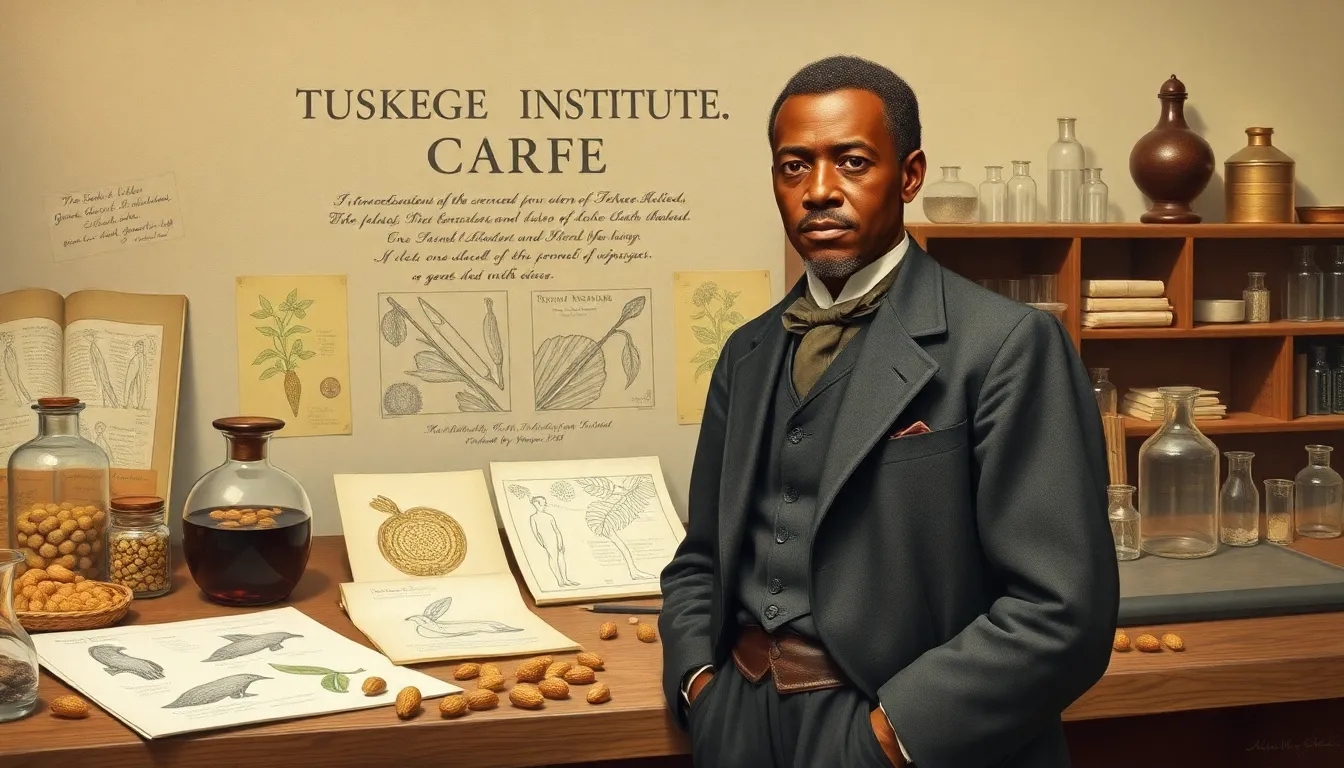
Upon completing his graduate work, Carver accepted a faculty appointment at the Tuskegee Institute in 1896, invited by its founder, Booker T. Washington. There, Carver established the Department of Agriculture and Botany, where he developed a curriculum linking scientific theory with practical farm work. His most celebrated contribution was the promotion of crop rotation, especially the introduction of peanuts, sweet potatoes, and soybeans as nitrogen‑fixing legumes to restore soil fertility after cotton extraction. Carver conducted extensive experiments, publishing bulletins such as “The Peanut as a Crop” (1911) and “Crop Rotation” (1919) that provided empirical data and guidance for Southern farmers.
Carver’s research extended beyond agronomy; he identified over 300 derivative products from peanuts—including oil, flour, dyes, and plastics—thereby diversifying the economic base of rural communities. He also pioneered the development of new uses for sweet potatoes, soybeans, and other plants, aiming to reduce poverty and improve nutrition. During World War I, Carver served as a consultant to the United States Food Administration, advising on domestic crop production to support the war effort.
Carver’s public profile grew through lectures, newspaper columns, and a widely circulated autobiography, “George Washington Carver: An Autobiography.” He traveled extensively, advocating for self‑sufficiency among African‑American farmers and promoting scientific education as a tool for social advancement.
Allies, Opponents, and Debate
Carver’s alliance with Booker T. Washington anchored his early career; Washington’s philosophy of vocational education aligned with Carver’s practical scientific approach. Within Tuskegee, Carver mentored many Black students, including future educators and agriculturalists, creating a network that disseminated his methods throughout the South.
Nonetheless, Carver’s prominence attracted criticism from several quarters. Some white agriculturalists doubted the applicability of his methods to the prevailing cotton‑centric economy, while a minority of Black intellectuals argued that his focus on agricultural modesty reinforced segregationist expectations rather than pursuing broader civil rights. A notable controversy involved the appropriation of Carver’s peanut inventions by commercial enterprises, especially the Goodyear Tire & Rubber Company, which negotiated patents that excluded Carver’s direct financial benefit. Consequently, Carver’s net worth remained modest; contemporary estimates place his personal assets at under $5,000 at the time of his death, reflecting the limited commercial exploitation of his intellectual property.
Scholars have also debated the veracity of certain anecdotal stories—such as Carver’s alleged invention of a “peanut butter” substitute for meat protein—due to sparse primary documentation. Nevertheless, archival records from Tuskegee, the National Agricultural Library, and contemporaneous scientific journals substantiate the majority of his published work.
Legacy and Interpretation
Carver died on January 5, 1943, at the Tuskegee Institute Hospital, aged approximately 78. In the immediate aftermath, he was celebrated as a national figure, receiving honors such as the Spingarn Medal (1923) and a fellowship in the Royal Society of Arts. Over subsequent decades, his legacy has been revisited through multiple lenses.
Historiographically, early biographies framed Carver as a triumphant “self‑made” scientist, emphasizing his humble origins and moral character. Later scholarship, especially from the 1970s onward, situates Carver within the broader context of African‑American scientific labor and the politics of agricultural reform, examining how his work intersected with Jim Crow segregation, the New Deal’s Agricultural Adjustment Act, and the Civil Rights Movement.
Modern interpretation also acknowledges Carver’s role in popularizing sustainable farming practices long before contemporary environmentalism. His advocacy for crop diversification, soil health, and the use of plant-based materials resonates with current debates on food security and ecological resilience.
Physical memorials—such as the George Washington Carver National Monument in Missouri, the Carver Museum at Tuskegee, and numerous schools and streets named in his honor—underscore his lasting cultural impact. Academic conferences, ongoing research on his laboratory notebooks, and renewed interest in his applied biotechnology contributions confirm Carver’s enduring relevance to both history and science.