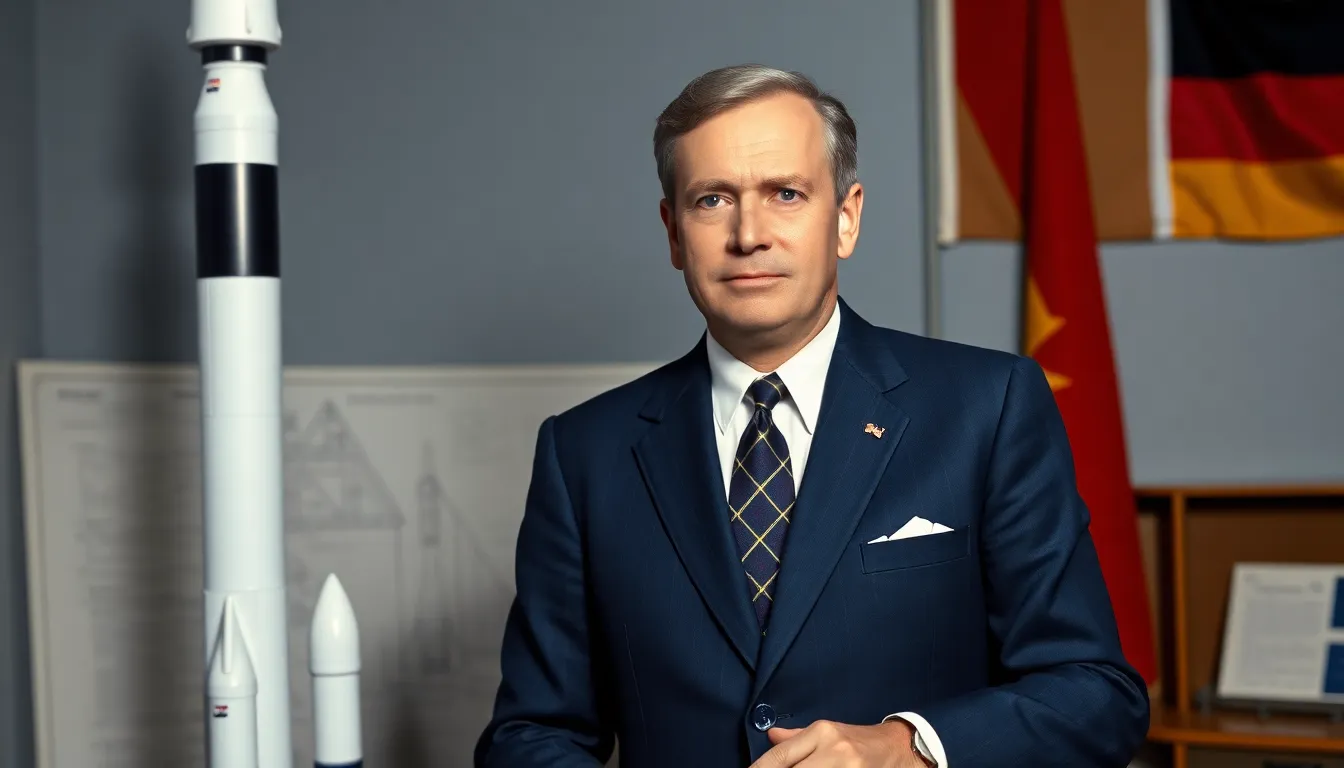
Historical Context
Wernher von Braun lived through some of the most turbulent decades of the 20th century. Born in the German Empire, he came of age during the Weimar Republic, trained as an engineer under the rise of National Socialism, and later worked for the United States during the Cold War. The interwar period saw rapid advances in aeronautics, while World War II created a state‑driven demand for long‑range weapons, notably the V‑2 ballistic missile. After the war, the United States and the Soviet Union competed for technical expertise, a rivalry that shaped the early Space Race (1957‑1975). Von Braun’s career therefore intersected with totalitarian regimes, post‑war scientific migration, and the emergence of a new geopolitical emphasis on space exploration.
Early Life and Formation
Wernher Magnus Maximilian Freiherr von Braun was born on 23 March 1912 in the town of Wirsitz, then part of the Province of Posen in the German Empire (now Wyrzysk, Poland). He was the second child of Magnus von Braun, a civil servant, and Emmy von Quistorp, both from aristocratic families with a strong tradition of military service. The family’s aristocratic status (Freiherr, equivalent to baron) afforded von Braun access to good education. He attended the elementary school in his hometown before moving to Berlin, where he entered the prestigious Gustav‑Heinrich Gymnasium in 1925.
Von Braun showed early aptitude for mathematics and physics. In 1929, at the age of 17, he entered the Technical University of Berlin (Technische Hochschule Berlin), where he studied mechanical engineering. He graduated in 1932 with a Diplom‑Ingenieur, writing his thesis on liquid‑fuel rocket propulsion under the supervision of Dr. Hermann Oberth, a pioneering theorist of space travel. Oberth’s 1923 book Die Rakete zu den Planetenräumen had a profound influence on the young von Braun, who joined the Verein für Raumschiffahrt (VfR), the German “Spaceflight Society.”
Primary sources from the VfR archives indicate that von Braun’s involvement was both technical and ideological; he embraced the idea of rockets as a means to transcend Earth’s limits, a view shared by many contemporaries who saw space travel as a civilizational mission. However, the economic crisis of the early 1930s limited funding, and the VfR remained a small, semi‑secret group until the rise of the Nazi regime altered the political landscape.
Role in Major Events
1930s – Integration into the German military‑rocket program
In 1932, von Braun and several VfR members were recruited by the German Army’s Ballistic Committee (Heereswaffenamt) as part of an effort to explore rocket technology for military use. By 1937, he was appointed technical director of the Peenemünde Army Research Center, a remote Baltic Sea facility where the V‑2 (Vergeltungswaffe 2) rocket was developed. The V‑2 became the world’s first long‑range guided ballistic missile, using liquid oxygen and ethanol as propellants and reaching altitudes of over 100 km—technically entering outer space.
During World II, von Braun oversaw a team of several hundred engineers, including notable figures such as Walter Dornberger, Hermann Steuding, and Arthur Rudolph. The V‑2 was deployed against Allied cities from 1944 to 1945, causing significant civilian casualties. Primary documentation (e.g., the Operation Paperclip dossier) confirms that von Braun was aware of the use of forced labor from concentration‑camp prisoners at the Mittelwerk subsidiary plant, although his personal responsibility has been debated among historians.
1945 – Surrender and transfer to the United States
As Nazi Germany collapsed, von Braun and his core team surrendered to American forces in May 1945 near Oberammergau. The Allied operation, later known as Operation Paperclip, sought to secure German rocket expertise before the Soviet Union could do so. Von Braun was brought to the United States, initially to Fort Bliss, Texas, where he worked on captured V‑2 rockets under the direction of the U.S. Army’s Ordnance Corps.
1950s – Transition to civilian space program
In 1955, von Braun and many of his colleagues were transferred to the newly formed Redstone Arsenal in Huntsville, Alabama. There, his team developed the Redstone missile, which powered the first American manned sub‑orbital flight (the 1961 Mercury‑Redstone mission piloted by Alan Shepard). By the early 1960s, von Braun had become a senior figure at the newly created National Aeronautics and Space Administration (NASA). He served as the director of the Apollo Saturn V launch vehicle program, overseeing the development of the massive rockets that would carry astronauts to the Moon.
Von Braun’s leadership style combined technical rigor with a charismatic vision of space exploration. Contemporary NASA documents credit him with integrating German engineering practices with American industrial capacity, a synthesis that proved crucial for the rapid development of the Saturn V.
1969 – Apollo 11 and later career
On 20 July 1969, the Apollo 11 mission achieved a historic lunar landing. While von Braun did not travel to the Moon himself, NASA’s internal histories attribute much of the Saturn V’s reliability to his program. After the Apollo program, von Braun advocated for a permanent lunar base and later for a manned mission to Mars. He retired from NASA in 1972, becoming a consultant and public speaker on space policy until his death in 1977.
Allies, Opponents, and Debate
Von Braun’s career was marked by shifting alliances. In Nazi Germany, he worked closely with the Army’s weapons development hierarchy, notably General Walter Dornberger, who granted him autonomy at Peenemünde. After the war, his primary allies became American military and civilian officials, such as General John Medaris, who championed the use of German expertise in the U.S. Army Ballistic Missile Agency, and NASA administrator James Webb, who integrated von Braun’s team into the civilian space effort.
Opponents and critics emerged on several fronts. Within the German scientific community, some contemporaries (e.g., physicist Max von Laue) criticized the militarization of rocket science and the use of forced labor. In the United States, civil‑rights activists and some members of Congress questioned the moral implications of granting clemency and high status to individuals who had served the Nazi war machine. The most prominent public debate occurred in the early 1960s, when journalists such as Walter Dornberger (different from the general) and Julius Streicher (not to be confused with the Nazi propagandist) raised allegations of von Braun’s complicity in war crimes.
Historical scholarship remains divided. Authors such as Michael J. Neufeld (in The Rocket and the Reich) argue that von Braun was a technocrat who prioritized engineering over ideology, whereas other scholars (e.g., Robert H. McNab) contend that his willingness to work within the Nazi apparatus implicates him morally. Recent archival releases (e.g., the 2020 US National Archives declassification) show that von Braun was aware of the harsh conditions at Mittelwerk, but he claimed limited operational control. The debate continues in historiography, reflecting broader tensions over how societies integrate former adversaries.
Legacy and Interpretation
Wernher von Braun’s legacy is paradoxical. Technologically, he is regarded as one of the founding fathers of modern rocketry, instrumental in both the German V‑2 program and the American Saturn V launch vehicle. His work made possible the first human steps on the Moon, an achievement that continues to inspire space exploration.
Conversely, his moral legacy remains contested. Memorials to von Braun exist in Huntsville, Alabama (the United States Space & Rocket Center), where he is celebrated as a “father of the US space program.” In Germany, his name has been more ambivalent; streets and schools that once bore his name have been renamed since the 1990s, reflecting a reassessment of his role during the Nazi era.
Scholarly interpretation has evolved. Early Cold‑War historiography tended to emphasize his scientific contributions while downplaying ethical concerns. From the 1990s onward, post‑Cold‑War scholarship has adopted a more critical approach, integrating social‑history perspectives that examine the human cost of the V‑2 program and the politics of scientific migration. Contemporary historians often view von Braun as a figure who embodied the dual nature of twentieth‑century science: capable of remarkable technological breakthroughs, yet deeply entangled in the totalitarian politics of his time.
In popular culture, von Braun appears in films, novels, and documentaries, sometimes as a visionary, sometimes as a cautionary tale about the moral responsibilities of scientists. His personal papers, housed at the Smithsonian Institution and the University of Alabama in Huntsville, continue to be a primary source for research on the development of rocketry, the Cold War, and the ethics of scientific work under authoritarian regimes.