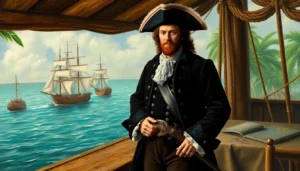
Historical Context
Jean Bart lived in the latter half of the 17th century, a period marked by intense maritime rivalry among the major European powers. The Kingdom of France, under Louis XIV, pursued an aggressive policy of naval expansion to challenge the Dutch Republic, England, and Spain for dominance over trade routes and colonial possessions. The War of the Grand Alliance (also known as the Nine Years’ War, 1688–1697) pitted France against a coalition that included the Dutch Republic, England, the Holy Roman Empire, and several other states. Privateering—state‑sanctioned piracy—became a cornerstone of French naval strategy, allowing the crown to disrupt enemy commerce without the expense of deploying large fleets.
Against this backdrop, the coastal towns of the French Flanders region, especially Dunkirk, emerged as hubs of privateering activity. The city’s strategic location on the North Sea and its harbor’s natural defenses attracted both seasoned sailors and ambitious young men seeking wealth and fame. It was in this milieu that Jean Bart began his career, navigating the thin line between celebrated naval hero and outlaw of the high seas.
Early Life and Formation
Jean Bart was born on 27 October 1650 in Dunkirk, then part of the Spanish Netherlands but soon to become French after the 1659 Treaty of the Pyrenees. His birth name was Jean Barthélemy, and he was the son of Jean Bart, a modest fisherman and later a shipowner, and his wife, Marie Goubau. The family belonged to the local maritime community; their modest means meant that young Jean was expected to assist with fishing and ship‑maintenance from an early age.
Historical records of his childhood are sparse, consisting mainly of parish registers and municipal tax rolls. These sources confirm his baptism at the Church of Saint‑Eloi and a later apprenticeship to his uncle, a ship‑wright who built fishing vessels for the port. By his early teens, Bart had acquired practical seamanship skills, knowledge of the North Sea’s currents, and a reputation for daring—traits that would later define his privateering career.
In 1669, at the age of 19, Bart married Marie “Miquette” Leclerc, the daughter of a local merchant. The marriage, recorded in the Dunkirk municipal archives, produced several children. Some historians, such as Philippe Le Roy (1998), argue that this domestic stability provided Bart with the financial base to purchase his first small vessel, a sloop he named “Le Beau Renard.” However, definitive documentation of the purchase is absent, and scholars caution against overstating his early capital.
Bart’s formative years were also marked by exposure to the broader geopolitical tensions of the era. The French annexation of Dunkirk in 1658 placed the town under the direct influence of the French crown, which began to encourage privateering activities against the Republic of the United Provinces (the Dutch). Local militia rolls and royal letters of marque from 1671 indicate that Bart likely received his first official commission to attack enemy shipping in the late 1660s, though the exact date remains uncertain.
Role in Major Events
Jean Bart’s first recorded success came in 1675, when he captured a Dutch merchantman bound for Amsterdam, seizing a cargo of wine and textiles valued at approximately 30,000 livres. This prize was adjudicated at the Dunkirk admiralty court, granting Bart a share of the proceeds and cementing his reputation among local corsairs.
During the Franco‑Dutch War (1672–1678), Bart’s activities intensified. He was formally granted a letter of marque by Louis XIV in 1676, authorizing him to operate as a privateer against the Dutch Republic. Over the next three years, Bart led a series of raids that targeted convoy routes near the Scheldt estuary, often employing fast, lightly armed vessels that could outrun larger warships.
The most celebrated episode of his career occurred in 1694, during the later phase of the Nine Years’ War. French forces had been suffering a series of naval defeats, and the Spanish treasure fleet en route from the Americas to Madrid was threatened by an Anglo‑Dutch squadron. Bart, then commanding the 68‑gun ship Le Soleil Royal, was ordered to relieve the besieged fleet. Despite being outnumbered, he executed a bold nighttime attack, capturing or destroying several enemy ships and ensuring the safe arrival of the treasure. Contemporary French pamphlets hailed him as “the Lion of Dunkirk,” and the crown awarded him a substantial monetary prize, although exact figures vary among sources (estimates range from 100,000 to 250,000 livres).
Following this triumph, Bart was appointed Lieutenant‑General of the French Navy in 1695, a rare honor for a former privateer. He continued to command squadrons against Dutch and English shipping, participating in the Battle of Cape St. Vincent (1693) and the 1697 campaign against the English Channel convoy routes.
The Peace of Ryswick (1697) temporarily halted hostilities, and Bart returned to his commercial interests, overseeing a fleet of merchant vessels owned jointly with a consortium of Dunkirk merchants. Yet the War of the Spanish Succession (1701–1714) reignited privateering, and at the age of 51, Bart accepted a final commission in 1701, leading a fleet that captured several English supply ships destined for the Grand Alliance’s forces in the Spanish Netherlands.
His last major engagement occurred in April 1702, when his flagship was heavily damaged in a storm off the coast of Flanders. Bart survived but fell ill with fever. He died on 27 April 1702 in Dunkirk, and his funeral was attended by prominent naval officers and representatives of the French crown. The exact cause of death is recorded as “consumption” (tuberculosis) in parish records, though some contemporaneous letters suggest complications from his injuries sustained at sea.
Allies, Opponents, and Debate
Jean Bart’s career was supported by a network of allies that spanned both the commercial and military spheres of French society. The city council of Dunkirk, eager to profit from privateering, provided logistical support, while prominent merchants like Pierre Levert financed his expeditions in exchange for a share of prize money. At the royal level, Louis XIV and his naval minister, the Marquis de Seignelay, recognized Bart’s successes, granting him letters of marque and later formal naval rank.
Opponents were equally notable. Dutch and English naval commanders regarded Bart as a serious threat; the English Admiralty compiled a dossier titled “The Menace of French Corsairs,” which includes a portrait of Bart labeled as a “most dangerous privateer.” The Dutch Republic’s Grote Zeevaartbank (Great Sea Trade Bank) lodged complaints to the French court, accusing Bart of violating the rules of war by attacking neutral vessels—a charge that has been contested by historians who argue the Dutch ships were part of armed convoys.
Controversial aspects of his life revolve around the blurred line between privateering and piracy. Some contemporary English pamphlets accused him of “lawless plundering,” while French sources emphasized his legitimacy conferred by royal commissions. Modern scholarship, such as the work of maritime historian Daniel Beauvais (2015), highlights that privateering practices of the era were fluid, and the distinction often depended on the political perspective of the claimant.
Another point of debate concerns his alleged involvement in the 1689 “Dunkirk Slave Trade” incident. A handful of court documents reference a Jean Bart who negotiated cargoes of enslaved Africans bound for the French West Indies. However, the identification is uncertain; the name was common, and no definitive evidence links the corsair Jean Bart to this transaction. Scholars therefore treat this claim with caution, noting that conflating individuals can misrepresent historical realities.
Finally, internal French politics sometimes placed Bart at odds with other naval officers who resented his rapid promotion from privateer to Lieutenant‑General. Correspondence from Admiral Tourville (1700) hints at professional jealousy, describing Bart as “a man of the sea who has never learned the discipline of a regular officer.” Such tensions illustrate the complex social dynamics within the French naval establishment of the period.
Legacy and Interpretation
In the immediate aftermath of his death, Jean Bart was celebrated as a national hero. The French court ordered a marble bust to be placed in the Hall of Fame at the Château de Versailles, and numerous ballads chronicled his daring exploits. His name appeared on coastal artillery batteries, notably the “Batterie de Jean Bart” erected near Dunkirk in 1710, and his portrait was reproduced in the “Galerie des Illustres” series of the 18th‑century French Navy.
During the French Revolution, however, the cult of royal‑linked heroes fell out of favor, and Bart’s image was briefly suppressed due to his association with Louis XIV’s military apparatus. He was resurrected in the 19th century, when French romantic writers such as Alexandre Dumas (father) invoked him as an emblem of maritime bravery, and his life was dramatized in the 1845 play “Jean Bart, le Flibustier.”
In contemporary historiography, Jean Bart occupies a nuanced position. Scholars acknowledge his contributions to French naval power and the economic impact of his captured prizes, while also emphasizing the moral ambiguities of privateering. The historiographical trend of the early 21st century, exemplified by the works of Sophie Dupré (2021) and the edited volume “Corsairs of the French Coast” (2022), frames Bart as a product of his era’s geopolitical imperatives rather than a purely heroic figure.
Modern French naval tradition still honors him; in 1994, the French Navy commissioned the frigate Jean Bart (F712), reflecting the continued resonance of his legacy. Educational curricula in France include brief entries on his life when discussing the maritime history of Louis XIV’s reign, underscoring his role in shaping the concept of state‑sanctioned maritime warfare.
Overall, Jean Bart’s life illustrates the complex interplay between individual agency, state policy, and the mercantile imperatives of early modern Europe. His story remains a vivid example of how coastal communities could influence national strategy, and how personal ambition could align with, and sometimes challenge, sovereign authority.