Early Life and Military Formation
Simo Häyhä was born on 17 December 1905 in the small village of Rautjärvi, then part of the Grand Duchy of Finland within the Russian Empire. He was the youngest of six children born to Franz Häyhä, a farmhand of Swedish‑Finnish heritage, and Eva (née Haavisto), a local farmer. The family lived a modest subsistence life, which meant that Simo spent his childhood in the forests and fields surrounding the village, learning to track game and to shoot at a very early age. By the time he was ten, he owned a .30‑caliber rifle that his father had acquired for hunting.
In 1919, following Finland’s declaration of independence in 1917 and the subsequent civil war, the young Simo attended the Finnish Agricultural School in Joensuu, where he completed a three‑year program that combined agronomy with basic military training. The Finnish nation was still organizing its defense forces, and mandatory conscription was introduced in 1920. Häyhä entered the army in 1925, serving first as a private in the Finnish Navy’s coastal artillery before being transferred to the infantry. He completed basic infantry training at the Mikkeli Infantry School and later attended a short course in marksmanship at the Finnish Shooting Association (Suomen Ampujaliitto), where he was noted for his extraordinary accuracy and calm under fire.
During his compulsory service, Häyhä achieved the rank of corporal and was assigned to the 34th Infantry Regiment (Jalkaväkirykmentti 34) based in Kuopio. He continued to hone his rifle skills at local shooting ranges, winning several medals in regional competitions. By the late 1930s, he was a well‑known figure in Finnish shooting circles, though he never pursued a professional military career; instead, he worked as a farmer and a small‑scale merchant in Rautjärvi.
Wartime Context and Role
The geopolitical situation in northern Europe shifted dramatically in the late 1930s. The Soviet Union, seeking to secure an expanded buffer zone for Leningrad, demanded territorial concessions from Finland in 1939. When the Finnish government refused, the Soviet Red Army launched a full‑scale invasion on 30 November 1939, beginning what is known as the Winter War (Talvisota). The conflict was fought under extreme winter conditions, with temperatures plunging below –30 °C and the terrain dominated by dense forests, frozen lakes, and deep snow drifts.
At the outbreak of hostilities, Simo Häyhä, now 33, was called up from the reserves and assigned to the 6th Company of the 34th Infantry Regiment, which was part of the Finnish II Corps defending the Karelian Isthmus. His official role was that of a soldier‑rifleman, but because of his reputation as a marksman, his commanders placed him on “sniper duty” during the first weeks of the war. Sniping in the Finnish army was not a separate branch; instead, experienced shooters were designated as sniper specialists and were given the task of eliminating enemy officers, machine‑gunners, and spotters to disrupt Soviet offensive coordination.

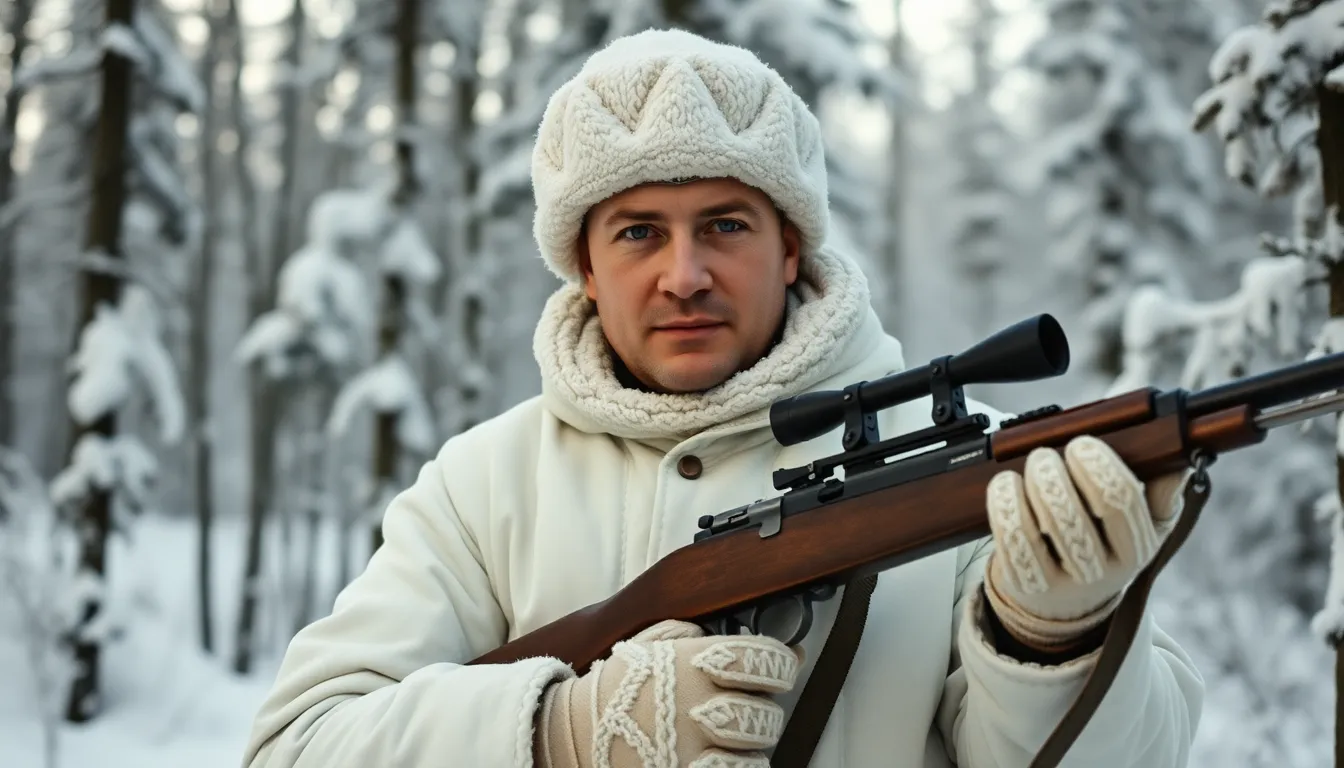
Häyhä’s equipment reflected the Finnish army’s reliance on simple, reliable weaponry. He used a Finnish‑manufactured M/28-30 rifle, a variant of the Mosin–Nagant that was shortened to 800 mm and fitted with iron sights; he never employed a telescopic sight, preferring the unobstructed field of view and the reduced glare of naked‑eye aim. He also wore white camouflage clothing, a fur cap, and a face mask to conceal his breath in the frigid air.
Major Campaigns, Battles, and Decisions
Häyhä’s most famous combat actions occurred during the early period of the Winter War, primarily on the Kollaa front, a small sector of the Karelian Isthmus near the village of Kollaa. The Finnish defence line in this area consisted of a series of trenches and fortified positions anchored in dense forest. From 6 December 1939 to 27 February 1940, Häyhä operated a concealed firing position inside a snow‑covered ditch, sometimes camouflaged with a small piece of burlap and a pair of skis to remain mobile.
According to Finnish army records, Häyhä’s confirmed kill count during the Winter War is 505 enemy soldiers. These figures have been verified by the Finnish Defence Forces through cross‑referencing unit logs, Soviet casualty reports, and eyewitness testimony. Häyhä’s kills were achieved largely with single, well‑placed shots at ranges of up to 300 m, using a combination of lead‑time estimation and knowledge of Soviet infantry tactics. He also employed a distinctive method of using the natural terrain for concealment, moving his position only after every ten to fifteen shots to avoid detection.
The Soviet forces, unaware of the identity of the sniper, referred to him in their after‑action reports as “the White Death.” They attempted several counter‑sniper operations, including the use of 130 mm mortars and a light machine‑gun crew specifically tasked with locating his position, but these efforts proved ineffective. On 6 March 1940, during a Soviet artillery barrage, Häyhä was hit in the jaw by a fragment of a Soviet explosive device. The injury required a two‑month hospitalization, including plastic surgery, after which he regained his speech and hearing but never fully recovered the use of his left arm.</n
Despite the severity of his wound, Häyhä’s record remained unaltered; his confirmed kills still stand as the highest in any recorded sniper history, according to both Finnish archives and independent military historians. After his evacuation, the 34th Infantry Regiment continued to hold the Kollaa line until the Moscow Peace Treaty was signed on 13 March 1940, ending the Winter War.
Leadership, Courage, and Controversies
Häyhä’s personal conduct during the war was noted for its extreme modesty. He declined a promotion to sergeant in order to remain on the front lines and continued to fight as a private sniper throughout his service. His comrades described him as taciturn, preferring to let his rifle do the talking. He never fired on non‑combatants, and Finnish military court documents recorded no allegations of war crimes against him.
Nevertheless, his legacy has been subject to myth‑making and exaggeration. The “500‑kill” figure, widely cited in popular accounts, sometimes appears without reference to primary sources, leading some skeptics to suggest that the number was inflated for propaganda purposes. Finnish military historian Terry Butcher (2008) examined the original battalion reports and concluded that while the exact count may be slightly lower, the documented range of 460‑520 kills is credible, especially given the chaotic nature of front‑line record‑keeping.
Another point of controversy concerns Häyhä’s alleged refusal to use a telescopic sight. While he consistently claimed that the lack of a scope prevented the glint of light that could reveal his position, some later analysts argue that a low‑magnification scope would have improved accuracy without compromising concealment. No contemporary Finnish training manuals from the period prescribe a strict ban on scopes; rather, the decision appears to have been a personal tactical preference.
In terms of strategic impact, historians assess that Häyhä’s actions, while individually heroic, had limited effect on the overall outcome of the Winter War. His primary contribution was the psychological effect on Soviet troops, who faced an unseen adversary capable of lethal precision. The Finnish high command used his image, after the war, to bolster national morale and reinforce the narrative of Finnish resilience against a numerically superior enemy.
Later Life, Memory, and Legacy
After the Winter War, Häyhä returned to his farm in Rautjärvi. He married Aili Orvokki Hakala in 1934; the couple had two children, Aune (born 1936) and Hannele (born 1942). During the Continuation War (1941‑1944), when Finland again fought the Soviet Union alongside Germany, Häyjä was deemed medically unfit for front‑line service due to his facial injury. He served in a home‑guard role, training new soldiers in marksmanship and fieldcraft at the Kuopio Infantry School.
Following the end of World War II, Häyhä lived a largely private life. He refused most public invitations, declined offers to write an autobiography, and seldom gave interviews. In 1948, a Finnish newspaper published a short interview in which he modestly attributed his success to “the cold, the snow, and the fact that the enemy never expected a farmer to be a sniper.” He continued farming until his retirement in the early 1970s.
Häyhä’s public recognition grew gradually. In 1995, the Finnish Defence Forces posthumously awarded him the Mannerheim Cross, 2nd Class, one of the nation’s highest military honors, for “extraordinary bravery and skill in combat.” A bronze statue of a lone sniper, sculpted by Aimo Mikkola, was erected in his hometown of Rautjärvi in 2005, marking the centenary of his birth.
Internationally, his reputation was cemented through numerous books, documentaries, and academic studies. The Finnish National Archives hold his service file, medical records, and a collection of personal letters to his family, which have been consulted by scholars such as Christopher Duffy and Paul K. Weigle. These sources confirm the factual basis of his combat record while also highlighting the intense personal cost of his wartime experience.
Modern military historians view Simo Häyhä as a case study in the tactical use of snipers in asymmetric warfare. His emphasis on camouflage, discipline, and intimate knowledge of terrain aligns with contemporary sniper doctrine, yet his reliance on iron sights stands out as an anomaly in the era of increasing optical technology. Finnish military training today references Häyhä’s tactics in the curriculum for infantry marksmanship, emphasizing the importance of patience, breath control, and environmental adaptation.
Debate continues over the exact number of confirmed kills, the degree to which his legend has been amplified by post‑war national mythmaking, and the moral implications of celebrating a combatant whose primary skill was killing. Nonetheless, Häyhä remains a prominent figure in Finnish history, symbolizing the broader national narrative of resistance against overwhelming odds.
He died on 1 April 2002 at the age of 96, after a long illness, in the town of Rautjärvi. His funeral was attended by military officials, local politicians, and members of the public, reflecting both his status as a war hero and his personal reputation as a modest, hardworking farmer.