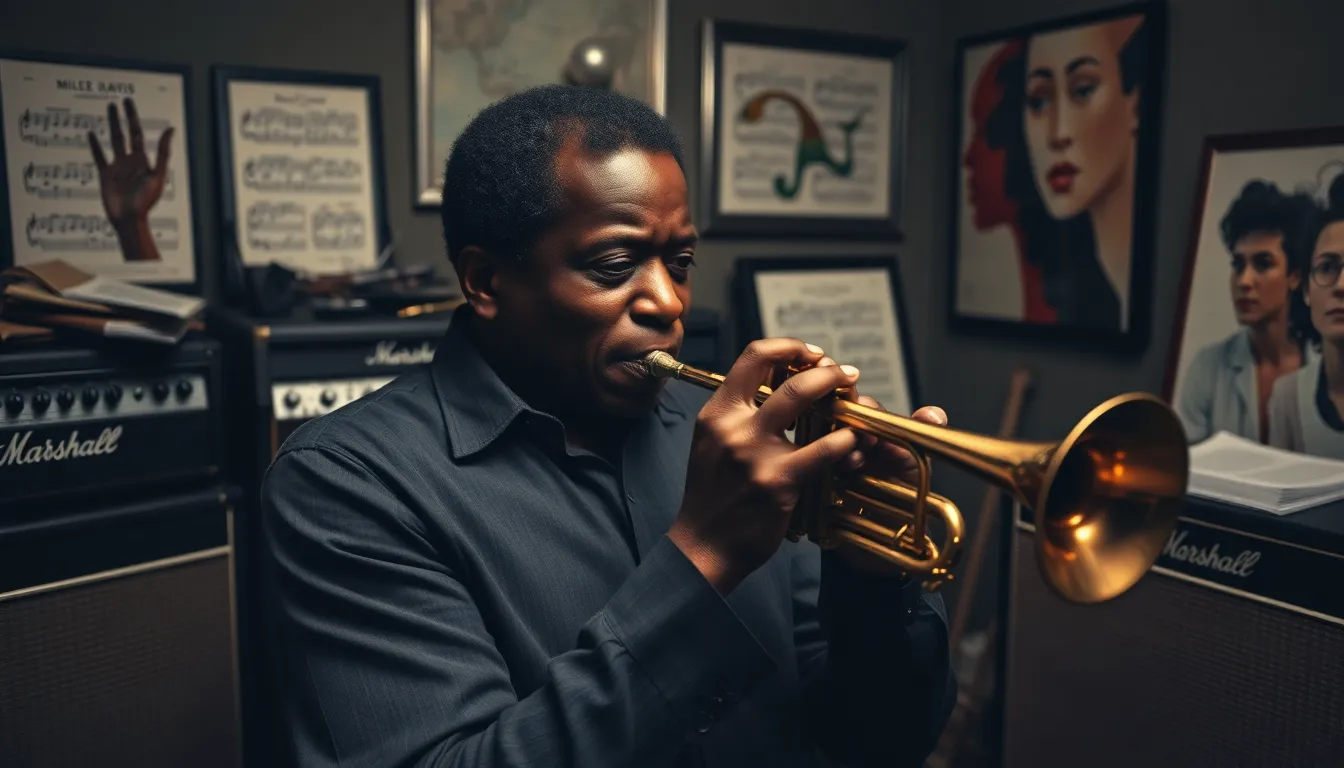
Early Life and Creative Formation
Miles Dewey Davis III was born on May 26, 1926, in Alton, Illinois, to a middle‑class African‑American family. His father, Miles Dewey Davis Jr., was a successful dental technician who owned a retail business, and his mother, Maria (Harriett) Davis, worked as a homemaker. In 1935, the family moved to East St. Louis, where young Miles first encountered the sounds of blues and swing on the radio. By age 13 he had begun playing the trumpet, receiving informal instruction from his older brother, the pianist Ray Davis, and later from the local music teacher, Craig William Nelson.
At age 16, Davis earned a scholarship to study at the prestigious Curtis Institute of Music in Philadelphia (although he never completed a formal degree there). His time at Curtis exposed him to the classical repertoire and to rigorous technical training, but Davis felt confined by its conventions. He left the institute in 1944 to join the United States Navy, where he served in the band and performed on the Pacific front during World War II. This military experience introduced him to a broader range of musicians and reinforced his desire to pursue a career in jazz.
After his discharge in 1945, Davis moved to New York City, the epicenter of post‑war jazz. He enrolled briefly at the Juilliard School of Music, where he studied composition under the modernist composer Walter Piston. Although his formal academic studies were short‑lived, they provided Davis with a grounding in orchestration and harmony that later informed his innovative arranging techniques. During this period he began performing with bebop pioneers, most notably Charlie Parker, whose aggressive improvisational language profoundly influenced the young trumpeter.
Medium, Style, and Vision
Miles Davis’s primary medium was the trumpet, but his artistry extended beyond performance to composition, arrangement, and band leadership. His style evolved through distinct phases, each characterized by a specific tonal palette, rhythmic approach, and philosophical stance toward improvisation. In the late 1940s, Davis embraced the rapid, high‑energy vocabulary of bebop, imitating Parker’s complex phrasing while developing a more lyrical, spacious tone.
By the early 1950s, Davis had begun to articulate a new aesthetic that would become known as “cool jazz.” This movement emphasized relaxed tempos, muted dynamics, and a collective, understated approach to improvisation. Davis’s seminal 1950 recordings with the “Birth of the Cool” nonet – featuring arrangements by Gil Evans, Gerry Mulligan, and others – employed unconventional instrumentation (French horn, tuba, and bass clarinet) and underscored Davis’s belief that jazz could function as a sophisticated, arranged art form rather than solely a vehicle for virtuosic soloing.

Throughout the late 1950s and early 1960s, Davis pioneered modal jazz, a harmonic framework built on scales rather than chord progressions. His 1959 album Kind of Blue (recorded with Bill Evans, John Coltrane, Cannonball Adderley, Paul Chambers, and Jimmy Cobb) remains the best‑selling jazz record of all time and showcases his emphasis on melodic development within static modal contexts. Davis’s vision here was to free improvisers from the constraints of rapid chord changes, allowing greater emotional depth and lyrical exploration.
In the late 1960s, Davis turned toward electronic instrumentation and rock influences, pioneering what became known as jazz‑fusion. Albums such as Bitches Brew (1970) integrated electric pianos, rock‑type drumming, and studio production techniques, reflecting Davis’s conviction that jazz must evolve alongside contemporary popular music. This period highlighted his willingness to incorporate new technology, such as the wah‑wah pedal and synthesizers, to expand the expressive capabilities of his trumpet and ensemble.
Across all phases, Davis’s creative philosophy remained consistent: he sought continuous reinvention, valued spontaneity, and prioritized group interaction over individual virtuosity. He often described his role as “a catalyst” who set the conditions for other musicians to thrive, underscoring his collaborative ethos.
Major Works and Breakthroughs
Birth of the Cool (1949‑1950) – A series of eight tracks recorded for Capitol Records that introduced the cool‑jazz aesthetic. Though initially released as singles, the recordings were compiled into an album in 1957, influencing later West Coast jazz and modern orchestral arrangements.
Milestones (1958) – An album that signaled Davis’s transition toward modal experimentation. Featuring John Coltrane, Cannonball Adderley, Red Garland, Paul Chambers, and Philly Joe Jones, the record includes the title track “Milestones,” which employs a two‑mode structure.
Kind of Blue (1959) – Recorded in two sessions at Columbia’s 30th Street Studio, the album’s modal framework and lyrical improvisations made it a landmark of both artistic achievement and commercial success. It has sold over 5 million copies worldwide and remains a staple in music education curricula.
Sketches of Spain (1960) – A collaboration with arranger Gil Evans that fused jazz improvisation with Spanish folk melodies, showcasing Davis’s interest in cross‑cultural synthesis.
E.S.P. (1965) and Miles Smiles (1967) – Albums produced with the second great quintet (Wayne Shorter, Herbie Hancock, Ron Carter, Tony Williams). These works pushed post‑bop boundaries, emphasizing abstract harmonic concepts and group telepathy.
Bitches Brew (1970) – A double‑LP recorded in August 1969, featuring an electric ensemble with musicians such as Chick Corea, Joe Zawinul, and John Mclaughlin. The record’s dense textures, open‑ended structures, and studio editing techniques heralded the jazz‑fusion era and sold over 2 million copies.
On the Corner (1972) – An album that incorporated funk, African percussion, and early electronic sequencing, representing Davis’s deepening engagement with world music rhythms.
Birth of the New (2022) – Posthumous Release – A compilation of previously unreleased sessions from the 1970s, illustrating the enduring interest in Davis’s late‑career experiments.
Beyond recordings, Davis’s live performances were pivotal. His 1964 concert at the Newport Jazz Festival, his 1976 “Live at the Philharmonic Hall” with Herbie Hancock, and numerous festival appearances cemented his reputation as an electrifying bandleader. Davis also contributed scores to film, notably the 1966 documentary Jazz on a Summer’s Day and the 1975 experimental film Jazz Meets the World.
Collaborations, Movements, and Reception
Davis’s career is marked by collaborations with a roster of seminal jazz figures. His early work with Charlie Parker placed him at the heart of bebop’s revolutionary language. The “Second Great Quintet” (1964‑1968) with Wayne Shorter, Herbie Hancock, Ron Carter, and Tony Williams redefined the concepts of time, harmony, and collective improvisation, influencing later avant‑garde and free‑jazz movements.
The partnership with arranger Gil Evans produced several landmark albums (Birth of the Cool, Sketches of Spain, Pyramid) that merged orchestral timbres with jazz improvisation, shaping the “third stream” movement that blended classical and jazz idioms.
In the 1970s, Davis worked closely with electric musicians such as Keith Jarrett, John McLaughlin, and bassist Jaco Pastorius, forming a cross‑genre network that broadened jazz’s audience. His bands often served as incubators for young talent; many alumni, including Chick Corea, Herbie Hancock, and Marcus Miller, became influential leaders in their own right.
Critical reception of Davis’s work has been largely favorable, though his stylistic shifts occasionally provoked controversy. The release of Bitches Brew divided purist jazz critics who viewed electric instrumentation as a betrayal of the acoustic tradition, while others praised its bold synthesis of rock and jazz. Over time, historical reassessment has positioned Davis as a visionary who consistently expanded the definition of jazz.
Davis received numerous honors, including the Grammy Lifetime Achievement Award (1990), the NEA Jazz Masters Fellowship (1992, posthumously), and multiple Grammy Awards for both performance and composition. He was inducted into the DownBeat Hall of Fame (1975) and the Rock and Roll Hall of Fame (1999) as a testament to his cross‑genre influence.
Legacy and Cultural Impact
Miles Davis’s impact extends far beyond his recordings. He reshaped the vocabulary of jazz trumpet playing, introducing a muted, lyrical tone that contrasted sharply with the high‑energy approaches of earlier bebop trumpeters. His emphasis on modal improvisation sparked a generation of musicians to explore scalar frameworks, influencing not only jazz but also rock (e.g., the modal explorations of The Doors) and classical composers such as Olivier Messiaen.
In popular culture, Davis’s persona—cool, enigmatic, and uncompromising—has become a symbol of artistic authenticity. He appears in films, literature, and visual art, often as an archetype of the avant‑garde creator. His 1991 death at the age of 65 elicited worldwide mourning, and his estate’s posthumous releases continue to generate scholarly discussion and commercial interest.
Economically, Davis’s net worth at the time of his death was estimated at around $5 million, derived primarily from record sales, royalties, performances, and a limited line of branded merchandise. After his death, the value of his master recordings rose substantially, contributing to the continued relevance of his catalogue in streaming platforms and licensing deals.
Educationally, Davis’s recordings are integral to jazz curricula globally. Institutions such as Berklee College of Music and the Juilliard School incorporate his works into performance and analysis courses. His approach to improvisation—prioritizing melodic development and atmospheric space—remains a cornerstone of modern jazz pedagogy.
In the broader visual and design fields, Davis’s collaborations with Gil Evans have been cited as early examples of interdisciplinary art, where music, graphic design, and album cover photography coalesce into a unified aesthetic. The iconic cover of Kind of Blue, photographed by Irving Penn, is recognized as a seminal visual artifact that continues to be reproduced in design textbooks.
Overall, Miles Davis’s career illustrates a continual pursuit of artistic renewal, a willingness to embrace new technologies, and an unrelenting influence on the trajectory of 20th‑century music and visual culture.