Early Life and Creative Formation
Diego María de la Concepción Juan Nepomuceno Estanislao de la Rivera y Barrientos was born on 8 December 1886 in Guanajuato, Mexico, to a prosperous middle‑class family. His father, Antonio Rivera, was a civil engineer, and his mother, Angélica Barrientos, came from a family with strong artistic inclinations. The Riveras owned a large house on the outskirts of the city, where Diego spent his childhood amidst a collection of paintings, sculptures, and imported books. This domestic environment fostered an early fascination with visual art.
Rivera attended the local primary school before enrolling at the Academia de San Carlos in Mexico City in 1901. At the academy, he studied under the academic painters Germán Gedovius and Román Piedra, receiving a rigorous grounding in drawing, anatomy, and classical composition. In 1905, at the age of 19, he won a scholarship that allowed him to travel to Europe. The scholarship was awarded by the Mexican government as part of a broader effort to expose promising artists to European artistic currents.
During his eight‑year stay in Europe (1906‑1913), Rivera lived primarily in Paris, the epicenter of modern art. He enrolled at the Académie de la Grande Chaumière, where he befriended fellow Mexican expatriates such as Alfredo Ramos Martínez and Cuban painter Wifredo Lam, as well as European modernists including Pablo Picasso, Georges Braque, and Amedeo Modigliani. Rivera’s early work from this period shows strong influences from Post‑Impressionism, Cubism, and the Fauvist use of colour. He exhibited at the Salon d’Automne (1910) and the Salon des Indépendants (1912), gaining modest recognition among avant‑garde circles.
While in Spain (1910‑1911), Rivera encountered the work of the Catalan architect Antoni Gaudí, whose integration of structural innovation and decorative detail left a lasting impression on Rivera’s later monumental murals. He also visited the Prado Museum, where he studied the narrative techniques of Diego Velázquez and the eighteenth‑century Mexican painters, laying a foundation for his later synthesis of European modernism with Mexican historicist themes.
Rivera returned to Mexico in 1913, amid the upheaval of the Mexican Revolution (1910‑1920). The political turmoil and the revolutionary rhetoric of land reform, workers’ rights, and national identity profoundly reshaped his artistic ambitions. He aligned himself with the intellectuals of the Bolivarian and Casa del Obrero Mundial circles, seeking to create an art that served the masses rather than the elite.

Medium, Style, and Vision
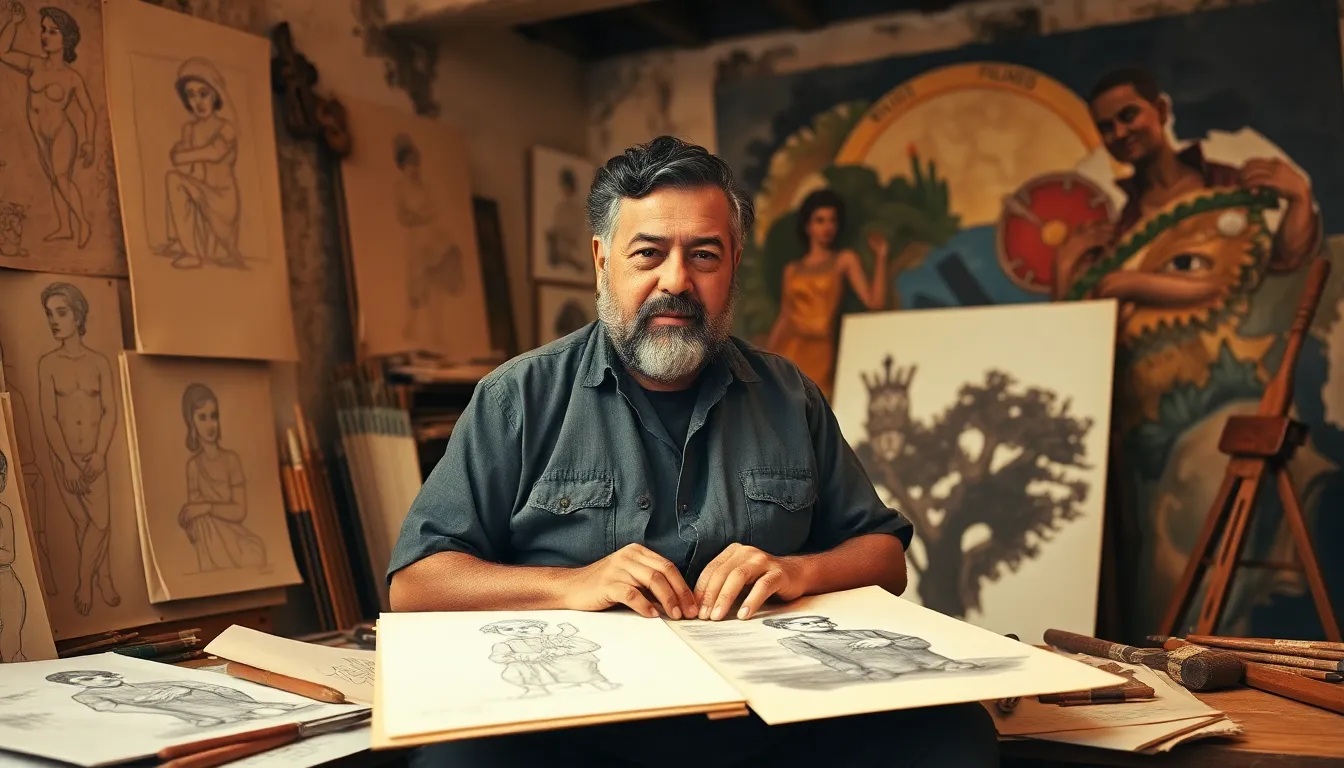
Rivera’s primary medium was mural painting—large, publicly visible frescoes executed directly on plaster walls. He revived the traditional Italian technique of fresco (buon fresco) for its durability and its capacity to integrate art into architectural space. Rivera often combined fresco with tempera, oil, and later, acrylic paint, allowing for a broader colour palette and finer detail.
Stylistically, Rivera fused the bold, flattened forms of Cubism with a narrative realism rooted in Mexican folk traditions. His figures are often rendered with strong outlines, simplified shapes, and vibrant, saturated colours that echo the palettes of Mexican textiles and pre‑Columbian art. This visual language served two purposes: it made the murals legible from a distance and reinforced a sense of collective identity.
Thematically, Rivera focused on the histories of labor, industry, and everyday life. He portrayed indigenous peoples, peasants, factory workers, and revolutionary leaders, positioning them as protagonists of Mexican history. Rivera articulated a design philosophy that art should be didactic, socially engaged, and accessible, famously stating, “Art is a weapon.”
His philosophical stance was heavily influenced by Marxist thought, though he never joined an official Communist party in Mexico. Rivera’s writings in the 1920s, collected in the essay “The Art of the People,” outline his belief that the artist must act as a historian and a moral guide, embedding political content within aesthetically compelling compositions.
Major Works and Breakthroughs
Rivera’s first major public commission after his return was the series of frescoes for the Ministry of Education in Mexico City (1922‑1924). These works, such as “The Arrival of the Spaniards” and “The Creation of the World,” synthesized pre‑Hispanic mythology with contemporary revolutionary ideals. The success of these murals established Rivera as a leading figure in the newly formed Mexican Muralism movement, alongside fellow artists José Clemente Orozco and David Alfaro Siqueiros.
In 1925, Rivera began a collaboration with the Mexican government to produce murals at the National Palace (“The History of Mexico”). The nine‑panel cycle presents a sweeping narrative from ancient Aztec civilization through the Mexican Revolution, featuring iconic figures such as Emiliano Zapata and Benito Juárez. This monumental project cemented his reputation and attracted international attention.
Rivera’s most famous work outside Mexico is the 1933 “Man at the Crossroads” mural commissioned for the RCA Building (now the Rockefeller Center) in New York City. The original composition depicted a socialist vision of industrial progress, including an image of Lenin. The inclusion of Lenin sparked controversy, leading to the mural’s destruction by the building’s owners before it was completed. Rivera recreated the work in 1933‑1934 at the Palace of Fine Arts (now the San Francisco Museum of Modern Art), now known as “The Making of a New World.”
Other landmark works include:
- “Detroit Industry Murals” (1932‑1933) at the Detroit Institute of Arts, a twenty‑panel series portraying the auto‑manufacturing process, scientific research, and the role of the worker.
- “The Flower Carrier” (1935), a canvas that has become an iconic image of Mexican laborers.
- “Dream of a Sunday Afternoon in the Alameda Central” (1947), a sprawling canvas that brings together historical and contemporary figures in a single compositional space.
- “Marxism Will Give Health to the People” (1935‑1936) in Mexico City’s Secretariat of Public Education, an explicit declaration of his political beliefs.
Rivera also executed important murals for Mexican educational institutions, such as the Universidad Nacional Autónoma de México (UNAM) and the Secretariat of Public Education, where his art served both decorative and pedagogical purposes.
Collaborations, Movements, and Reception
Rivera was a central figure in the Mexican Muralism movement, which emerged as a state‑sponsored effort to educate an illiterate populace and forge a cohesive national identity after the Revolution. He worked closely with his contemporaries Orozco and Siqueiros, sharing technical knowledge and political ideals, though artistic rivalries occasionally surfaced.
On a personal level, Rivera’s marriage to Swedish-American painter Frida Kahlo in 1929 created one of the most celebrated artistic partnerships of the twentieth century. Their relationship was marked by mutual artistic influence, political collaboration, and intense personal drama. Though they divorced in 1939, they remarried in 1940 and remained intertwined until Kahlo’s death in 1954.
Internationally, Rivera’s murals were exhibited in Europe and the United States, generating both acclaim and controversy. Critics in the United States praised his technical mastery and the monumental scale of his work, while some conservative commentators condemned his overt political messages. The destruction of “Man at the Crossroads” sparked a national debate about artistic freedom and censorship, solidifying Rivera’s reputation as a politically engaged artist.
Rivera received numerous honors, including the Mexican Order of the Aztec Eagle (1939) and a posthumous tribute at the 1965 Venice Biennale, where his works were featured in a retrospective exhibition.
Legacy and Cultural Impact
Diego Rivera’s legacy endures through the continued presence of his murals in public institutions worldwide. His approach to integrating art within architecture inspired later generations of public artists, including the American muralist Thomas Hart Benton and contemporary street artists such as Banksy.
In Mexico, Rivera’s frescoes remain integral to the nation’s cultural heritage, serving as visual textbooks for schoolchildren and tourists alike. His synthesis of European modernist techniques with indigenous Mexican iconography paved the way for later movements such as the “Nueva Imagen” and the Chicano art movement in the United States.
From a market perspective, Rivera’s paintings command high prices at auction; a 2021 sale of “The Night of Santa‑Marta” fetched US$6.2 million. While precise net‑worth figures at the time of his death are unavailable, scholars estimate that, adjusted for inflation, Rivera’s estate would be valued in the tens of millions of dollars, reflecting both his prolific output and his influence on the global art market.
Rivera’s writings on art theory continue to be studied in art‑history curricula, and his murals are regularly the subject of scholarly research, restoration projects, and public tours. The continued preservation of his work underscores its importance as a visual archive of the Mexican Revolution, industrialization, and the broader struggles of the working class.
In sum, Diego Rivera transformed mural painting into a vehicle for social critique, national storytelling, and artistic innovation, establishing a model for public art that remains relevant in contemporary discourse about the role of the artist in society.