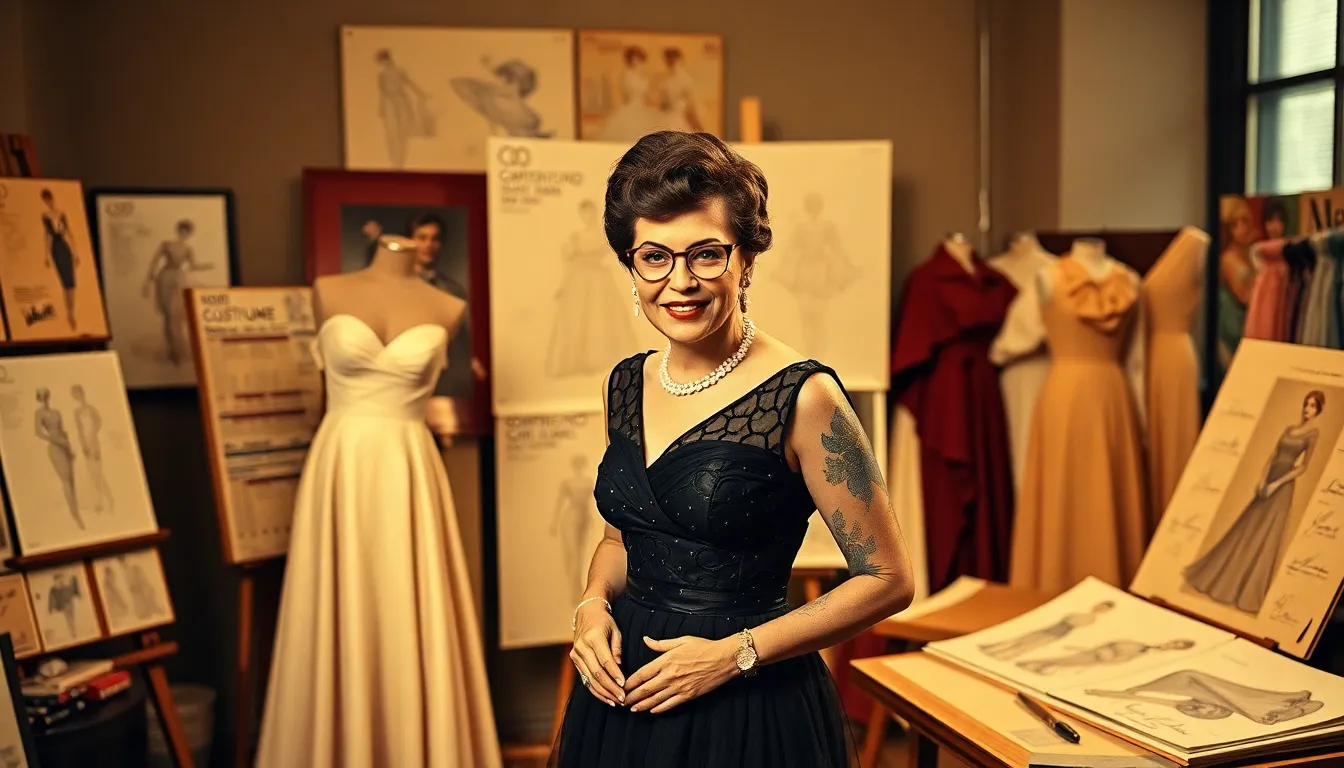
Early Life and Creative Formation
Edith Elizabeth Head was born on October 21, 1897, in San Bernardino, California, to Jacob Head, a pharmacist, and Josephine Leavens, a schoolteacher. The family moved to Santa Monica when Edith was a child, where she grew up in a middle‑class household that valued education and cultural pursuits. Her early exposure to the nascent film industry came through the motion‑picture theatres of Los Angeles, where she observed the impact of clothing on character perception.
Head attended Santa Monica High School, where she demonstrated a talent for drawing and a fascination with textiles. After graduating in 1915, she enrolled at the Los Angeles School of Expression, a private school that combined drama, art, and fashion. There she met the influential costume designer and theater professional Robert Edmond Jones, who encouraged her to consider a career in design. In 1918, she secured a scholarship to the prestigious Otis Art Institute, studying illustration, color theory, and silhouette construction.
Following her formal education, Head entered the film industry as a sketch artist for the fledgling Paramount Pictures. Her first credited work appeared on the 1923 silent drama Anne of the West. During the 1920s, she apprenticed under the studio’s senior costumer, Travis Banton, learning the practical demands of rapid production schedules, the importance of collaboration with directors, and the mechanics of creating garments that photographed well under early lighting technologies.
Medium, Style, and Vision
Edith Head’s primary medium was costume design for motion pictures, a discipline that demanded a hybrid skill set of fashion design, textile engineering, and narrative storytelling. She worked primarily with wool, silk, rayon, and later synthetic fibers such as nylon, adapting her material choices to both the aesthetic aims of a film and the technical constraints of camera work. Head emphasized silhouette over ornamentation, believing that a character’s personality could be communicated through the cut, drape, and proportion of clothing rather than merely through decorative details.
Her visual language was marked by a clean, architectural precision combined with a sensitivity to the zeitgeist of each era. During the 1930s, she embraced the streamlined Art Deco aesthetic, employing geometric patterns and bias‑cut fabrics to convey modernity. In the 1940s, wartime austerity prompted a shift towards simpler, utilitarian garments, yet Head maintained elegance through subtle tailoring and the strategic use of color to reflect emotional states.

Head’s design philosophy foregrounded collaboration with directors and actors. She famously kept detailed sketchbooks, known as “look books,” that catalogued over 2,000 costume ideas, each annotated with the personality traits it was intended to express. She argued that a costume should be an extension of the screenplay, providing visual shorthand for the audience. This philosophy earned her the reputation of being a “visual psychologist” among her peers.
Major Works and Breakthroughs
The turning point of Head’s career arrived with the 1939 film Stage Door, for which she received her first Academy Award for Best Costume Design (Black‑White). The offering of luxurious gowns for the character played by Katharine Hepburn demonstrated her capacity to blend character development with contemporary fashion trends. The award solidified her status at Paramount, leading to a multi‑year contract.
Throughout the 1940s and 1950s, Head designed iconic garments for a host of leading actresses. Notable examples include the legendary silk chiffon gowns in All About Eve (1950), which used pastel palettes to underscore the film’s themes of ambition and deception, and the sleek, shoulder‑padded suits in Mildred Pierce (1945), which mirrored the protagonist’s rise from modest beginnings to business empire. Her work on Roman Holiday (1953) earned her a second Oscar and introduced a fashion trend of the “Alpine sweater” that influenced both cinema and ready‑to‑wear markets.
In 1956, Head achieved a career milestone with The Ten Commandments, a biblical epic that required massive scale costume production. She oversaw a team of over seventy assistants and coordinated with textile manufacturers to produce historically inspired yet cinematic fabrics. The film’s costumes garnered critical praise for their blend of historical research and dramatic flair, cementing Head’s reputation as a designer capable of managing both intimate dramas and large‑scale spectacles.
Head’s later work includes her collaboration with director Blake Edwards on The Pink Panther series (starting 1963) and her pioneering use of synthetic fibers in the 1960s, which allowed for more vibrant color palettes and cheaper production costs. Her last credited film was Queen of the Gypsies (1974), after which she retired from active design but continued to mentor emerging designers through workshops at the Fashion Institute of Technology.
Collaborations, Movements, and Reception
Edith Head’s career was defined by long‑standing collaborations with leading actors and directors. She worked repeatedly with Alfred Hitchcock, designing the sleek, modernist wardrobe for the femme‑fatale in Vertigo (1958). Her partnership with star actresses such as Grace Kelly, Audrey Hepburn, and Marilyn Monroe resulted in fashions that transcended the screen and entered mainstream culture. For instance, the ivory gown she fashioned for Monroe in Gentlemen Prefer Blondes (1953) sparked a surge in demand for similar silhouettes in contemporary women’s wear.
Head was a central figure in the Hollywood costume department movement that professionalized costume design as a distinct artistic discipline. She was a founding member of the Academy of Motion Picture Arts and Sciences’ Costume Designers Branch, which advocated for the recognition of costume design as an integral element of filmmaking.
Critics praised Head’s ability to balance narrative function with aesthetic beauty. While some contemporary fashion critics in the 1960s accused her of favoring “Hollywood glamour” over avant‑garde experimentation, Head responded that her priority was storytelling, not fashion futurism. She received eight Academy Awards—a record that still stands—and thirteen additional nominations, reflecting both industry respect and public admiration.
Controversy touched her career only sparingly; a 1948 press incident alleged that Head had borrowed designs from European couturiers without credit. The matter was settled amicably, with Head acknowledging the influence of Parisian fashion houses and emphasizing the collaborative nature of design.
Legacy and Cultural Impact
Edith Head’s influence extends far beyond the silver screen. Her costume sketches are housed in the Museum of Modern Art (MoMA) and the Academy Museum of Motion Pictures, serving as primary research sources for scholars exploring mid‑century fashion and film studies. The “Head Look Book” methodology pioneered by her has become a standard pedagogical tool in costume design curricula worldwide.
Her designs helped shape the public’s visual vocabulary of femininity, power, and elegance in the 20th century. The “Head silhouette” – characterized by defined waistlines, refined shoulders, and purposeful use of color to signal mood – continues to inform contemporary costume designers in cinema, theater, and television.
In the commercial fashion realm, Head’s partnership with the luxury label Saks Fifth Avenue in the 1950s introduced “Hollywood‑Inspired” ready‑to‑wear lines, bridging the gap between costume and consumer fashion. Moreover, major fashion designers such as Yves Saint Laurent and Christian Dior cited her work as an inspiration for their own cinematic collaborations.
Edith Head lived to the age of 99, passing away on September 20, 1997, in Los Angeles. Posthumously, her contributions have been recognized with a dedicated retrospective at the Los Angeles County Museum of Art (LACMA) in 2005, and a star on the Hollywood Walk of Fame. Academic conferences continue to examine her role in constructing gendered identities on screen, affirming her status as a pivotal figure in both cinematic and design histories.