Early Training and Background
Zlatan Ibrahimović was born on 3 October 1981 in Malmö, Sweden, to a Bosniak Muslim father, Šefik Ibrahimović, and a Croatian Catholic mother, Jurka Gravić. Growing up in the Rosengård district, a multicultural suburb known for its economic challenges, Ibrahimović was introduced to football at a very young age. He joined the local club Malmö FF’s youth academy in 1995 at the age of 14, after initial stints with smaller neighbourhood teams such as Halmstad and Malmö FF’s junior side.
Under the mentorship of Malmö coach Tom Prahl, Ibrahimović’s natural athleticism, height (1.95 m), and raw technical ability were honed. He quickly progressed through the U‑17 and U‑19 squads, often training with the senior team. At 17, he made his professional debut for Malmö FF in an Allsvenskan match against IFK Göteborg on 1 June 1999, becoming the youngest player to appear for the club in the modern era.
His formative years were marked by a blend of street‑football improvisation and disciplined academy training. Ibrahimović credited his early development to the multicultural environment of Rosengård, where he learned to incorporate flair, improvisation, and a strong mental resolve—traits that would later define his playing style.
Competitive Career
Malmö FF (1999–2001) – After breaking into the first team, Ibrahimović scored 16 goals in 40 league appearances, helping Malmö secure the 2000 Allsvenskan title. His performances attracted attention from abroad, and the Swedish national team called him up for a friendly against the Czech Republic in 2001.
Ajax Amsterdam (2001–2004) – In the summer of 2001, Ibrahimović transferred to Ajax for a reported €9 million. Under coach Ajax legend Johan Cruyff, he refined his technical skill, particularly his first‑touch and vision. He won two Eredivisie championships (2001‑02, 2003‑04) and the KNVB Cup (2002). Over three seasons he recorded 48 league goals in 110 appearances and was named Dutch Footballer of the Year in 2002.

Juventus (2004–2006) – Ibrahimović’s move to Juventus for €12 million marked his entry into Serie A. Playing alongside stars such as Gianluigi Buffon and Alessandro Del Piero, he helped Juventus finish runner‑up in the 2004‑05 Serie A season. He scored 20 league goals in 68 appearances before the Calciopoli scandal resulted in Juventus’s relegation, prompting his departure.
Inter Milan (2006–2009) – Joined on a free transfer after Juventus’s demotion, Ibrahimović thrived under coach Roberto Mancini, winning three consecutive Serie A titles (2006‑07, 2007‑08, 2008‑09). He became the first player since Ronaldo in 1996 to win the Scudetto with three different clubs (Ajax, Juventus, Inter). His 57 Serie A goals in 123 matches cemented his reputation as a prolific forward.
FC Barcelona (2009–2010) – In July 2009, Ibrahimović signed for Barcelona for €69.5 million, the club’s record fee at the time. Despite sharing the pitch with Lionel Messi and Xavi, he struggled to adapt to Pep Guardiola’s possession‑centric style, scoring only 16 league goals. He left after one season, citing tactical misfit.
AC Milan (2010–2012, 2020–2023) – Ibrahimović moved to Milan for €24 million, immediately rediscovering form. He topped Serie A’s scoring chart in 2011‑12 with 28 goals, earning the Capocannoniere award. After a brief return to his hometown club Malmö in 2012, he re‑joined Milan in 2020 at age 38, scoring decisive goals that helped the club avoid relegation and later win the 2021‑22 Serie A title, making him the oldest scorer in a Serie A championship season.
Paris Saint‑Germain (2012–2016) – Ibrahimović became PSG’s record signing for €22 million. He won four Ligue 1 titles (2012‑13 to 2015‑16) and became the club’s all‑time top scorer (156 goals) by the time he left. His physical dominance and aerial ability were pivotal in establishing PSG as a dominant force in French football.
Manchester United (2016–2018) – Under José Mourinho, Ibrahimović signed for United for €29 million. He scored 28 Premier League goals in 56 appearances and helped the team win the 2016‑17 EFL Cup and the 2017 UEFA Europa League, where he also scored in the final.
LA Galaxy (2018–2019) – In January 2018, Ibrahimović joined MLS side LA Galaxy for a reported €5 million. He recorded 52 goals in 58 league matches, earning MLS Player of the Month awards and becoming the league’s top scorer in 2019.
Sweden National Team (2001–2016, 2021) – Ibrahimović earned 122 caps, scoring 62 goals, ranking as Sweden’s all‑time leading scorer. He represented Sweden at three FIFA World Cups (2002, 2006, 2018) and two European Championships (2004, 2012). He announced retirement from international football in 2016, returned briefly for the 2020 Euro qualifiers, and retired definitively after the 2022 World Cup qualifiers.
Major Wins, Records, and Data
Ibrahimović’s career is distinguished by a blend of team trophies and individual milestones:
- Domestic league titles: 20 top‑flight championships across four countries – Netherlands (2), Italy (5), France (4), England (1), Sweden (1).
- European competition: UEFA Europa League winner (2017) with Manchester United; UEFA Champions League runner‑up (2009) with Barcelona.
- Scoring records: All‑time top scorer for PSG (156 goals), LA Galaxy (52 goals), and second‑most scorer in Serie A history among non‑Italian players.
- Individual awards: Four-time Serie A Footballer of the Year (2008, 2009, 2011, 2021), Ligue 1 Player of the Year (2013, 2014, 2015), MLS Best XI (2018, 2019), and Swedish Footballer of the Year (six times).
- Age‑defying feats: Oldest player to score in a UEFA Champions League knockout match (40 years, 2022), oldest Serie A champion (41), and oldest scorer in a top‑five European league season.
Statistically, Ibrahimović has amassed over 570 senior career goals in club football, surpassing the 600‑goal milestone when international goals are included. His goal‑per‑game ratio stands at approximately 0.61 across all competitions.
Style, Rivalries, and Setbacks
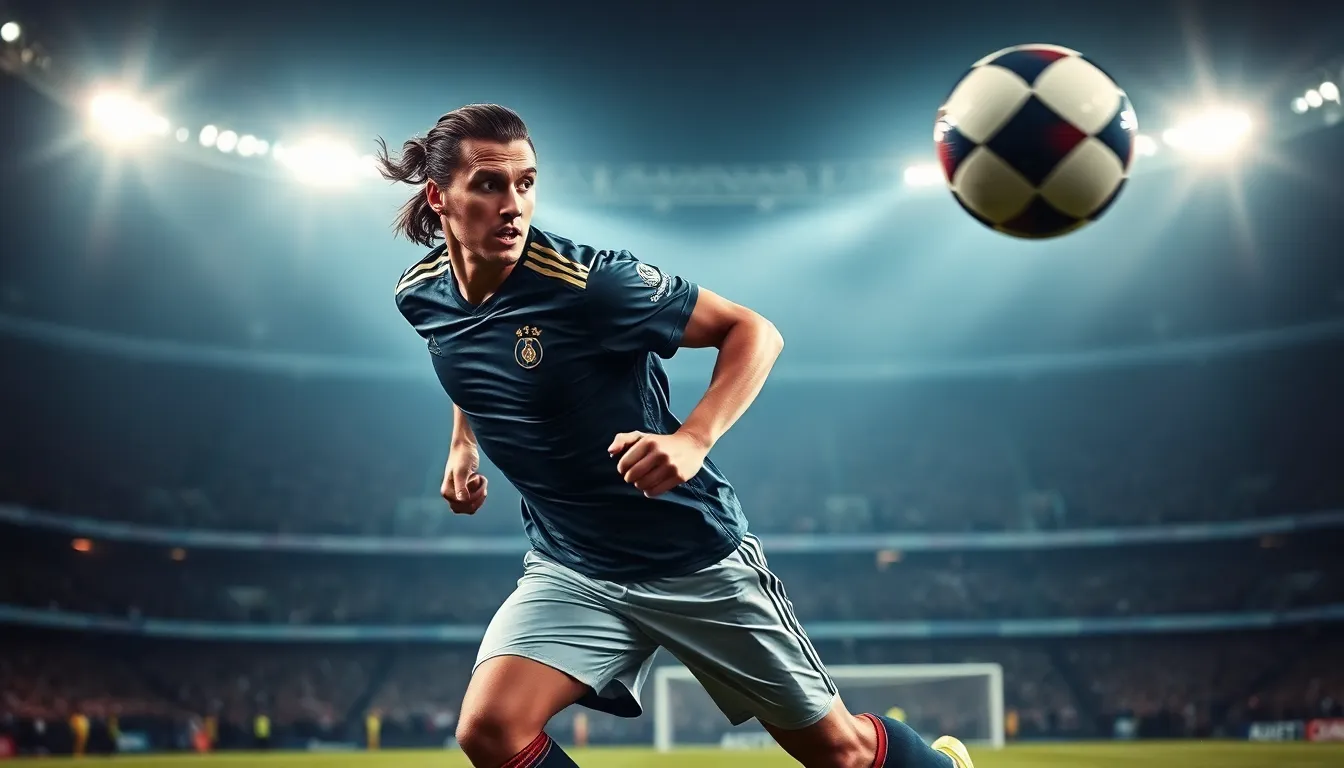
Playing style – Ibrahimović combines exceptional physical presence with technical finesse. Known for his powerful first touch, acrobatic volleys, and trademark “panenka” penalties, he excels both as a target man and a deep‑lying forward. His ability to score from distance, head, and on the turn makes him a versatile threat. Off the ball, his intelligence in positioning and knack for creating space for teammates have contributed to his longevity.
Rivalries – Throughout his career Ibrahimović has engaged in high‑profile rivalries:
- FC Barcelona vs. Real Madrid – While at PSG, his frequent duels with Cristiano Ronaldo and Lionel Messi in the UEFA Champions League elevated his global profile.
- Inter Milan vs. AC Milan – The “Derby della Madonnina” featured his personal transition from Inter to AC Milan, intensifying the intra‑city rivalry.
- Sweden vs. Denmark – A long‑standing Scandinavian rivalry, often highlighted by Ibrahimović’s decisive goals in Nordic Championship qualifiers.
Setbacks and controversies – Ibrahimović’s career has not been devoid of challenges. In 2006, he suffered a severe knee ligament injury while playing for Juventus, sidelining him for six months. A high‑profile spat with Barcelona coach Pep Guardiola in 2010 resulted in an early exit. His outspoken personality has also sparked media controversy, most famously a 2011 interview where he claimed “I’m not a man, I’m a god,” leading to disciplinary fines.
Nevertheless, his resilience is evident. After his 2010 Barcelona disappointment, he resurrected his form at Milan, winning the Serie A top scorer award. In 2019, a ruptured Achilles tendon at LA Galaxy threatened his career, but he returned to top‑level football with AC Milan at age 38, disproving conventional age expectations.
Influence and Sporting Legacy
Zlatan Ibrahimović’s impact extends beyond the pitch. He has become an emblem of self‑belief and artistic expression in sport. His autobiography, “I Am Zlatan,” published in 2013, provides insight into his upbringing and mindset, influencing young athletes across Europe and the United States.
From a tactical perspective, Ibrahimović helped popularise the “complete forward” archetype—players capable of finishing, creating, and dictating play. Coaches have adapted training regimes to accommodate his blend of size, technique, and personality, thereby influencing scouting and recruitment strategies, especially in Scandinavian clubs seeking multifaceted attacking talent.
His commercial success and media presence have also contributed to football’s global marketability. As a brand ambassador for major companies (e.g., Nike, Audi), he has leveraged his persona to expand the sport’s reach into markets traditionally under‑represented in football fandom.
In Sweden, Ibrahimović’s success galvanized discussions on multicultural integration, as his family’s immigrant background and his rise to national hero status challenged traditional narratives about Swedish identity. He has funded youth academies in Malmö, providing pathways for children from disadvantaged neighborhoods.
Overall, Ibrahimović’s legacy is defined by a rare combination of on‑field excellence, off‑field charisma, and a relentless drive to redefine personal limits. Future generations of forwards will likely study his footage for technical mastery while emulating his mental fortitude.