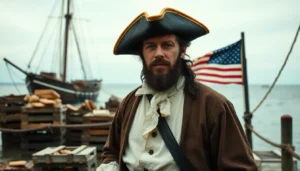
Historical Context
Blackbeard operated during the so‑called Golden Age of Piracy (c. 1650‑1730), a period when the Atlantic and Caribbean seas were rife with privateers‑turned‑pirates. The decline of European wars, especially the War of the Spanish Succession (1701‑1714), left many seasoned naval men unemployed. Colonial powers such as Britain, Spain, France, and the Netherlands vied for control of lucrative trade routes, while the British Crown, under the rule of Queen Anne and later King George I, struggled to enforce maritime law across its far‑flung colonies. This environment created a fertile breeding ground for piracy, where men like Edward Teach could exploit weak colonial defenses and the high demand for illicit goods.
Early Life and Formation
The precise details of Blackbeard’s birth remain contested. Most contemporary scholarship agrees that he was born around 1680, possibly in Bristol or London, England. Parish registers list an Edward Teach (or Thatch) baptized in 1680 in Bristol, but the connection to the pirate is not definitively proven. Little is known of his family background, though some sources suggest a modest middle‑class upbringing. No contemporary documents record his education, but it is likely he possessed basic literacy given his later ability to sign documents and command crews.
Teach first appears in the historical record in 1716 as a crewman on the privateer Margaret under Captain Benjamin Hornigold, a veteran pirate who later became an informant for the Royal Navy. Hornigold’s mentorship was crucial: it introduced Teach to the pirate code, ship handling, and the importance of reputation. By 1717, Teach had risen to the rank of quartermaster, a position granting him authority over discipline and distribution of loot. The paucity of primary sources—most notably the reliance on Charles Johnson’s 1724 compilation A General History of the Pyrates—means many details of his early years are speculative.
Role in Major Events
In late 1717, after Hornigold retired from piracy, Teach captured the French slave ship La Concorde off the coast of Saint Kitts. He renamed her Queen Anne’s Revenge and refitted her as a formidable frigate armed with up to 40 cannons. Over the next year, Teach used the vessel to conduct a series of bold raids against merchant ships travelling between the West Indies and the American colonies. Notable captures include the Joseph (a large plantation ship) and the Scorpion (a well‑armed sloop). These actions brought him immense wealth, though exact net‑worth estimates remain conjectural; historians typically infer a fortune equivalent to several hundred thousand pounds in contemporary value.
In the summer of 1718, Blackbeard blockaded the port of Charleston, South Carolina, demanding a medical supply ransom of 6,000 gold guineas. The blockade lasted 24 hours, after which the mayor, under duress, paid the ransom and released the ship. This incident highlighted his strategic use of intimidation over outright violence and cemented his notoriety in colonial newspapers, which often exaggerated his cruelty.

By autumn 1718, colonial governors, motivated by pressure from merchants and the Crown, authorized naval expeditions against piracy. In November, a Royal Navy contingent led by Lieutenant Robert Maynard aboard HMS Pearl located Blackbeard near Ocracoke Island, North Carolina. The ensuing battle was fierce; Maynard’s men boarded the Adventure, Blackbeard’s flagship after the Queen Anne’s Revenge ran aground. Blackbeard sustained multiple gunshot and sword wounds and died shortly thereafter on 22 November 1718. His death was recorded in the official “Colonial Office Correspondence” (1730) and confirmed by contemporary reports.
Allies, Opponents, and Debate
Blackbeard’s network of allies was fluid. While early in his career he served under Hornigold, later he cooperated with fellow pirates such as Stede Bonnet, who commanded the Revenge. Their partnership was short‑lived; Bonnet was captured and executed in 1718, a fate that underscored the precarious nature of pirate alliances. Some historians argue that Blackbeard may have acted as a “pirate king” among a coalition of captains, coordinating raids and sharing intelligence, though documentary evidence for a formal coalition is scant.
Opponents ranged from private merchant captains, who recounted the terror of his black‑smoked ship, to colonial officials like Governor Charles Eden of North Carolina, who is alleged to have colluded with Blackbeard for personal gain. The Eden‑Blackbeard connection is debated: while some colonial court records hint at Eden’s tolerance (e.g., the “Ocracoke Petition” of 1719), no definitive proof of bribery exists.
The reliability of primary sources is a major scholarly challenge. Charles Johnson’s account, while invaluable, blends fact with sensationalism—portraying Blackbeard as a near‑mythic figure with “twisted beard” and “fire‑spitting” theatrics. Modern historians such as David Cordingly and Marcus Rediker caution against accepting Johnson’s depictions at face value, emphasizing the need to cross‑reference Admiralty records, colonial correspondence, and archaeological evidence from the shipwreck of the Queen Anne’s Revenge (discovered off Beaufort, North Carolina in 1996).
Legacy and Interpretation
Blackbeard’s death did not end his legend. In the 18th and 19th centuries he became a staple of popular literature, appearing in works by Robert Louis Stevenson and later influencing cinematic portrayals, such as the 1952 film Blackbeard the Pirate. His image—tied to the legend of a fearsome, flame‑adorned beard—has been repeatedly romanticized, often obscuring the economic and geopolitical realities of early 18th‑century piracy.
Archaeologically, the 1996 discovery of the Queen Anne’s Revenge hull and subsequent excavations have provided tangible data, confirming some aspects of Johnson’s narrative (e.g., the ship’s armament) while challenging others (e.g., the exact location of the final battle). Scholarly reinterpretations in the early 21st century view Blackbeard not merely as a villain but as a product of imperial overreach, labor displacement after war, and the fluid boundaries of legality on the high seas.
In contemporary historiography, Blackbeard serves as a case study for the construction of criminal celebrity. His life illustrates how colonial governments, merchants, and later popular culture shape the memory of outlaws. The debate over his net worth, his true motives—whether profit‑driven, opportunistic, or ideologically rebellious—remains open, reflecting broader uncertainties about the socioeconomic underpinnings of piracy.