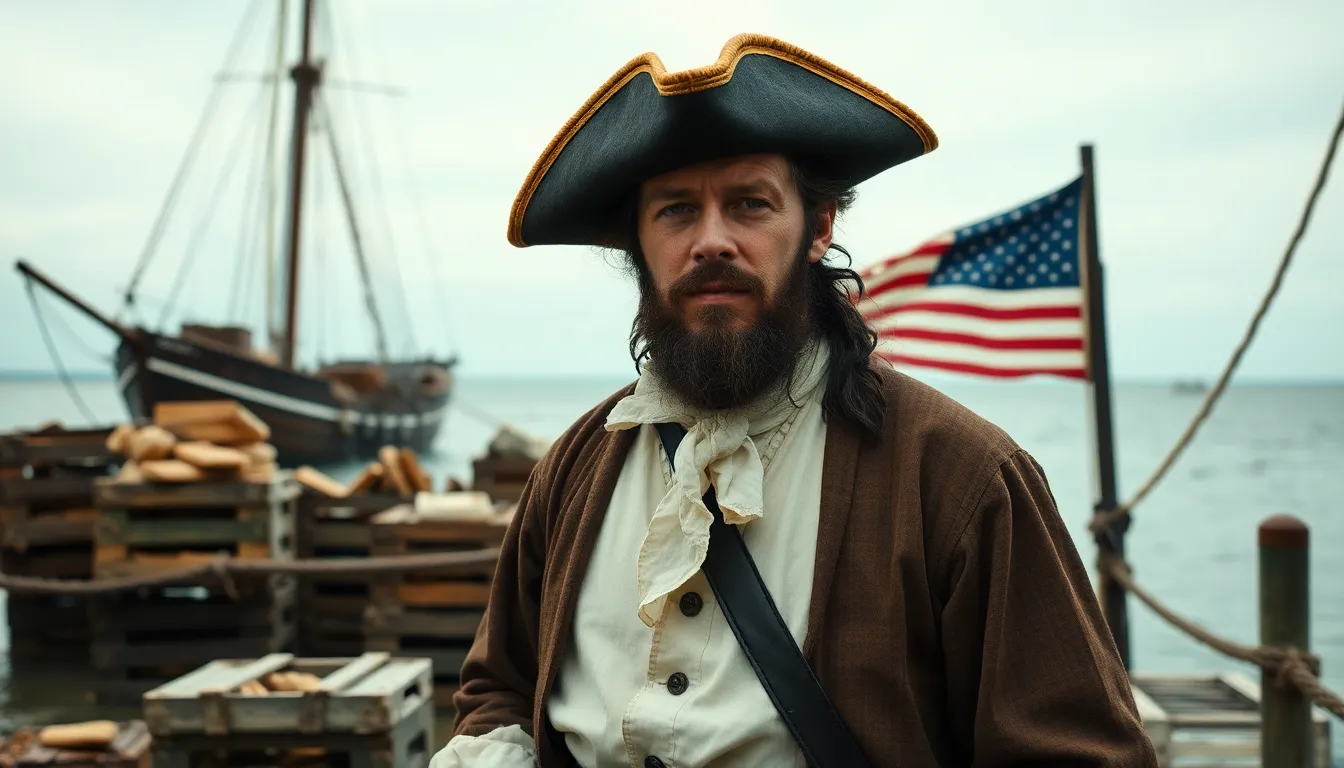
Historical Context
Jean Lafitte lived during a period of intense geopolitical upheaval in the Gulf of Mexico. The early 19th century saw the waning of Spanish control over Louisiana, the expansion of the United States under the Louisiana Purchase (1803), and the resurgence of European colonial interests after the Napoleonic Wars. Piracy and privateering flourished in the Caribbean and the Gulf, where weak naval patrols and lucrative trade routes created a fertile environment for men like Lafitte to operate. The War of 1812 between the United States and Britain provided both a threat and an opportunity, as coastal settlements required defense and the U.S. government was willing to negotiate with irregular forces.
Early Life and Formation
Precise details of Jean Lafitte’s birth remain uncertain. Most contemporary sources place his birth between 1776 and 1780, likely in a French port city such as Bordeaux or Saint-Malo, though some accounts suggest he may have been born in the French colony of Saint-Domingue (now Haiti). He was the son of a French seaman, and his family was reportedly of modest means. Lafitte’s early exposure to maritime life is inferred from the fact that he entered the merchant marine as a teenager, gaining experience in navigation, trade, and the illicit activities that accompanied the bustling Atlantic traffic of the era.
By the turn of the century, Lafitte had migrated to the Gulf Coast, where the Spanish-controlled colony of Louisiana offered a permissive environment for privateers. He settled in the marshy Barataria Bay, a natural harbor that would become the base for his smuggling operations. The paucity of reliable records from this period means that many aspects of his formative years are derived from later memoirs, court documents, and contemporary newspaper reports, each of which contains varying degrees of bias.
Role in Major Events
Establishment of the Barataria Base (c. 1804‑1809)
Between 1804 and 1805, Lafitte organized a semi‑formal pirate fleet out of Barataria Bay, near present‑day New Orleans. He recruited seasoned sailors, many of whom were French or Caribbean refugees fleeing political turmoil. The fleet engaged in the capture of Spanish, British, and American merchant vessels, diverting a portion of the plunder to a black market that supplied the growing city of New Orleans with contraband goods such as sugar, tobacco, and firearms.
Negotiations with Spanish Authorities (1809‑1810)
In 1809, the Spanish governor of Louisiana, Governor Alejandro de Cespedes, confronted Lafitte about the smuggling. A negotiated settlement allowed Lafitte to retain his base in return for a modest tribute and a promise to limit attacks on Spanish shipping. This pragmatic arrangement illustrates the blurred lines between piracy, privateering, and state‑sanctioned commerce in the Gulf.
War of 1812 and the Battle of New Orleans (1814‑1815)
When the United States entered the War of 1812, General Andrew Jackson sought to defend New Orleans from a British assault. Recognizing the strategic value of Lafitte’s knowledge of local waterways and his militia of 300‑400 men, Jackson offered Lafitte a pardon in exchange for assistance. Lafitte accepted and provided artillery, ammunition, and intelligence that proved decisive at the Battle of New Orleans on 8 January 1815. The British defeat cemented Lafitte’s reputation as a patriot‑like figure, though his motives were likely pragmatic rather than purely patriotic.
Post‑War Period and Decline (1815‑1823)
After the war, Lafitte attempted to legitimize his operations. He received a provisional commission from the newly formed United States government to continue privateering against Spanish vessels in the Caribbean, though this commission was short‑lived. Increased pressure from the U.S. Navy and the closing of Barataria Bay forced him to relocate his base to Galveston Island, Texas, then a part of Spanish Texas. In 1817, Lafitte and his brother Pierre attempted to establish a fortified settlement there, but the Mexican authorities expelled them by 1821. The final years of Lafitte’s life are shrouded in mystery; he is believed to have died sometime between 1823 and 1825, possibly in Cuba or on the Gulf Coast.
Allies, Opponents, and Debate
Lafitte’s career was marked by fluid alliances. His primary allies included local merchants, the Spanish colonial officials who tolerated his operations for revenue, and later General Andrew Jackson, who valued his militia. Opponents ranged from U.S. naval officers, who viewed him as a pirate, to rival privateers such as the “Néréide” crew, who contested his dominance of Gulf smuggling routes.
The historical debate over Lafitte centers on whether he should be classified as a pirate, a privateer, or a patriotic hero. Early American newspapers portrayed him as a menace, while post‑war accounts, especially those influenced by Jacksonian politics, celebrated his contributions to the defense of New Orleans. Modern scholarship, citing primary court records and Spanish administrative documents, emphasizes the economic dimension of his activities and the pragmatic tolerance he garnered from colonial powers.
Legacy and Interpretation
In the immediate aftermath of his death, Lafitte faded from public discourse, with only occasional references in shipping logs and local legends. The 19th‑century romanticization of piracy revived interest in his life; writers such as Edward R. Romano and later James A. Holman produced semi‑fictionalized biographies that blended fact and folklore.
Contemporary historians view Lafitte as a complex figure embodying the fluid nature of early‑American maritime law. His involvement in the Battle of New Orleans has been incorporated into the larger narrative of American resilience, while his smuggling empire is studied as an early example of black‑market economies that shaped the development of New Orleans.
Monuments to Lafitte are scarce, reflecting the ambivalence of his legacy. However, a historical marker in Louisiana’s New Orleans French Quarter commemorates the site of his Barataria settlement. Academic interest continues, especially in the fields of Gulf Coast maritime history and the legal evolution of piracy versus privateering.