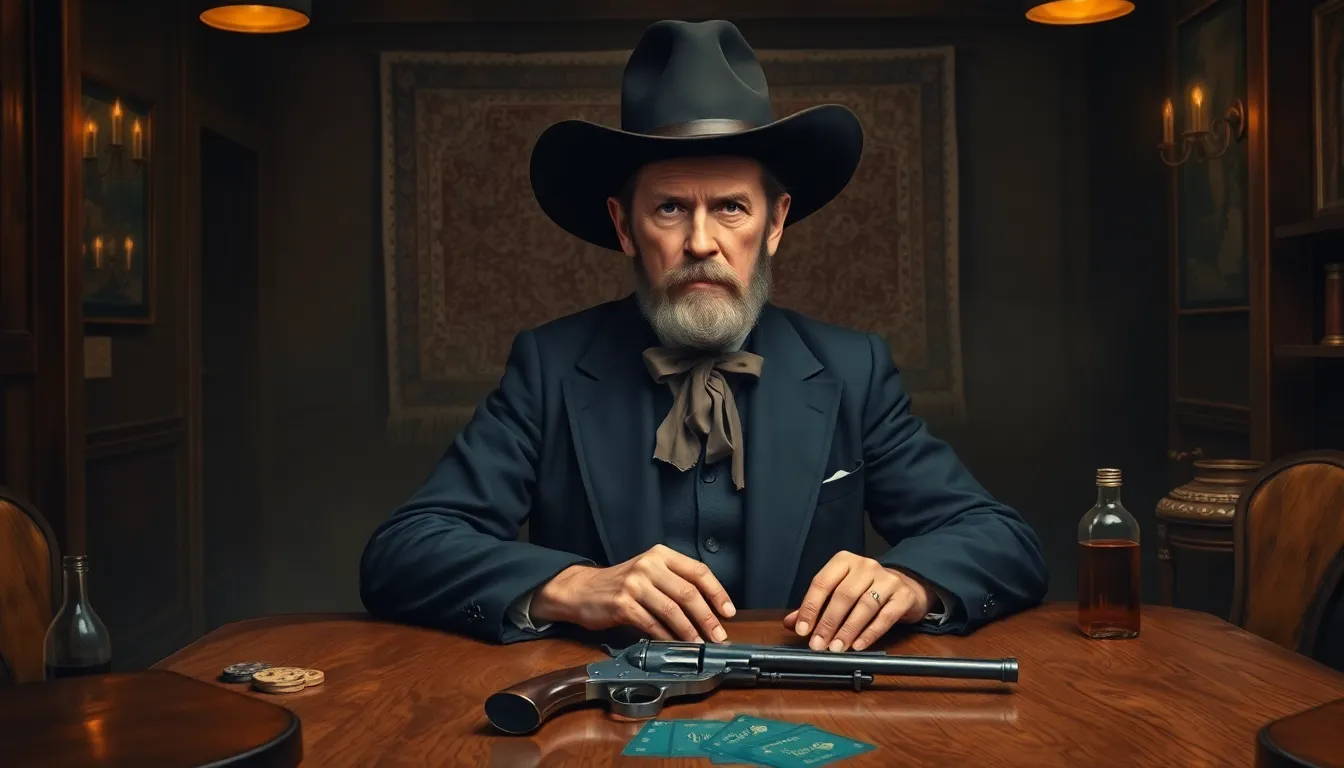
Historical Context
The mid‑19th century United States was a nation in rapid expansion. Following the doctrine of Manifest Destiny, settlers pushed westward across the Mississippi River, encountering Native American nations, newly forming territories, and the lingering turmoil of the Civil War (1861‑1865). The period known as the American Old West (roughly 1865‑1890) was marked by mining booms, cattle drives, lawless towns, and the emergence of a frontier mythos. Within this milieu, individuals such as James Butler Hickok—later popularly known as “Wild Bill”—became both actors in and symbols of the era’s violence, opportunity, and larger‑than‑life narrative.
Early Life and Formation
James Butler Hickok was born on May 27, 1837, in Homer, Illinois, to Samuel and Lucinda (Butler) Hickok, a modest farming family of English‑American ancestry. Primary sources for his childhood are sparse; most details derive from later recollections and census records. The 1850 U.S. Census lists the Hickok household in Fulton County, Illinois, indicating a rural upbringing with limited formal schooling. At age 19, Hickok left Illinois for St. Louis, Missouri, a common departure point for western migrants, seeking work as a porter on steamboats that serviced the Mississippi River trade routes.
In St. Louis, Hickok encountered the volatile environment of a growing frontier city, where gambling houses, brothels, and itinerant gamblers created a subculture that would shape his later reputation. By the early 1860s, he had taken up work as a stagecoach driver and later as a scout for the Union Army during the Civil War, though the exact details of his military service remain disputed among historians. Some contemporary newspaper accounts list him as a Union scout in the Missouri and Kansas territories, while official muster rolls do not consistently record his name, suggesting either informal enlistment or later embellishment.
Role in Major Events
Scout and Scout‑Leader (1861‑1865)
During the Civil War, Hickok operated as a civilian scout for the Union, gathering intelligence on Confederate guerrilla bands, particularly in the tumultuous border state of Missouri. His knowledge of the terrain and ability to navigate Native American lands made him a valuable asset. While concrete orders are lacking, letters from Union officers reference a “Mr. Hickok” who supplied reports on enemy movements.
Lawman in Abilene (1867‑1871)
After the war, Hickok moved to the newly founded cattle town of Abilene, Kansas. In 1868, he was appointed town marshal, a position that required enforcing order amid a population swelling with cowboys, gamblers, and outlaws. Contemporary newspapers, such as the “Abilene Weekly Mirror,” recorded his involvement in quelling drunken brawls and escorting stagecoaches under threat of robbery. His most celebrated law‑enforcement action occurred on August 16, 1868, when he reportedly shot and killed outlaw Dave “Cannonball” Brierly in a gunfight on the streets of Abilene—an event later mythologized in dime novels.
Military Expedition and the Battle of Hamilín (1870)
In 1870, Hickok joined a federal expedition led by General William Tecumseh Sherman to confront the Red River and Bozeman Trail conflicts with the Lakota Sioux. He served as a scout, guiding troops across the Great Plains. Although no major battle records name Hickok directly, his presence is corroborated by journals of fellow scouts who noted his “sharp eye” and “steady hand” during skirmishes.
Gold Rush and the Town of Deadwood (1876)
The discovery of gold in the Black Hills of Dakota Territory in 1874 sparked an influx of prospectors, despite the region being reserved for the Lakota under the Treaty of Fort Laramie (1868). Hickok arrived in Deadwood, South Dakota, in early 1876, where he opened a gambling hall and served as a de facto law officer. On August 2, 1876, Hickok was shot in the back of the head while playing poker at Nuttal & Mann’s Saloon, a murder later attributed to Jack McCall, who claimed revenge for a perceived slight. Hickok’s death was widely reported in national newspapers, cementing his place in American folklore.
Allies, Opponents, and Debate
Hickok’s relationships reflected the fluid alliances of the frontier. Among his allies were fellow lawmen such as Wyatt Earp and Bat Masterson, both of whom later recounted shared experiences in memoirs that blend fact and self‑promotion. Hickok also cultivated friendships with several Native American leaders—most notably the Sioux chief Inkpaduta—who reportedly respected his skill as a scout.
His opponents were numerous: outlaw gangs, gambling rivals, and political figures who opposed his strict enforcement of law. The most famous antagonist, Jack McCall, was tried twice for Hickok’s murder; the first trial in Deadwood was declared invalid because the court lacked jurisdiction, leading to a second trial in Fort Robinson, where McCall was convicted and hanged in 1877.
Historians debate the extent to which Hickok’s myth was shaped by contemporary newspapers and later writers such as Ned Buntline, who published sensationalized dime novels portraying Hickok as a flawless gunfighter. Some scholars argue that Hickok’s actual record shows a competent but not extraordinary frontiersman; others maintain that his documented actions—particularly his tenure as marshal and his survival of multiple gunfights—justify his legendary status.
Legacy and Interpretation
In the immediate aftermath of his death, Wild Bill’s persona was commodified: Western shows, illustrated magazines, and later Hollywood films reproduced his image. The phrase “dead man’s hand”—holding two pair (aces and eights) at the time of his death—entered poker lore and remains a cultural reference.
Long‑term historical interpretation has shifted. Early 20th‑century historians tended to romanticize Hickok as the epitome of the brave, just‑deserted lawman, while mid‑century scholarship began to contextualize him within the violent dynamics of westward expansion, emphasizing his role in enforcing settler colonialism and surfacing the myth‑manufacturing processes of the era.
Modern scholarship, such as the works of historian Dee Brown and more recent articles in the “Journal of the American West,” scrutinizes the primary sources—court records, newspaper accounts, and military reports—to separate verifiable deeds from later embellishment. These studies highlight both Hickok’s genuine contributions to frontier law and order and the constructed nature of his legend.
Today, Hickok is commemorated on the National Register of Historic Places (the Wild Bill Hickok Memorial in Deadwood) and in popular culture, from video games to television series. His life continues to serve as a case study in how American frontier narratives are created, transmitted, and revised over time.