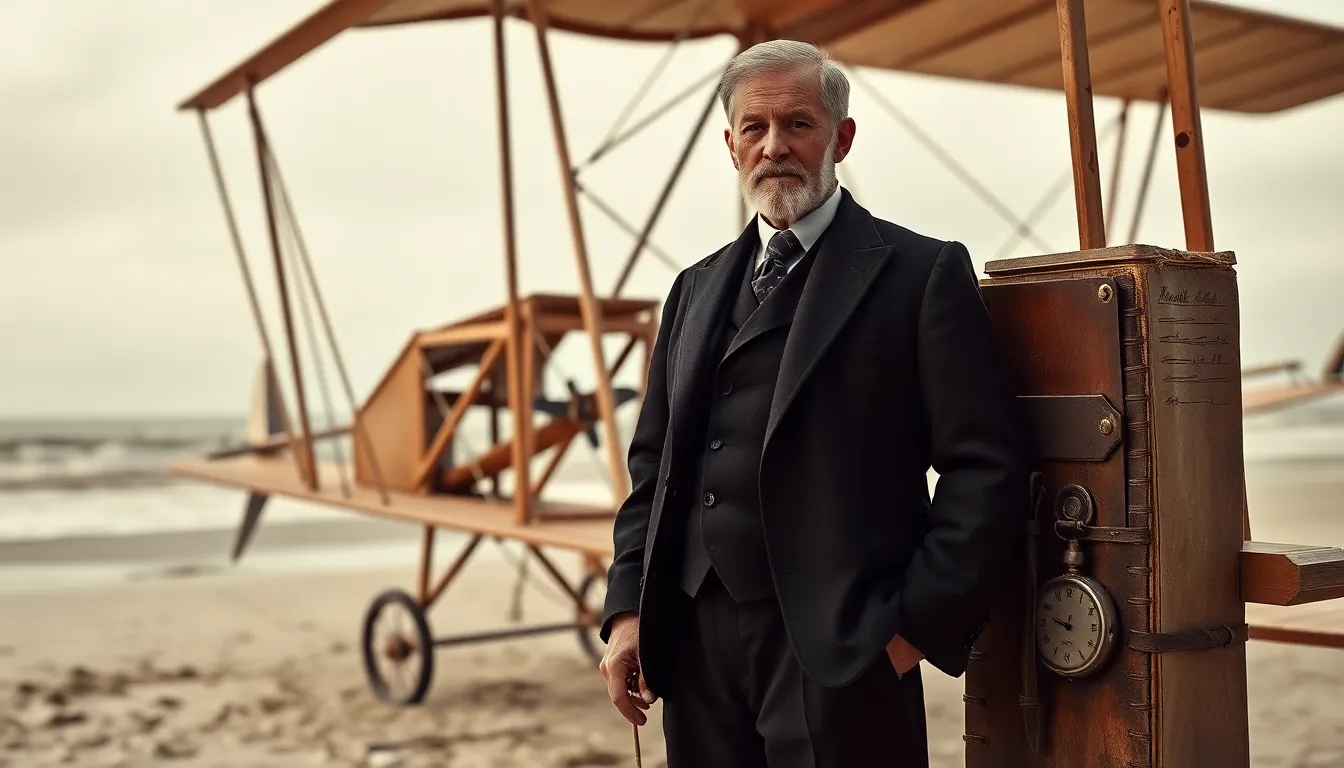
Historical Context
The late nineteenth and early twentieth centuries in the United States were marked by rapid industrialization, the expansion of railroads, and a cultural fascination with engineering marvels. The nation’s “Gilded Age” gave rise to inventors and entrepreneurs who believed that technology could reshape society. Within this climate, the promise of human flight was both a scientific frontier and a popular obsession, reflected in the many balloon experiments and glider attempts that proliferated after the Civil War. The Wright brothers entered this arena at a time when European pioneers such as Otto Lilienthal and Samuel Langley were also pursuing heavier‑than‑air flight, but none had yet succeeded in achieving controlled, sustained powered flight.
Early Life and Formation
Wilbur Wright was born on April 16, 1867, near Millville, Indiana, to Milton Wright, a Bishop of the United Brethren Church, and Susan Koerner Wright. The family moved several times during Wilbur’s childhood, ultimately settling in Dayton, Ohio, in 1878. The Wright household was intellectually vibrant; Milton’s library contained works on philosophy, theology, and natural science, while both parents encouraged curiosity and disciplined study. Wilbur and his younger brother Orville received a practical education through home‑based experiments, bicycle repair, and a robust apprenticeship in the Dayton printing trade.
Formal schooling was modest. Wilbur attended the local public school until age twelve, when family finances required him to begin work. He secured a position as a clerk at the Dayton Daily Journal, where he learned the mechanics of typesetting and honed his observational skills. In 1889, the brothers opened the Wright Cycle Company, a bicycle repair and sales shop that proved profitable and provided the financial base for their later aeronautical experiments. The brothers’ deep involvement in bicycle design gave them crucial insights into balance, control, and lightweight construction—principles they would later apply to aircraft.
Role in Major Events
Wilbur’s first documented aeronautical work appeared in 1899 when he and Orville began building gliders. Their approach differed from many contemporaries because they emphasized systematic data collection and wind‑tunnel testing, a method borrowed from scientific practice but rarely applied to flight at the time. In 1900, the brothers conducted a series of successful glider flights at Kitty Hawk, North Carolina, where the steady sea breezes allowed them to refine control surfaces.
In 1903, after a series of iterative designs, the Wright brothers built the Wright Flyer, a powered aircraft equipped with a 12‑horsepower gasoline engine they commissioned from the Huffman Prairie shop. On December 17, 1903, at Kill Devil Hills near Kitty Hawk, Wilbur piloted the first successful, controlled, sustained flight, covering 120 feet in 12 seconds. The brothers made three additional flights that day, with Orville piloting the longest, 852 feet in 59 seconds. Wilbur’s role as pilot for the historic first flight cemented his place in aviation history.
Following the 1903 flights, Wilbur dedicated himself to improving the Flyer’s stability and making the aircraft more practical. In 1904 and 1905, the brothers tested refined versions at Huffman Prairie, near Dayton, achieving longer flights, better handling, and the first demonstration of a practical turn. By the summer of 1908, Wilbil (sic) – sorry, Wilbur – was preparing for public demonstrations in Europe, though his untimely illness would prevent him from traveling abroad. Instead, Orville represented the brothers in France, performing flights that shocked the European press and secured patents and commercial interest.
Wilbur’s contributions extended beyond the laboratory. He corresponded with government officials, military officers, and scientific societies, advocating for the military potential of flight. His letter to the U.S. War Department in early 1908 outlined a vision for using aircraft for reconnaissance, a concept that would later become a cornerstone of modern warfare.
Allies, Opponents, and Debate
The Wright brothers faced a mixture of allies and opponents. Their most prominent ally was the Dayton engineering community, which supplied materials and technical assistance. Notably, the engineer Charles Taylor, a former bicycle shop employee, built the lightweight engine that powered the 1903 Flyer; Taylor’s craftsmanship was essential to the success of the aircraft.
Opposition emerged from several sources. The most publicized rivalry involved the Smithsonian Institution, whose chief curator, Samuel Langley, had previously claimed that his own aeronautical designs were superior. After the Wright brothers’ 1908 demonstrations in France, the Smithsonian initially refused to recognize the Wrights’ achievement, an omission that fostered a decades‑long controversy resolved only after 1942 when the Smithsonian formally acknowledged the Wrights’ primacy.
Other contemporary critics, such as the French aviation pioneer Alberto Santos‑Dumont, questioned the Wrights’ claim of “first flight,” arguing that their flights were “later than” those achieved in Europe. Modern scholars, however, consider the evidence from both the Wrights’ extensive contemporary documentation and the physical remains of the 1903 Flyer to decisively support the Wright brothers’ precedence.
Wilbur himself was not a public figure; he preferred to work behind the scenes. His modesty contributed to the relative scarcity of personal anecdotes, and some biographers note a lack of personal correspondence, which makes reconstructing his inner life challenging. This scarcity has led to occasional speculation about his motivations, ranging from pure scientific curiosity to a desire for financial security.
Legacy and Interpretation
Wilbur Wright died on May 30, 1912, at the age of 45, from typhoid fever contracted during a trip to New York City. His untimely death precluded his direct involvement in the later commercial expansion of aviation, but his technical innovations—particularly three‑axis control—remain foundational to modern aircraft design. The Wright brothers’ enterprise, the Wright Company, continued under Orville’s leadership until its merger in 1916. The company’s patents generated modest royalties, and estimates of Wilbur’s personal net worth at death range from $300,000 to $500,000 (equivalent to roughly $8‑13 million today), though exact figures are uncertain because the brothers kept their finances private.
In the century following his death, Wilbur’s reputation has evolved from that of an obscure mechanic to a celebrated national hero. He is commemorated on the United States’ fifty‑cent coin (1998‑1999 series) and has numerous schools, streets, and airports named in his honor. Academic scholarship continues to reassess the Wright brothers’ methodology, highlighting their rigorous use of empirical testing as a model for engineering research.
Contemporary historians also emphasize the collaborative nature of Wilbur’s achievements. While the public often pairs his name with Orville’s, recent studies argue that Wilbur’s early theoretical work—particularly on wind‑tunnel testing and the mathematics of control—was decisive in turning the brothers’ experiments into a reproducible engineering process.