Historical Context
David Crockett was born into a world still defined by colonial borders and frontier expansion. The American Revolutionary War had ended only a few years before his birth, and the new United States was rapidly extending its claim beyond the Appalachian Mountains. By the early 19th century, settlers, hunters, and traders were pressing into the lands of the Cherokee, Shawnee, and other Indigenous nations. The era saw the rise of the Jeffersonian vision of a ‘yeoman farmer’ and a growing national mythos around the rugged individualist who could tame the wilderness. This was also a period of intense political conflict between Federalists and Democratic‑Republicans, a debate that would shape Crockett’s later political career.
Early Life and Formation
David Crockett was born on August 17, 1786, in what is now Greene County, Tennessee, then part of the Southwest Territory of the United States. His parents, John and Mary (née “Crockett”) were of modest means; John was a farmer and a craftsman. Contemporary records, including the 1790 census, confirm the family’s residence on the frontier, but details about Crockett’s early education are scarce. He likely received only basic literacy instruction, common for children in remote settlements.
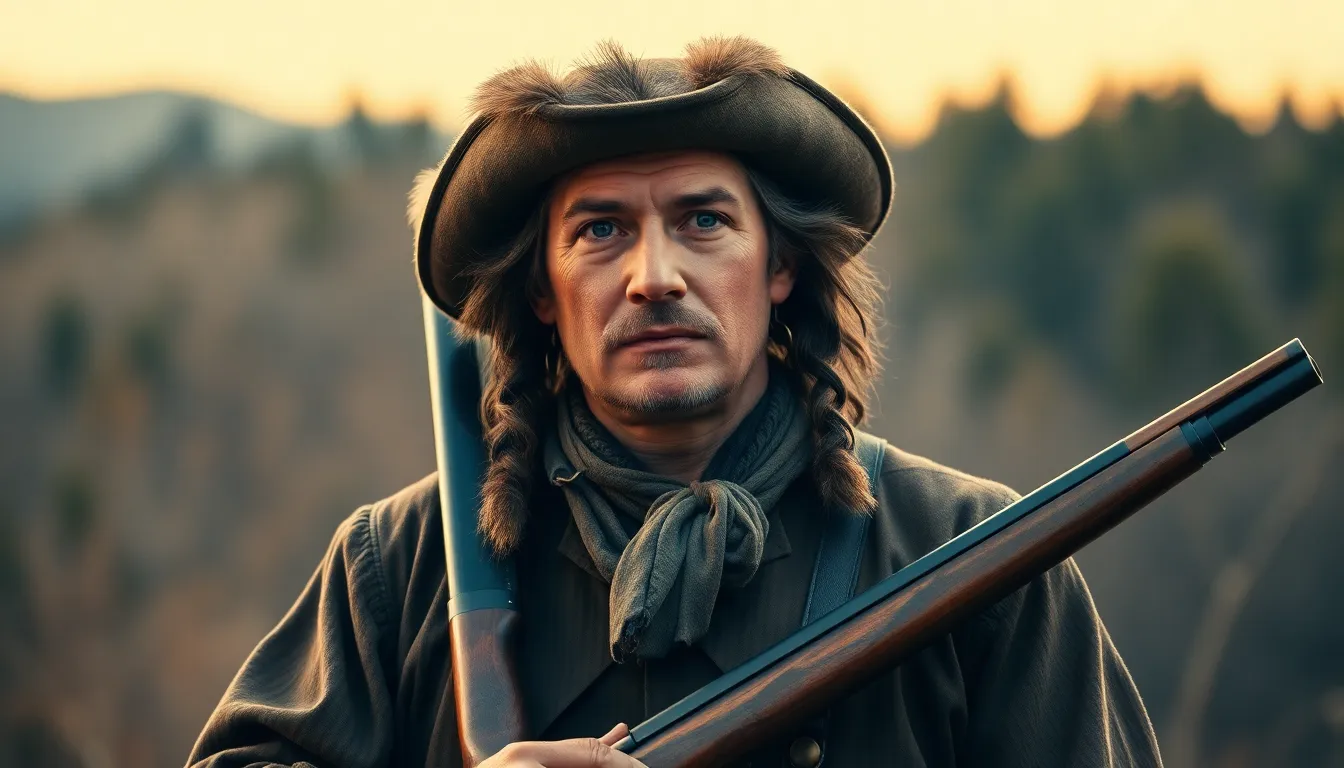
At the age of fourteen, Crockett left home to work as a hunter and trader with the Indian Trade Company. This apprenticeship gave him firsthand knowledge of the Appalachian and Cumberland Plateau environments, as well as extensive contact with Cherokee and other Indigenous peoples. These experiences cultivated his reputation as an adept woodsman and marked the beginning of the “frontier” persona that would dominate his public image.
Role in Major Events
By the early 1800s, Crockett had become a prominent figure in Tennessee’s militia. In 1813, during the War of 1812, he volunteered for service against the Creek Nation in the Battle of Talladega. Though official rosters list him as a private, Crockett claimed to have performed acts of bravery, a claim that is difficult to verify independently because contemporary muster rolls are incomplete.
Following the war, Crockett entered politics. In 1827, he was elected as a representative from Tennessee’s 9th district to the U.S. House of Representatives as a member of the Democratic‑Republican Party. His tenure was marked by opposition to the so‑called “Corrupt Bargain” of 1824 and a vocal stance against President Andrew Jackson’s Indian Removal Act of 1830. Crockett’s opposition was rooted in both personal connections with Cherokee leaders—most notably his friendship with Chief John Ross—and a broader ideological commitment to states’ rights. He famously declared, “I will support no law that punishes me for my honest opposition.”
Crockett lost his seat in 1830 after supporting the anti‑removal cause, but he returned to Congress in 1833. During his second term, he continued to argue against forced relocation, although his efforts failed to halt the policy’s implementation.
In 1835, lured by a growing national legend of the “frontier hero,” Crockett accepted an invitation from the Texas provisional government to aid in its struggle for independence from Mexico. He traveled to San Antonio with a modest group of volunteers, arriving in early 1836. On March 6, 1836, Crockett perished in the Battle of the Alamo, a pivotal siege that became a rallying point for Texas independence. His death cemented his status as a martyr‑hero in American folklore, though the precise circumstances of his final moments are subject to varying eyewitness accounts.
Allies, Opponents, and Debate
Crockett’s allies included fellow frontiersmen such as James Fannin and William B. Travis, who shared his belief in the “freedom of the frontier”. Within Congress, he found a sympathetic cohort among anti‑Jacksonians and those who opposed the Indian Removal Act, notably John Quincy Adams and Henry Clay. However, his outspoken criticism of President Jackson made him a target for political opponents who labeled him a “populist demagogue”. Jackson himself considered Crockett’s defiance a personal affront, and political diaries from the era record that Jackson used his influence to block Crockett’s re‑election bids.
The debate over Crockett’s legacy is complicated by the myth-making that followed his death. 19th‑century dime novels, illustrated lithographs, and folk songs portrayed him as a larger‑than‑life figure—”the King of the Wild Frontier”—often embellishing or fabricating events such as his alleged one‑man duel with a British officer at the Alamo. Modern historians, including James M. McCavitt and Ted R. Proctor, caution that these legends obscure the more nuanced reality of a politician who sometimes compromised his ideals for electoral success.
Legacy and Interpretation
In the immediate aftermath of the Alamo, Crockett’s death was used by Texan and American propagandists to galvanize support for the Republic of Texas. Monuments to Crockett were erected in Nashville (1849) and San Antonio (1901), reflecting a nineteenth‑century desire to celebrate frontier masculinity.
During the twentieth century, Crockett’s image was co‑opted by popular culture. The 1936 Walt Disney film “Davy Crockett” and the accompanying Disneyland attraction turned him into a household name, further solidifying the mythic narrative of the humble frontiersman. However, academic scholarship has increasingly re‑examined his role in the displacement of Native peoples, his participation in slave‑holding societies, and the contradictions between his frontiersman image and his political opportunism.
Contemporary historiography tends to view Crockett as a complex figure: a skilled hunter and charismatic storyteller who leveraged his frontier reputation for political capital, but who also demonstrated genuine, if limited, resistance to the era’s most oppressive policies. His life illustrates the tensions between personal agency, myth‑making, and the broader forces of American expansion.