Historical Context
In the late fifteenth and early sixteenth centuries, European powers were driven by the search for new trade routes to the lucrative spice markets of Asia. The Age of Discovery, spurred by advances in navigation, shipbuilding, and cartography, saw Portugal and Spain vie for maritime supremacy after the 1494 Treaty of Tordesillas divided the world’s unknown lands between them. Portugal, under King Manuel I, had already pioneered a route around Africa to India, while Spain, led by monarchs Ferdinand and Isabella, sought alternate passages to the East. The Iberian rivalry created a climate in which ambitious, court‑educated captains could secure royal patronage for daring expeditions, offering both wealth and prestige.
Early Life and Formation
Fernão de Magalhães was born around 1480 in Sabrosa, a small town in the Kingdom of Portugal. Precise details of his birth are scarce; contemporary Portuguese records do not list an exact date, and later historians rely on indirect evidence from Magellan’s own testimony and the documentation of his family’s nobility. He descended from a minor noble family, the Magalhães, who owned modest estates in the Trás‑os‑Montes region. The family’s status allowed young Fernão to receive a basic education, likely at a local ecclesiastical school, where he would have learned Latin, arithmetic, and the rudiments of navigation.
Around 1499, Magellan entered the service of King Manuel I as a page and soon became a squire in the royal household. His early exposure to the court’s military and diplomatic circles facilitated his entry into the Order of Christ, a successor to the medieval Knights Templar, which was instrumental in financing Portuguese explorations. He participated in several campaigns against the Mamluks in North Africa (the Battle of Oran, 1509) and later served on a fleet bound for India under the famous Viceroy Dom Afonso de Albuquerque.
A pivotal formative episode occurred during his service aboard the Portuguese carrack *São Gabriel* in 1511, when the fleet engaged in the Battle of Karkardá, capturing the strategic city of Malacca. Magellan’s experience in long‑distance navigation, exposure to Portuguese navigational charts, and contacts with seasoned pilots such as João de Lisboa laid the technical foundation for his later command of a multinational fleet.
Role in Major Events
After returning to Portugal, Magellan fell out of royal favor due in part to a dispute with the influential Minister‑General of the Order of Christ, Dom Rui de Mello. In 1517 he petitioned King Charles I of Spain (later Holy Roman Emperor Charles V) for sponsorship, arguing that Spain could find a western route to the Spice Islands that circumvented the Portuguese monopoly established by the Treaty of Tordesillas.
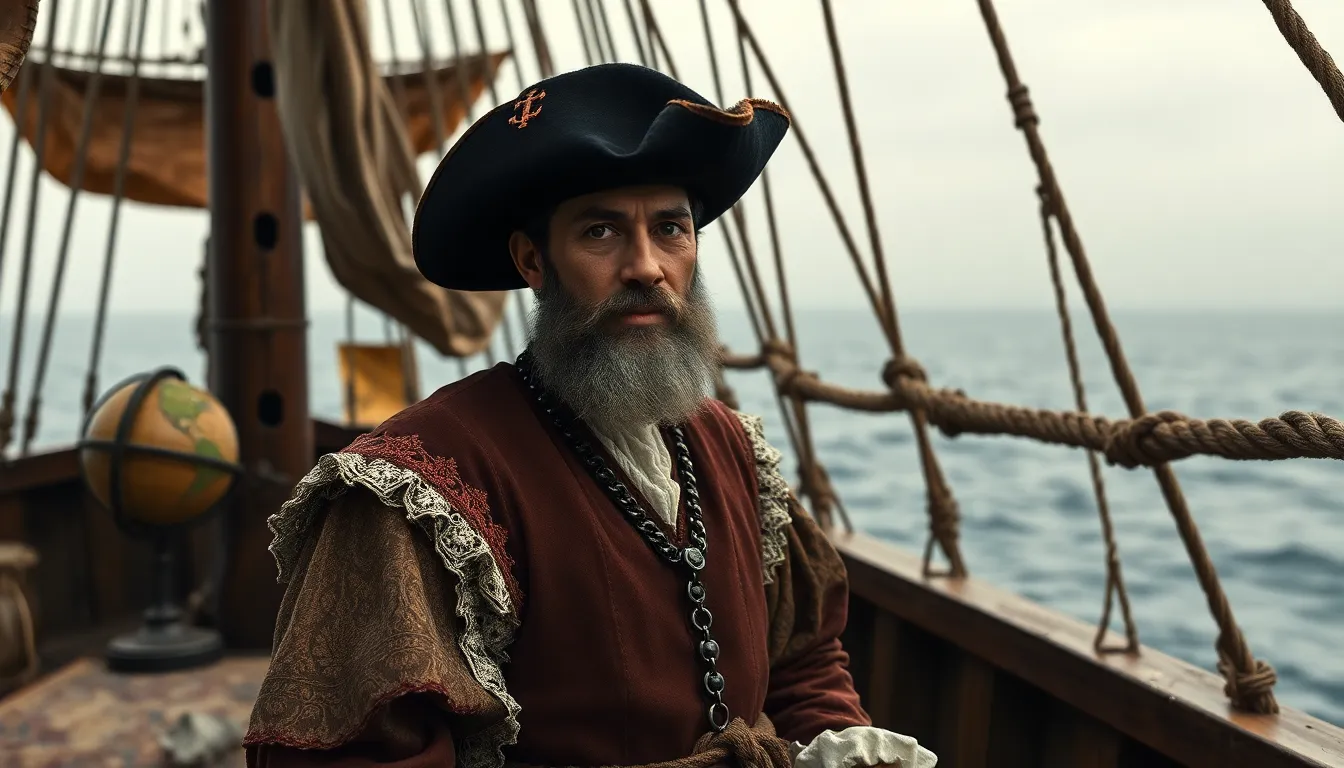
In 1519, after protracted negotiations, Charles I granted Magellan a *capa e espada* (cap and sword) and a royal charter (the *capitulación*) authorising a fleet of five ships—*Trinidad*, *San Antonio*, *Concepción*, *Victoria*, and *Santiago*—and a crew of roughly 270 men. The expedition set sail from Seville on 20 September 1519, aiming to reach the Moluccas (the modern Maluku Islands) by sailing westward across the Atlantic, navigating the yet‑unexplored southern tip of the Americas, and then crossing the Pacific.
During the Atlantic crossing, Magellan’s fleet encountered a severe storm that scattered the ships; two vessels, the *Santiago* and the *San Antonio*, turned back, leaving a core group of three ships. Magellan then entered the Río de la Plata and navigated northwest along the coast of modern Argentina and Chile. In November 1520, after months of arduous sailing, the fleet discovered a navigable passage through the jagged terrain of southern South America—today known as the Strait of Magellan. The strait stretched over 350 miles and proved a critical, albeit challenging, route to the Pacific.
Emerging into the vast Pacific in December 1520, the expedition faced unprecedented hardships. The ships endured a three‑month crossing with scant provisions; scurvy, starvation, and mutiny threatened the venture. A notorious mutiny in April 1521 saw the ship’s officers—including the Spanish captains Luis de Mendoza and Gaspar de Quevedo—attempt to seize command. Magellan quelled the revolt decisively, executing the ringleaders and imposing strict discipline.
Reaching the Philippines in March 1521, Magellan forged an alliance with the local ruler Rajah Humabon of Cebu, converting him to Christianity. However, later that month, during an attempt to subdue the island of Mactan, Magellan was killed in battle on 27 April 1521. His death left the expedition without its chief commander; command eventually passed to the Spanish sailor Juan Sebastián Elcano, who completed the circumnavigation by returning to Spain aboard the *Victoria* on 6 September 1522.
The expedition’s return delivered the first unequivocal proof that the Earth could be circumnavigated by sea, shattering contemporary geographic assumptions and opening a new era of global trade. Although only one ship survived and most of the crew perished, the voyage proved the viability of a western route to the Spice Islands, albeit a longer and more costly one than the Portuguese Indian Ocean route.
Allies, Opponents, and Debate
Magellan’s career was marked by shifting alliances and enduring rivalries. Early on, his allegiance to the Portuguese crown afforded him patronage and access to seasoned pilots. However, his later break with King Manuel I created a personal antagonist in the Portuguese court, which branded him a traitor. The Spanish monarchy, motivated by geopolitical competition with Portugal, welcomed Magellan’s proposal, yet internal Spanish rivalries manifested in the mutinous officers who opposed his command.
The *capitulación* itself reflected the political compromise: while Magellan received a modest share of any spoils, the Spanish Crown retained the majority of profits, thereby limiting the personal wealth that could accrue to the explorer. Consequently, speculation about Magellan’s net worth remains inconclusive; contemporary financial records do not disclose a substantial personal fortune. Some historians argue that, had the expedition succeeded commercially—bringing back a cargo of cloves and nutmeg—Magellan might have enjoyed considerable wealth, but the loss of most of the fleet and cargo precluded this outcome.
Contemporary chroniclers such as Antonio Pigafetta, a Venetian scholar who accompanied the voyage, provide a primary source for Magellan’s character. Pigafetta portrays Magellan as determined, religiously devout, and often austere, but also as a capable commander who could inspire loyalty. However, later Spanish and Portuguese historiography displayed diverging interpretations: Portuguese narratives emphasized his betrayal, casting him as a despised rogue, whereas Spanish accounts glorified his bravery and depicted his death as martyrdom for the faith.
Modern scholarship debates several aspects of Magellan’s expedition. The exact location of the southern terminus of the strait—whether the strait was fully understood at the time—remains contested. Some scholars argue that Magellan’s navigation through the strait was serendipitous and relied heavily on indigenous knowledge, while others credit Portuguese cartographic tradition for preparing the expedition to anticipate such a passage. Additionally, the moral dimension of his interactions with indigenous peoples, particularly the forced conversion of Cebu’s ruler, is re‑examined in post‑colonial studies, highlighting the complex interplay of evangelisation, coercion, and alliance‑building.
The question of Magellan’s religious motivations also fuels debate. While he was a devout Catholic and sought papal approval for the expedition, some historians suggest that his primary drive was personal advancement and retribution against Portuguese slights rather than pure missionary zeal. The balance between these motivations remains a nuanced and contested scholarly topic.
Legacy and Interpretation
Magellan’s immediate legacy was the proof of a navigable western passage to the East Indies, albeit one that proved far less profitable than the Portuguese route. The Spanish Crown, dissatisfied with the long and costly voyage, did not immediately launch comparable expeditions; instead, they focused on consolidating their holdings in the Americas.
In the long term, Magellan’s circumnavigation reshaped European conceptions of world geography. By confirming the globe’s continuity, it encouraged subsequent explorers to pursue alternative passages, eventually culminating in the establishment of the Manila‑Acapulco Galleon Trade, which linked Asia with the New World via the Pacific.
Magellan’s name entered the geographical lexicon through the eponymous strait, which remained a crucial, albeit treacherous, maritime corridor until the opening of the Panama Canal in 1914. His expedition’s logbooks, especially Pigafetta’s narrative, became foundational texts for the study of early modern exploration, influencing cartographers such as Gerardus Mercator.
Culturally, Magellan has been remembered variably as a hero, a traitor, and a colonial aggressor. In Portugal, 20th‑century nationalist historiography often portrayed him as a renegade who betrayed his native country. In Spain, he is celebrated as a pioneer of the empire’s “global” ambition, featuring in curricula and monuments, such as the statue in Seville’s Plaza de América.
Contemporary scholarship adopts a more balanced view, acknowledging his navigational skill and the expedition’s scientific contributions while critically assessing the imperialist and violent aspects of his encounters with indigenous societies. The historiographical trend emphasizes the multinational character of the crew, the role of indigenous allies, and the broader geopolitical context of Iberian rivalry.
Magellan’s personal life remains largely undocumented. He married Beatriz de Quintanilha in 1510, but the marriage produced no recorded children. The lack of personal correspondence and the loss of many primary documents limit knowledge of his private affairs, wealth, and daily life. Consequently, attempts to calculate a precise net worth are speculative; historians agree that any such figure would be conjectural.
Overall, Ferdinand Magellan stands as a complex figure whose daring voyage altered the course of global history, while his personal motivations and the ethical dimensions of his actions continue to provoke scholarly discussion.