Education and Scientific Formation
Maria Skłodowska was born on 7 November 1867 in Warsaw, then part of the Russian‑controlled Kingdom of Poland. Her parents, Bronisława (Boguł) Skłodowska and Władysław Skłodowski, valued education despite the restrictions placed on Poles by the Russian authorities. Marie received her earliest schooling at the clandestine “Flying University,” an underground institution that offered advanced scientific instruction to women who were barred from formal universities.
In 1891, at the age of 24, she moved to Paris to continue her studies at the Sorbonne (University of Paris). There she enrolled in the Faculty of Science, earning a licentiate in physics in 1893 and a licentiate in mathematics in 1894. Her professors included eminent scientists such as Pierre Curie (who would later become her husband), Gabriel Lippmann, and Henri Becquerel, the discoverer of natural radioactivity. The rigorous training she received at the Sorbonne, combined with her fluency in several languages, laid the foundation for her later breakthroughs.
During this period, Curie was deeply influenced by the work of Wilhelm Röntgen, whose discovery of X‑rays in 1895 demonstrated the existence of invisible, penetrating radiation. Curie’s curiosity about the nature of matter and energy propelled her toward the emerging field of radioactivity, a term she herself would later coin.
Research Career
After completing her studies, Curie secured a position as a laboratory assistant to Pierre Curie at the School of Physics and Chemistry in Paris. Their collaboration quickly became a partnership both scientific and personal. In 1895 they married, and the couple began systematic investigations into the mysterious rays emitted by uranium salts.
In 1896, the Curies established a modest laboratory in a small, poorly ventilated apartment on Rue de La Tour, funded largely by Marie’s modest stipend and Pierre’s salary. Despite limited resources, they devised innovative experimental setups, including a custom‑made electrometer and a highly sensitive photographic plate system to measure radiation intensity.
Their research attracted the attention of the French Academy of Sciences, and in 1900 they were appointed to the Laboratory of Physics at the University of Paris (now the Institut du Radium). Marie Curie continued to rise through the academic ranks, becoming the first woman to obtain a doctorate in France (1903) and later the first female professor at the Sorbonne (1906), where she succeeded Pierre after his untimely death in 1906.
Discoveries, Inventions, and Methods
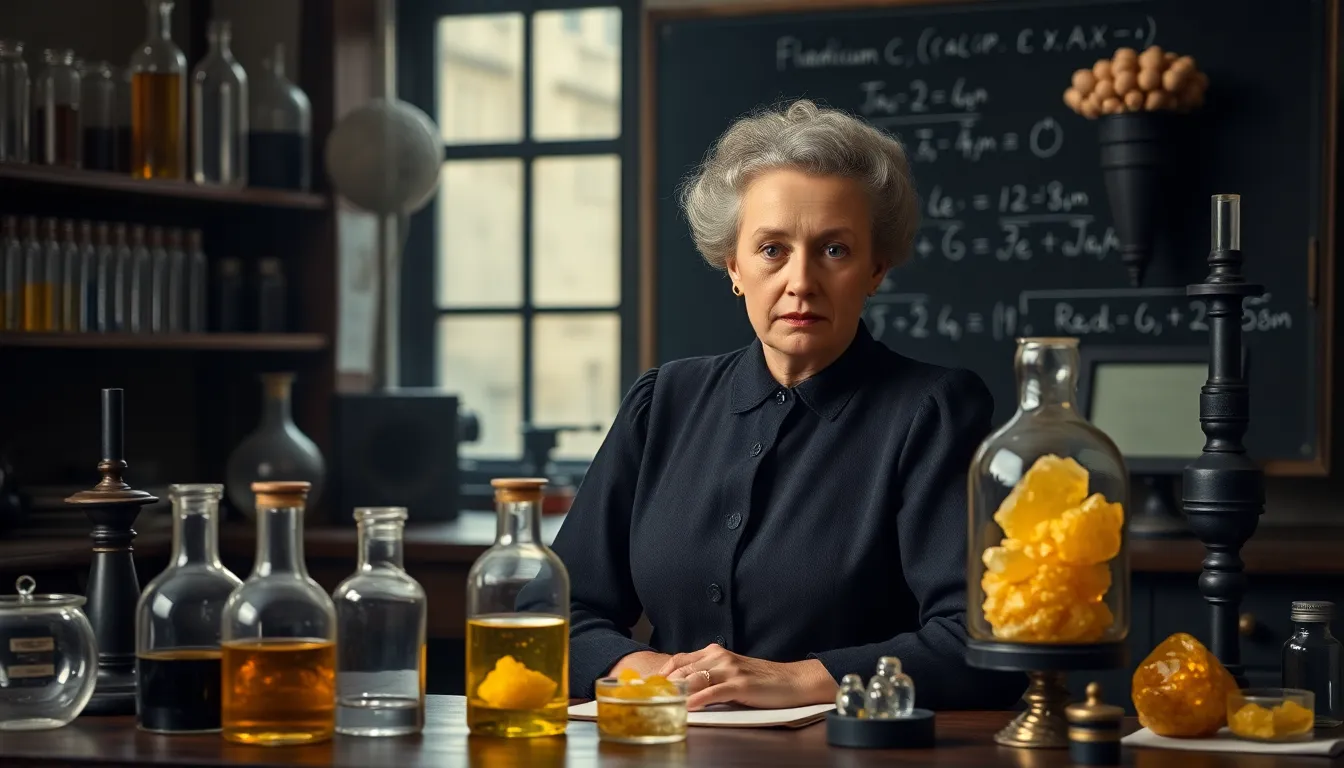
The Curies’ most celebrated achievement was the isolation of two new radioactive elements, polonium (named after Marie’s native Poland) and radium, from tons of pitchblende (uranium ore). Through painstaking fractional crystallization, they separated these elements in a series of iterative steps that required processing more than 30 kilograms of ore to obtain a few grams of radium chloride.
In 1898, their work confirmed that radioactivity was a property of the atom itself, a radical departure from the prevailing view that atoms were indivisible. This insight laid the groundwork for modern nuclear physics and chemistry.
Marie Curie also developed the concept of the curie (Ci), a unit of radioactivity still used today, based on the activity of one gram of radium. Her methodological innovations included the use of a new type of electrometer (the “Curies’ electrometer”) and the systematic application of quantitative measurements to what had previously been a qualitative field.
Publications, Recognition, and Debate
Curie’s research was disseminated through numerous papers in leading scientific journals. Notable publications include:
- “Research on Radioactive Substances” (Comptes Rendus, 1898) – reporting the discovery of polonium and radium.
- “The Radio-Active Substances” (Treatise, 1910) – a comprehensive monograph summarizing two decades of work.
In 1903, Marie and Pierre Curie shared the Nobel Prize in Physics with Henri Becquerel for their combined work on radioactivity. This made Marie the first woman to receive a Nobel Prize. In 1911, she received a second Nobel Prize, this time in Chemistry, for her services to the advancement of chemistry by the discovery of the elements radium and polonium, and for the isolation of radium.
Her accolades also included the French Legion of Honour (Chevalier in 1908, Officer in 1911) and the Davy Medal from the Royal Society (1905). Despite these honors, Curie faced gender‑based criticism and rumors, especially after the 1911 scandal concerning her alleged affair with physicist Paul Langevin. The public debate surrounding her personal life was exacerbated by sensationalist press coverage, yet she maintained her scientific stature.
Impact on the Field
Curie’s work fundamentally transformed scientific understanding of atomic structure and energy. The discovery of radioactive elements paved the way for the development of X‑ray imaging, radiation therapy for cancer, and eventually nuclear power. During World War I, Curie organized mobile radiography units—known as “petite Curies”—and trained hundreds of women to operate X‑ray equipment, directly saving countless lives on the battlefield.
Her establishment of the Radium Institute (Institut du Radium) in 1914 created a dedicated research hub that attracted a generation of physicists and chemists, including future Nobel laureates. The institute’s archives still contain samples and equipment from Curie’s original experiments, serving as a testament to her meticulous methodology.
Beyond tangible scientific outcomes, Curie’s career shattered gender barriers in academia. She became a role model for women in science, and her legacy endures in educational curricula worldwide.
Personal Life, Age, and Net Worth
Marie Curie married Pierre Curie on 26 July 1895. The couple had two daughters, Irène (1897–1956) and Ève (1904–1956). Irène followed in her mother’s footsteps, earning a Nobel Prize in Chemistry in 1935, making the Curies the only family to have three Nobel laureates.
Marie Curie died on 4 July 1934 from aplastic anemia, a condition now recognized as resulting from prolonged exposure to ionizing radiation. At the time of her death she was 66 years old.
Estimating Curie’s net worth is challenging because she never amassed personal wealth; her scientific work was publicly funded, and she renounced any commercial exploitation of her discoveries. Contemporary historians suggest that, adjusted for inflation, her modest earnings from teaching and research would be equivalent to roughly US $50,000–$100,000 today—a figure far below the economic value of the radium patents she could have claimed, which she deliberately refused to patent.
Legacy
Marie Curie’s contributions persist in modern science, medicine, and culture. The Curie National Museum in Paris preserves her laboratory artifacts, while the International Year of the Woman in Science (2023) highlighted her achievements. The SI unit for absorbed dose, the gray (Gy), and the former unit ‘curie’ both honor her impact. Her name continues to inspire scholars, as evidenced by institutions such as the Curie Institute (Paris) and the Marie Skłodowska‑Curie Actions of the European Commission, which fund scientific mobility across Europe.