Education and Scientific Formation
Aristotle was born in 384 BC in Stagira, a coastal town in the Macedonian kingdom (modern northern Greece). His father, Nicomachus, served as court physician to King Amyntas III, giving Aristotle early exposure to practical medicine and natural observation. At the age of seventeen, he moved to Athens to study at Plato’s Academy, where he remained for about twenty years. Although the Academy emphasized dialectic and metaphysics, Aristotle distinguished himself by insisting on empirical observation and systematic classification, an approach that later defined his scientific method.
Under Plato, Aristotle studied logic, epistemology, and the theory of forms, yet he grew increasingly critical of Platonic idealism. He was particularly influenced by the Academy’s library, which housed works on mathematics, astronomy, and early biological treatises. His formative mentors included Plato himself and later, the mathematician Eudoxus of Cnidus, from whom Aristotle absorbed sophisticated geometric models of the heavens. These experiences forged a dual curiosity: a philosophical quest for first principles and a practical desire to catalog the material world.
Research Career
After Plato’s death in 347 BC, Aristotle left Athens and spent several years traveling. He was invited by King Philip II of Macedon to serve as tutor to the future Alexander the Great, a position he held from 343 BC to 335 BC. While in the Macedonian court, Aristotle continued his investigations, compiling notes on zoology, physiology, and the natural environment of the Balkans. His access to royal resources enabled him to assemble a modest laboratory and a menagerie of animals, which later informed his seminal biological works.
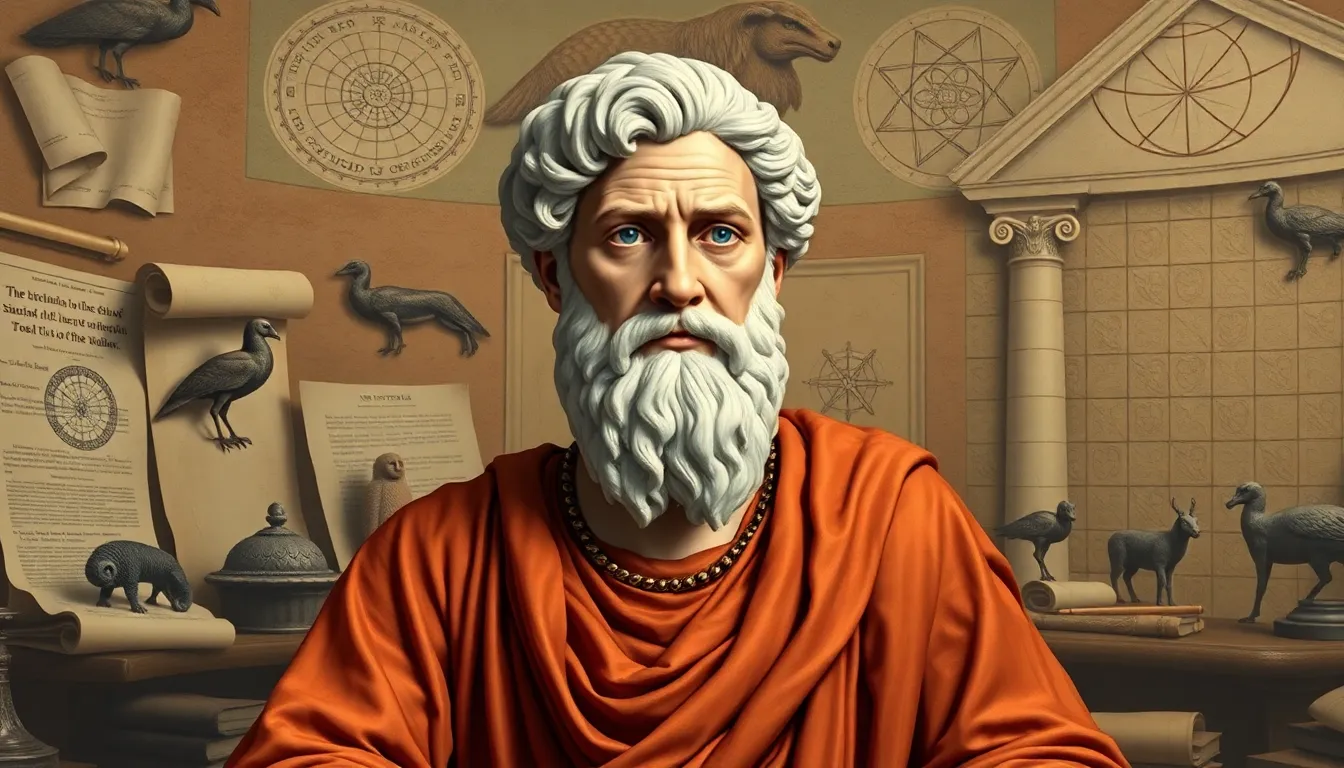
In 335 BC, Aristotle returned to Athens and founded his own school, the Peripatetic School or Lyceum, named after the covered walkways where he and his students conducted discussions. The Lyceum functioned as both a philosophical academy and an early research institute. Aristotle organized a library that grew to contain thousands of scrolls, acquired through purchases, gifts, and the collection of works from declining institutions. He appointed a team of scholars, including Theophrastus (his eventual successor), Eudemus, and Demetrius of Phalerum, to assist in data collection, transcription, and experimental demonstrations. Field excursions were routine; Aristotle’s students systematically gathered specimens of marine life, insects, and plants from the Aegean coast, providing a comparative basis for his biological classifications.
Discoveries, Inventions, and Methods
Aristotle’s scientific output spanned a remarkable range of topics. In biology, he produced the first known systematic classification of animals, distinguishing between “blooded” (vertebrates) and “bloodless” (invertebrates) groups, and further subdividing them by habitat, mode of reproduction, and anatomical features. His observations on embryology, such as the development of the chick in the egg, were recorded in the Historia Animalium and Parts of Animals. While many of his specific conclusions (e.g., that spontaneous generation occurs) were later disproved, his methodological emphasis on direct observation, dissection, and comparative anatomy set a lasting precedent.
In physics, Aristotle formulated theories about motion, causality, and the elements. He introduced the four‑element theory (earth, water, air, fire) and the concept of natural place, asserting that heavy objects fall because they seek their natural position toward the earth’s centre. Though later superseded by Archimedes and Newton, these ideas dominated scientific thought for over a millennium. In metaphysics, his doctrine of the “unmoved mover” presented a teleological explanation for cosmic order, influencing both medieval Islamic and Christian scholasticism.
Aristotle also contributed to logic, devising the syllogistic system that formalized deductive reasoning. His Organon comprised six treatises that codified logical forms still studied today. While not an invention in the modern engineering sense, his logical apparatus functioned as a foundational tool for scientific argumentation, allowing subsequent scholars to evaluate hypotheses with rigor.
Publications, Recognition, and Debate
Aristotle’s corpus originally consisted of around 200 treatises, of which about 30 survive in complete or fragmentary form. The most influential among them include Physics, Metaphysics, Nicomachean Ethics, Politics, On the Soul (De Anima), and his biological works mentioned above. These texts were disseminated throughout the Hellenistic world via copies made in the Library of Alexandria and later in the Roman imperial libraries.
During his lifetime, Aristotle enjoyed substantial prestige in Athens and the broader Macedonian realm, receiving patronage from both King Philip II and later Alexander. However, his philosophical rivalry with the Academy persisted; Plato’s followers criticized his empirical focus as a departure from the pure forms. After his death, the Lyceum continued under Theophrastus, preserving his manuscripts. In the Roman period, Aristotle’s works were translated into Latin by Boethius and later into Arabic by scholars such as Al‑Kindi and Avicenna, establishing him as a central authority in both Eastern and Western intellectual traditions.
In the medieval era, Aristotle’s authority was both championed and contested. Christian theologians, notably Thomas Aquinas, integrated Aristotelian philosophy with Christian doctrine, whereas others, like the 12th‑century Condemnations of 1210–1277, temporarily banned certain Aristotelian propositions deemed incompatible with theological teachings. The scientific revolution gradually eroded Aristotelian physics, yet his logical treatises remained indispensable.
Impact on the Field
Aristotle’s influence is unparalleled in the history of Western science. His empirical methodology prefigured the systematic observation that characterizes modern biology. By cataloguing over 500 animal species and describing their anatomy, behavior, and habitats, he established a comparative framework that centuries later would be refined by Linnaeus and Darwin. In logic, his syllogistic system underpinned the development of formal reasoning, informing medieval scholasticism and the later evolution of symbolic logic.
Aristotle’s metaphysical and ethical works shaped philosophical discourse well beyond the scientific domain, affecting political theory, education, and the philosophy of science. The notion of “teleology”—explaining phenomena by their purpose—remained a guiding principle in biology until the advent of mechanistic explanations in the 19th century. Moreover, his emphasis on the unity of knowledge—a single, rational order underlying both natural and moral realms—continues to inspire interdisciplinary approaches in contemporary research.
While Aristotle did not leave behind patents or inventions in the modern sense, his legacy as a systematic investigator and educator qualifies him as a pioneering figure in the scientific enterprise. His model of an organized research community, the Lyceum, anticipates modern universities and research institutes. The enduring relevance of his works in philosophy of science, ethics of research, and comparative biology attests to his lasting impact on the intellectual foundations of multiple disciplines.