Early Life and Creative Formation
Walter Elias Disney was born on December 5, 1901, in Chicago, Illinois, to Elias Disney, an Irish‑American carpenter, and Flora Call, a Canadian‑American household worker. The Disney family moved to Marceline, Missouri, in 1906, where the rural environment and the town’s small‑scale entertainment—particularly traveling vaudeville shows—left an early imprint on young Walt’s imagination. He later recalled Marceline as “the happiest place on earth” and credited its community theater and the surrounding farmland for fostering his storytelling instincts.
After a brief stay in Kansas City, his family settled in Chicago again, where Walt attended public schools and first encountered motion‑picture exhibitions. In 1917, at the age of sixteen, he left high school to enlist in the Red Cross Ambulance Corps during World War I, an experience that exposed him to mechanical devices and disciplined teamwork. Upon his return, Disney enrolled at the Kansas City Art Institute, studying commercial art, drawing, and photography. He worked as a newspaper cartoonist for the Kansas City Star and took night classes at the Chicago Academy of Fine Arts, honing a rapid‑sketch style that would later become essential for storyboard development.
In 1922, Disney secured a position as a commercial artist at the Pesmen-Rubin Art Studio in Kansas City, where he met Ub Iwerks, a fellow animator with a talent for fluid motion. The two formed a partnership that produced a series of short animated advertisements for local businesses, marking Disney’s first professional forays into animation. Their work on the Alice Comedies—a hybrid of live‑action and animation—caught the attention of silent‑film producer Margaret J. Winkler, who offered a distribution contract that led Disney to Hollywood in 1923.
Medium, Style, and Vision
Disney’s early animations were crafted using hand‑drawn cel animation, a labor‑intensive process in which each frame was painted on transparent celluloid sheets. He refined this technique by introducing the “rubber‐hose” style, characterised by fluid, elastic limbs and simplified anatomy, allowing characters such as Oswald the Lucky Rabbit to move with unprecedented flexibility. This aesthetic was rooted in the visual language of vaudeville slapstick and comic strips, emphasizing exaggerated motion over realistic anatomy.
Throughout the 1930s, Disney pursued a philosophy of “entertainment for the whole family,” seeking to elevate animation from novelty to narrative art. He invested heavily in technological innovation, most notably developing the multiplane camera in 1937. This apparatus enabled layered backgrounds to move at different speeds, creating a sense of depth that revolutionised storytelling in Snow White and the Seven Dwarfs, the first full‑length animated feature film. Disney’s visual style evolved toward greater realism, employing meticulous research and reference photography to render naturalistic environments and nuanced character expressions.

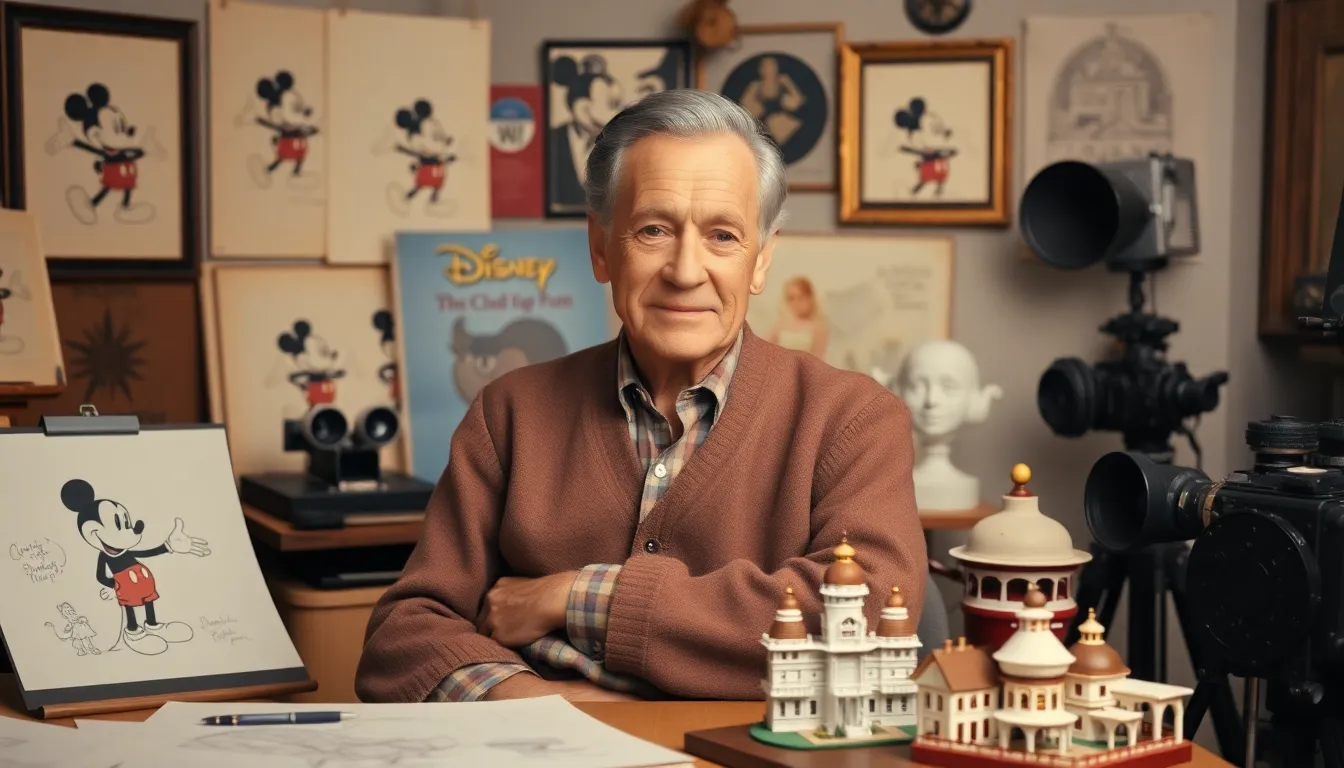
Beyond animation, Disney’s creative vision expanded into themed environments. The design of Disneyland (opened 1955) manifested his belief that “the world should be structured for happiness.” The park’s concept of immersive, narrative‑driven lands derived from his studio’s storyboard practices, translating cinematic sequencing into physical spaces. This interdisciplinary approach blended architecture, industrial design, and theatrical set design, establishing a new paradigm for experiential entertainment.
Major Works and Breakthroughs
The Disney studio’s catalogue includes several landmark works that redefined the medium. Snow White and the Seven Dwarfs (1937) was a commercial risk, costing $1.5 million—equivalent to over $30 million today—and became the highest‑grossing film of its era, recouping its budget within a year. Its success spawned a series of feature films: Pinocchio (1940), Dumbo (1941), and Bambi (1942), each pushing technical boundaries in color, sound, and narrative depth.
During World War II, Disney produced propaganda and training films for the U.S. government, including the beloved Der Fuehrer’s Face (1943), which won an Academy Award for Best Animated Short. Post‑war, the studio embraced television, launching the Mickey Mouse Club (1955) and the anthology series Disneyland (1954), which served as both entertainment and promotional platform for upcoming films and theme park projects.
Disney’s foray into theme‑park design culminated in Disneyland, a 100‑acre park in Anaheim, California, which introduced concepts such as “forced perspective,” “audio‑animatronics,” and meticulously themed lands. The park’s success led to the development of Walt Disney World (opened 1971, after his death) and subsequent international resorts, cementing the Disney brand as a global cultural force.
Collaborations, Movements, and Reception
Collaboration was central to Disney’s methodology. Ub Iwerks remained Disney’s chief technical collaborator, inventing the first synchronized sound cartoon, Steamboat Willie (1928), which introduced Mickey Mouse. The studio’s nurturing of talent produced future luminaries such as animator Frank Thomas, animator and author Ollie Johnston, and producer/writer Bill Walsh. Disney’s partnership with composer Leigh Harline, songwriter the Sherman Brothers, and visual artist Mary Blair infused his films with distinctive musical and color palettes.
Disney’s work intersected with broader artistic movements, most notably American modernism and the emerging field of visual storytelling. While some critics dismissed early Disney cartoons as low‑brow entertainment, others, such as film scholar James D. Boggs, recognised them as pioneering achievements in narrative integration and mass‑media aesthetics. The Academy of Motion Picture Arts and Sciences honoured Disney with 22 Oscars—fourteen honorary or special awards and eight competitive wins—underscoring both industry admiration and the novelty of his technical contributions.
The studio faced controversies, including labor disputes in 1941 (the Disney animators’ strike) and criticism over cultural representation in films like Song of the South (1946). These issues spurred discussions about corporate power, artistic responsibility, and the portrayal of race in American media. Nonetheless, Disney’s public image remained largely positive, reinforced by his carefully curated persona as an industrious, family‑focused American pioneer.
Legacy and Cultural Impact
Walt Disney’s legacy extends well beyond animation. His innovations in storytelling, technological processes, and brand management reshaped the entertainment industry. The Disney model of cross‑media synergy—where characters migrate between film, television, merchandise, and theme parks—set a template for contemporary media conglomerates.
Institutionally, Disney’s influence is evident in the establishment of the animation department at the University of Southern California and the founding of the Academy of Motion Picture Arts and Sciences’ Animation Branch. The Walt Disney Family Museum, opened in 2009 in San Francisco, preserves archival materials and educates the public on his artistic process.
Financially, at the time of his death on December 15, 1966, Disney’s estate was estimated at $5 billion in today’s dollars, reflecting both his personal holdings and the valuation of the Disney corporation, which had become a publicly traded company in 1957. His net worth attracted scholarly interest in the intersection of creative labor and corporate capitalism.
Globally, Disney characters remain cultural icons, appearing in translations, adaptations, and parodies across more than 100 countries. The studio’s emphasis on optimistic narratives and archetypal heroes continues to influence filmmakers, designers, and storytellers. Contemporary animators cite Disney’s commitment to research, storyboarding, and character development as foundational to the craft.
In academic discourse, Disney is studied as a case of American soft power, a creator of a mythic national identity, and a catalyst for the evolution of visual media. His commitment to combining art with emerging technologies presaged today’s digital animation pipelines and immersive experience design, ensuring his relevance in the Digital Age.