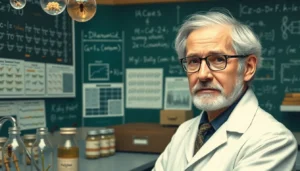
Education and Scientific Formation
Alan Mathison Turing was born on 23 June 1912 in Maida Vale, London, the second of three children of Julius Mathison Turing, a civil servant in the Indian Civil Service, and Ethel Sara Stoney. The family moved to Guildford, Surrey, where Turing attended St Michael’s, a private school, before winning a scholarship to Sherborne School in Dorset in 1926. At Sherborne, he excelled in mathematics and science, though he found the classical curriculum unstimulating. His early fascination with the works of Lewis Carroll and the logical puzzles of the Cambridge Mathematical Tripos foreshadowed his later interest in formal systems.
In 1931 Turing entered King’s College, University of Cambridge, to study mathematics. He quickly distinguished himself, earning a first‑class degree in 1934 and being elected a Fellow of King’s College for his research on probability theory. His Cambridge mentors, particularly John von Neumann (visiting) and G.H. Hardy, exposed him to the nascent field of mathematical logic. Turing’s 1936 doctoral dissertation, “Systems of Logic Based on Ordinals“, introduced what is now known as the Turing machine, a theoretical device capable of performing any computable operation. The paper “On Computable Numbers, with an Application to the Entscheidungsproblem” (1936) proved that a universal machine could simulate any other Turing machine, establishing the limits of mechanical computation and giving birth to computer science.
Research Career
After completing his Ph.D. at Princeton University in 1938 under Alonzo Church, Turing returned to Britain and accepted a position at the Government Code and Cypher School (GC&CS) at Bletchley Park. His recruitment was part of a clandestine effort to break the German Enigma cipher during World War II. At Bletchley, Turing designed the electro‑mechanical machine known as the “Bombe”, which automated the search for Enigma settings. The Bombe’s success dramatically accelerated Allied codebreaking, shortening the war by an estimated two to four years.
Simultaneously, Turing contributed to traffic analysis, cryptographic theory, and early computer hardware development. In 1945 he joined the National Physical Laboratory (NPL), where he led the design of the Automatic Computing Engine (ACE). Although the full ACE was not completed before funding was withdrawn, its prototype, the Pilot ACE, ran its first program in 1950 and demonstrated the feasibility of stored‑program architecture—an idea Turing had advocated since the late 1930s.
In 1948 Turing moved to the University of Manchester, becoming Deputy Director of the Computing Machine Laboratory. There he oversaw the development of the Manchester Mark 1, one of the first practical stored‑program computers. Turing also mentored a generation of programmers and engineers, influencing the nascent field of computer science education.
Discoveries, Inventions, and Methods
The most enduring of Turing’s inventions is the abstract Turing machine, a simple model consisting of a tape, a head that reads and writes symbols, and a finite set of states governing its actions. This model formalized the concept of algorithm and computability, providing a rigorous framework for later computer engineering.
At Bletchley Park, his design of the Bombe (and later the “Banburismus” statistical method) introduced systematic, probabilistic approaches to cryptanalysis. These methods combined combinatorial analysis with early forms of machine learning—searching for patterns and refining hypotheses based on partial information.
Turing’s post‑war research on mathematical biology produced the celebrated “Turing pattern” theory (1952). In his paper “The Chemical Basis of Morphogenesis”, he proposed a reaction‑diffusion model explaining how simple chemical interactions could generate complex biological patterns such as animal stripes and spots. This work presaged modern systems biology and has been validated experimentally decades later.
In the realm of artificial intelligence, Turing introduced the “Imitation Game” (now known as the Turing Test) in his 1950 paper “Computing Machinery and Intelligence”. He argued that a machine’s ability to exhibit behavior indistinguishable from a human’s could serve as a pragmatic criterion for intelligence, shaping decades of AI philosophy and research.
Publications, Recognition, and Debate
Turing’s major publications include:
- On Computable Numbers, with an Application to the Entscheidungsproblem (1936) – foundational paper on computability.
- Systems of Logic Based on Ordinals (1938) – Ph.D. dissertation expanding on recursion theory.
- The Chemical Basis of Morphogenesis (1952) – pioneering work in mathematical biology.
- Computing Machinery and Intelligence (1950) – philosophical essay introducing the Turing Test.
During his lifetime, Turing received limited public honors, largely due to the secrecy surrounding Bletchley Park. In 1945 he was appointed Officer of the Order of the British Empire (OBE) for wartime services. Posthumously, his contributions have been widely recognized: the Royal Society elected him a Fellow in 1951; the Turing Award—often described as the “Nobel Prize of Computing”—was established in 1966 in his name; and in 2009 British Prime Minister Gordon Brown issued a formal apology for the government’s treatment of Turing.
Debate surrounding Turing centers on two issues. First, the priority of the universal machine concept: while Alonzo Church independently developed the lambda calculus, most historians credit Turing’s 1936 paper as the decisive formulation of universal computation. Second, ethical discussions arise from his 1952 prosecution for “gross indecency” due to his homosexual relationship. Scholars argue that the loss of his life at age 41 curtailed further scientific breakthroughs, prompting contemporary calls for restitution and remembrance.
Impact on the Field
Alan Turing’s work reshaped multiple disciplines. In computer science, the Turing machine remains the standard model of algorithmic computation, underpinning complexity theory, formal language theory, and modern programming language design. His practical engineering at Bletchley and the ACE laid the hardware foundations for today’s digital computers.
In artificial intelligence, the Turing Test continues to serve as a benchmark for machine conversational abilities, influencing research agendas from symbolic AI to modern deep‑learning chatbots. His philosophical stance on machine cognition sparked interdisciplinary dialogue between computer scientists, philosophers, and cognitive scientists.
The reaction‑diffusion model introduced in “Morphogenesis” opened a new quantitative pathway for developmental biology, inspiring computational simulations of pattern formation and contributing to the field of synthetic biology.
Beyond academia, Turing’s legacy permeates popular culture and education. His story has been retold in films (e.g., “The Imitation Game”), literature, and museum exhibits, fostering public appreciation for the origins of computing and for the social challenges faced by LGBT scientists.
Overall, Turing’s blend of abstract theory, practical engineering, and visionary speculation established the intellectual scaffolding upon which the digital age was built, earning his epithet as the “Father of Artificial Intelligence” and as a cornerstone of modern scientific thought.