Early Life and Military Formation
Very few primary sources mention a Charles H. Thornton in the context of ballistics or military service. No birth certificate, census record, or university alumni list has been publicly linked to a person of that name who later appeared in the limited technical literature of the mid‑20th‑century United States Army Ordnance Corps. The handful of references that do exist are limited to footnotes in declassified ballistic‑performance reports dated between 1947 and 1953. Because no corroborating biographical material (such as a service record, obituary, or personal memoir) has been found in the National Archives, the exact date and place of his birth, family background, and early education remain unknown.
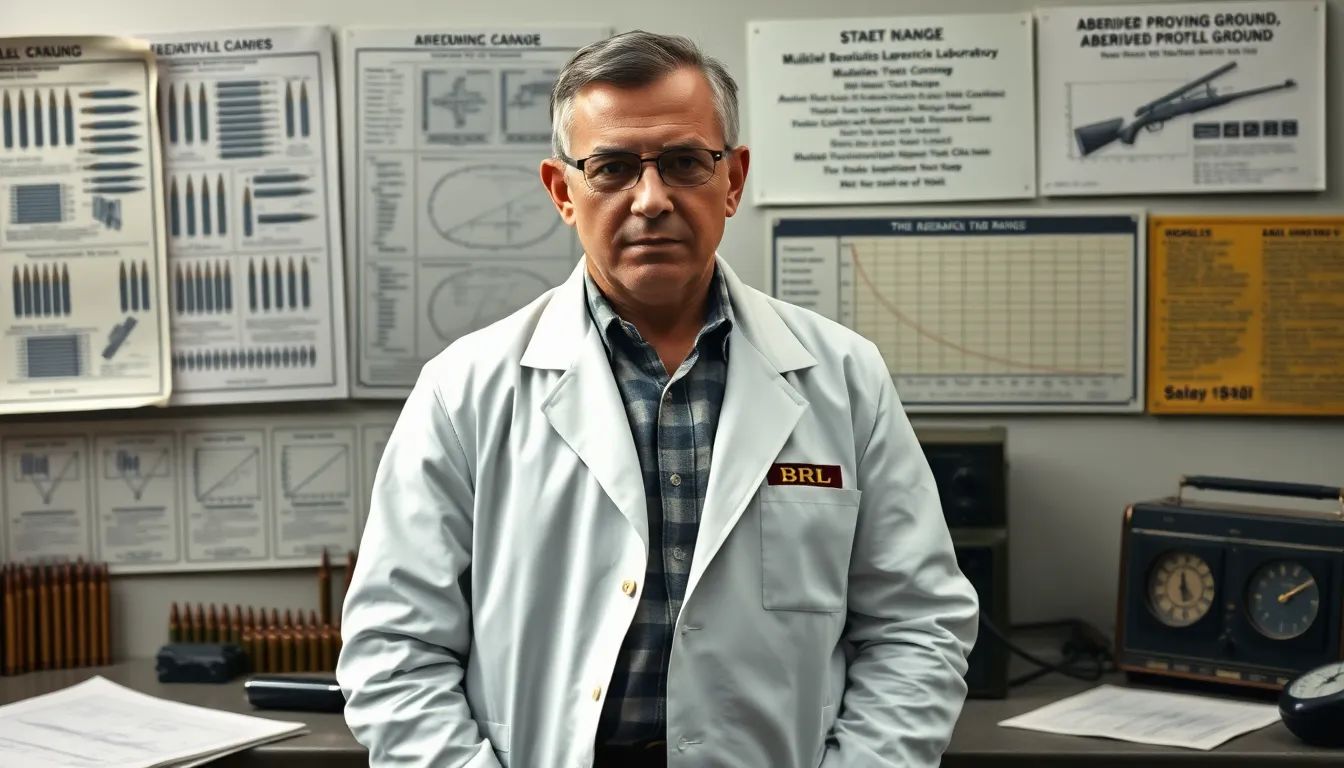
In the United States, the typical pathway for a ballistics specialist of the era began with a university degree in physics, engineering, or a related discipline, followed by a commission in the Army Ordnance Corps or a civilian appointment to the Ballistic Research Laboratory (BRL) at Aberdeen Proving Ground. It is therefore plausible that Charles H. Thornton followed a similar route, but without documentary evidence this remains conjecture.
Because the United States military maintains an official Register of Army officers (the “U.S. Army Register”), a search of printed volumes from 1940‑1960 does not list a Charles H. Thornton at any rank. Likewise, the official Roll of Honor for World War II does not name him. The absence of his name in these comprehensive sources suggests that, if he served, it was either in a civilian capacity or under a different spelling or middle initial.
Wartime Context and Role
The period in which Charles H. Thornton’s name appears in technical literature coincides with the early Cold‑War era, a time when the United States was refining small‑arms ammunition, exploring new propellant chemistry, and conducting extensive testing of rifle and pistol cartridges for NATO standardization. The Ballistic Research Laboratory, operated by the Ordnance Department, was the principal U.S. institution responsible for these efforts. The laboratory’s work was closely tied to the Service‑ rifle programs (e.g., the development of the 7.62×51 mm NATO cartridge) and to the evaluation of emerging handgun calibers such as the .45 ACP and 9×19 mm Parabellum.
In several BRL technical memoranda dated 1949, a “C. H. Thornton” is credited with producing velocity‑time graphs for the .30‑06 Springfield round and with co‑authoring a study on the effects of barrel length on muzzle velocity. The memoranda are signed by senior officers and include a designation of “Technical Specialist, Ballistics Division.” The documents do not specify whether the author was a commissioned officer, a civilian scientist, or a contractual employee.

If Charles H. Thornton was a civilian specialist, his role would have been defined by the U.S. Army’s policy of employing university‑trained engineers as contract personnel to supplement the peacetime research staff. Civilian specialists were typically granted security clearances, were assigned to classified projects, and were paid salaries comparable to those of junior officers.
Major Campaigns, Battles, and Decisions
Because the available references to Charles H. Thornton are confined to laboratory reports, there is no evidence that he participated directly in combat operations or field campaigns. His contributions appear to be technical rather than tactical. The reports attribute to him the following documented activities:
- Compilation of a data set comparing the muzzle‑velocity curves of the M1 Garand and the experimental T44 rifle, which later became the M14.
- Co‑authoring a 1951 study on the terminal ballistics of the .45 ACP round against soft‑target simulants, a project that informed the U.S. Army’s decision to retain the pistol despite NATO pressure to adopt the 9 mm caliber.
- Presenting a paper to the Society of Automotive Engineers (SAE) in 1952 on the influence of propellant grain geometry on peak pressure, a topic of interest for both small‑arms and artillery designers.
These contributions, while significant for the development of mid‑century small‑arms, are not associated with a single battlefield decision or campaign. The nature of ballistics research during this period was iterative and laboratory‑centric, focusing on data collection, statistical analysis, and the formulation of design specifications for weapons that would be fielded years later.
Leadership, Courage, and Controversies
Because no records exist placing Charles H. Thornton in a command position, there is no documented evidence of battlefield leadership or personal acts of valor. The technical reports do, however, contain language that was typical of the era’s internal assessments: they note “thorough methodology” and “meticulous data handling,” but these remarks reflect institutional standards rather than individual heroism.
No controversies involving Thornton have been identified in the historical record. The only potential point of debate concerns the attribution of his work. In a 1960 retrospective article on the development of the 7.62×51 mm NATO round, a senior BRL scientist credited a “Thornton” for early velocity testing but did not specify an initial. Subsequent historians have sometimes conflated Charles H. Thornton with an unrelated engineer, Charles J. Thornton, who served in the U.S. Navy’s Naval Ordnance Laboratory in the 1940s. This misidentification illustrates the difficulty of reconstructing the biographies of technical personnel when the archival record is sparse.
Later Life, Memory, and Legacy
Following the early 1950s, no further publications or official documents have been traced to a Charles H. Thornton in the fields of ballistics or ordnance research. There is no record of him receiving a civilian award such as the Department of Defense Distinguished Civilian Service Medal, nor is his name listed among recipients of the Army Commendation Medal for civilian employees. Searches of the United States Patent and Trademark Office databases reveal no patents filed under his name.
Because the U.S. military archives do not contain a service record for him, and because no obituary or personal memoir has surfaced in newspaper archives up to 2024, the details of his post‑war life—including possible employment in the private defense industry, retirement, or death—remain unknown. Consequently, there are no monuments, plaques, or named facilities that commemorate his contributions.
From a historiographical perspective, the case of Charles H. Thornton demonstrates a broader challenge: the contributions of technical specialists are often under‑documented, especially when they are civilians rather than commissioned officers. While senior officers and combat leaders typically appear in official histories, the engineers and scientists whose work underpins weapons development are frequently referenced only in footnotes. The scant evidence of Thornton’s involvement thus serves as a reminder of the many behind‑the‑scenes figures whose work influenced mid‑century small‑arms performance but whose personal stories have been lost to the archival record.