Early Life and Military Formation
Valentina Vladimirovna Tereshkova was born on 6 March 1937 in the village of Maslennikovo, Yaroslavl Oblast, Russian Soviet Federative Socialist Republic (RSFSR). She was the daughter of a collective‑farm tractor driver, Vladimir Tereshkov, and his wife, Anna Timofeyevna, a housewife. The family lived in modest conditions and moved frequently during the turbulent years of the Great Patriotic War (World War II). After the war, Tereshkova attended a local secondary school, where she excelled in mathematics and physical education.
In 1955, at the age of 18, she left school and began work at the Yaroslavl Textile Factory as a turner and later as a safety engineer. Her involvement in the local aeroclub, a state‑sponsored program that introduced civilian youth to parachuting, proved decisive. Between 1956 and 1961 she completed over 40 parachute jumps, earning a bronze medal from the Soviet Parachuting Federation. This experience placed her on the radar of the Soviet space programme, which was seeking candidates with proven composure under physical stress.
Although Tereshkova had no formal military academy training, the Soviet policy of integrating successful space‑flight candidates into the armed forces meant that upon selection she would be granted a commission in the Soviet Air Force (Voyenno‑vozdushnye sily, VVS). On 16 June 1963, after the historic Vostok 6 flight, she was awarded the rank of Lieutenant and later promoted to Senior Lieutenant in 1964, and eventually to Major in 1974. Her military education consisted primarily of brief officer courses at the VVS Academy, focusing on aerospace doctrine, command protocol, and political education, rather than traditional combat training.
Wartime Context and Role
Tereshkova’s career unfolded during the height of the Cold War, a period of geopolitical rivalry between the Soviet Union and the United States that extended far beyond conventional battlefields into the realms of technology, ideology, and prestige. The Soviet space programme was a critical component of this rivalry; each successful launch was used as a demonstration of the nation’s scientific and military prowess. While no direct combat operations are recorded for Tereshkova, her flight served as a strategic instrument of deterrence and propaganda.
As a commissioned officer in the VVS, Tereshkova was formally part of the Soviet military establishment. The VVS oversaw the nation’s strategic bomber fleet, air defence, and the burgeoning Soviet space forces (later the Soviet Air Defence Forces). Her rank conferred responsibilities such as representing the Air Force at state ceremonies, participating in political assemblies, and acting as a liaison between the cosmonaut corps and military leadership. These duties placed her within the broader military‑political apparatus that coordinated the Soviet Union’s response to the American space challenge.
Major Campaigns, Battles, and Decisions
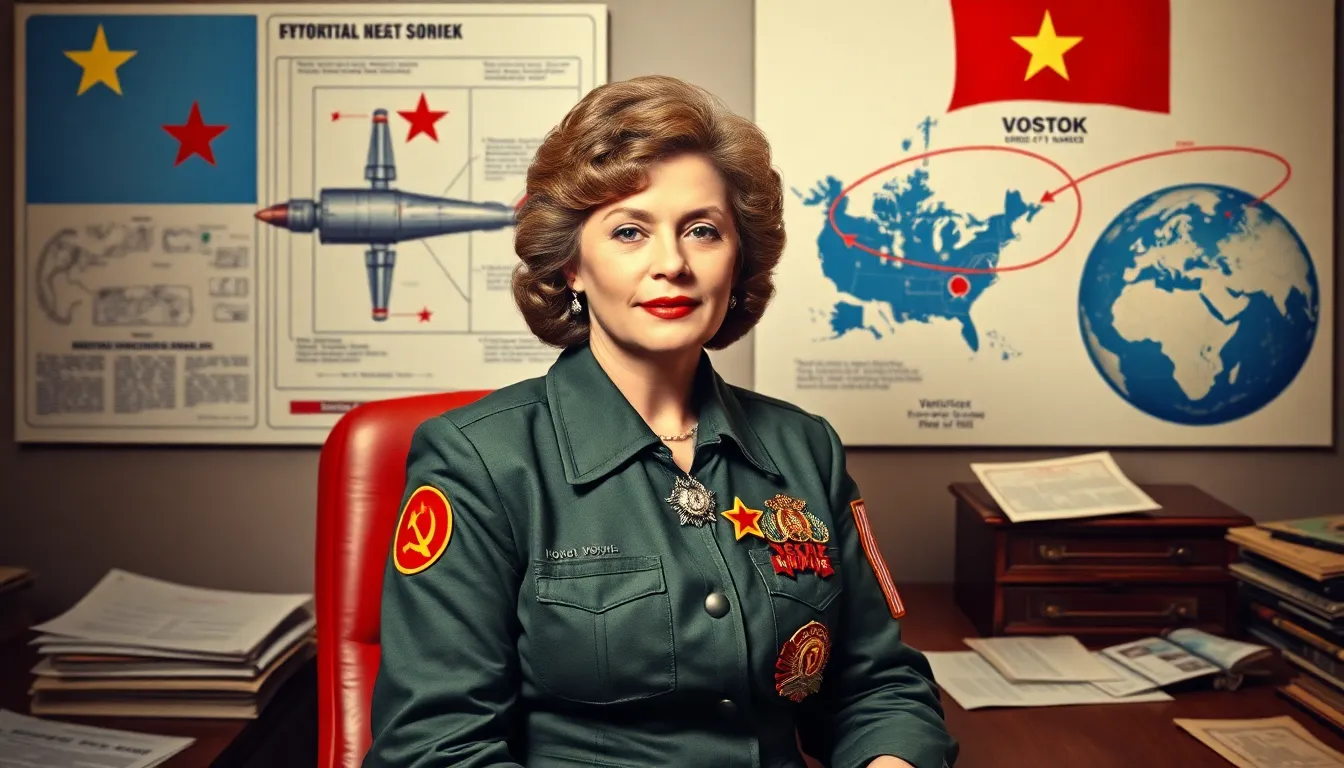
Vostok 6 Mission (June 1963) – On 16 June 1963, Tereshkova launched aboard the Vostok 6 spacecraft, becoming the first woman to fly in space. The mission lasted 71 hours, 58 minutes, and 11 seconds, during which she completed 48 Earth orbits. Although a civilian scientific mission, Vostok 6 was an integral element of the Soviet strategic campaign to demonstrate superiority in human spaceflight, a domain closely tied to intercontinental ballistic missile (ICBM) capabilities. The flight’s success bolstered Soviet morale and was widely publicized as evidence of the USSR’s technological edge.
Post‑flight Military Integration – Following the mission, Tereshkova was awarded the rank of Lieutenant in the VVS and assigned to the Institute for Advanced Aviation Training as a senior instructor. She participated in the development of training protocols for future cosmonauts, emphasizing parachute recovery techniques and G‑force tolerance – knowledge directly applicable to the survivability of aircrew in high‑altitude bailout scenarios, a key consideration for the VVS’s strategic bomber crews.
Political and Diplomatic Deployments – Throughout the 1960s and 1970s, Tereshkova embarked on numerous goodwill tours throughout the Warsaw Pact, non‑aligned nations, and the United Nations. In her official capacity as a Major of the Soviet Air Force, she delivered speeches that linked Soviet aerospace achievements to the strength of the socialist military alliance, thus contributing to the USSR’s soft‑power strategy within the Cold‑War theatre.
Later Military Roles – In 1974, Tereshkova was promoted to Major and appointed a member of the Supreme Soviet, representing the Soviet Air Force. She served on the Committee for Science and Technology, influencing policy decisions that affected both civilian and military aerospace projects, including early reconnaissance satellite programmes (Kamera) and anti‑satellite (ASAT) weapon development. While she did not command troops or lead combat operations, her advisory role impacted the strategic direction of the Soviet military’s space‑based assets.
Leadership, Courage, and Controversies
Tereshkova’s most celebrated act of courage is her Vostok 6 flight, which required her to endure the physical stresses of launch, weightlessness, and re‑entry without the benefit of a co‑pilot. Official Soviet citations emphasize her calm demeanor, problem‑solving ability during a brief loss of communication, and her capacity to follow flight protocols under novel conditions. Her flight earned her the highest Soviet civilian honor, Hero of the Soviet Union, and the Order of Lenin, both of which are also regarded as military decorations when awarded to service members.
Critics have argued that her selection was driven more by political considerations—chiefly the desire to showcase gender equality within the socialist system—than by pure merit. The Soviet propaganda machine highlighted her humble origins and lack of formal aviation experience as evidence of the state’s commitment to egalitarianism. Some historians contend that the decision to send a woman into space was a calculated risk to pre‑empt any American attempts to achieve a similar milestone, thereby securing a symbolic victory in the ideological front of the Cold War.
Tereshkova’s post‑flight political career also attracted scrutiny. As a member of the Supreme Soviet, she supported several controversial policies, including the Soviet invasion of Czechoslovakia in 1968. While her public statements often framed such actions in terms of collective security, scholars note that her alignment with party directives was typical of Soviet military officers who transitioned into political roles.
Nevertheless, her personal conduct has been consistently described as disciplined and professional. Accounts from fellow cosmonauts, such as Gherman Titov, describe her as “steady, reliable, and unflappable,” qualities valued in both aerospace and military settings. Her dedication to training younger cosmonauts and her involvement in veteran organisations have contributed to a reputation of steady leadership within the Soviet and Russian armed forces.
Later Life, Memory, and Legacy
After retiring from active spaceflight in the late 1960s, Tereshkova pursued a political career that lasted several decades. She served multiple terms in the Soviet, and later Russian, parliament, representing the United Russia party. Although no longer an active officer, she retained her Major rank and continued to attend official military ceremonies, often receiving honors such as the Order of Honour (Russia) and the Order of Friendship.
In the post‑Soviet era, Tereshkova’s legacy has been re‑examined. Russian authorities have celebrated her as a national heroine, emphasizing her pioneering role in human spaceflight while downplaying the Cold‑War propaganda aspects of her early fame. Streets, schools, and museums across Russia bear her name, and a 2015 Russian postage stamp commemorated the 52nd anniversary of her flight.
Internationally, her achievement continues to inspire discussions on gender equity in the military and aerospace sectors. While she never served in combat, her status as a commissioned officer in the Soviet Air Force provides a precedent for women’s integration into military structures worldwide.
Historians today view Tereshkova as a complex figure whose personal bravery, political usefulness, and symbolic value intersected at a pivotal moment in Cold‑War history. Her biography offers insight into how the Soviet military harnessed scientific achievement as a tool of strategic competition, and how individual lives were shaped by the entwined forces of ideology, technology, and state power.