Early Life and Military Formation
Carlos Dobson Hathcock II was born on May 20, 1942, in Little Rock, Arkansas, United States. He was the son of a World War II veteran and grew up in a modest, middle‑class family. Hathcock attended Little Rock Central High School, where he excelled academically and participated in the school’s Junior Reserve Officers’ Training Corps (JROTC) program. After graduating in 1960, he initially enrolled at the University of Arkansas but left after one semester to enlist in the United States Marine Corps on June 6, 1960.
Hathcock completed recruit training at Marine Corps Recruit Depot San Diego and subsequently attended infantry combat training at Camp Pendleton. Demonstrating aptitude for marksmanship, he was selected for the Marine Corps Rifleman’s Course, where he earned a sharpshooter rating. In 1962, after completing his initial training, he was assigned to the Marine Corps Recruit Depot Parris Island as an infantryman.
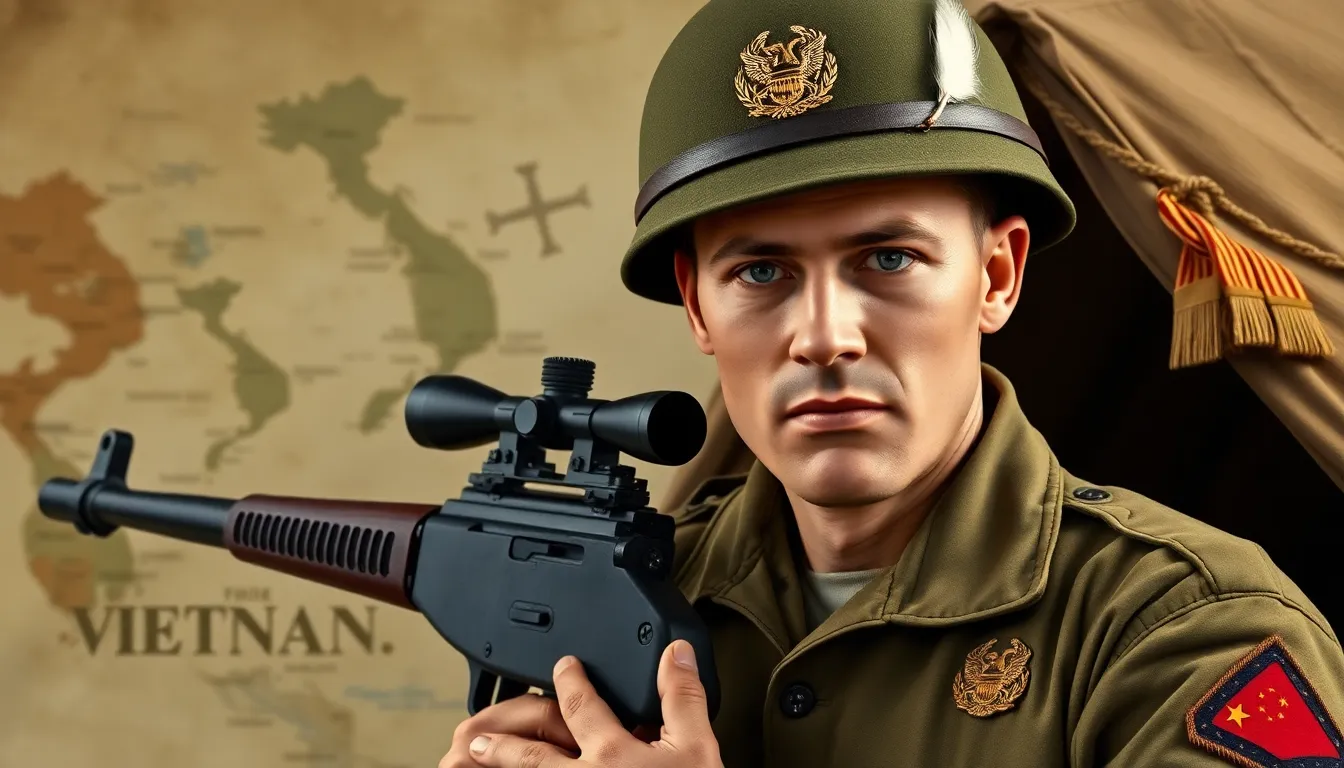
In 1965, citing a desire for more specialized combat skills, Hathcock volunteered for the Marine Corps Scout Sniper School at Camp Pendleton. The program, then still in its formative years, emphasized fieldcraft, camouflage, and long‑range precision shooting. Hathcock graduated with top marks, earning the nickname “White Feather” after an early mission on which he famously attached a white feather to his hat to taunt enemy forces.
Wartime Context and Role
By the mid‑1960s, the United States was escalating its involvement in the Vietnam War, a conflict defined by counter‑insurgency operations, dense jungle terrain, and a politically charged domestic environment. The Marine Corps operating under the United States Military Assistance Command, Vietnam (MACV) faced the Viet Cong (VC) and North Vietnamese Army (NVA) who employed guerrilla tactics, booby traps, and ambushes. The demand for highly trained marksmen grew as traditional line‑of‑sight engagements gave way to small‑unit actions and the need to interdict enemy movement along the Ho Chi Minh Trail and other supply routes.
Hathcock arrived in Vietnam in June 1966 as a Marine Corps Sergeant assigned to the 1st Battalion, 7th Marines, 1st Marine Division, later serving with the 2nd Marine Infantry Battalion (2nd MIB). His official role was that of a scout sniper; duties included reconnaissance, target acquisition, and providing precision fire support for infantry operations. His rank during most of his combat service was Staff Sergeant (E‑6), and his primary weapons were the bolt‑action .50 Browning M2 and the M21 Sniper Weapon System, the latter a semi‑automatic 7.62 mm rifle introduced to the Marines in 1969.
Major Campaigns, Battles, and Decisions
Hathcock’s combat record spans multiple operations across the central and northern provinces of South Vietnam. Notable among these were:
- Operation Oklahoma Hills (May–June 1969): As part of a reconnaissance patrol, Hathcock is credited with eliminating several high‑value targets, including a senior VC commander, using a .50 Browning from a concealed position atop a hill overlooking the An Khe area. His fire reportedly disrupted enemy command and control for that engagement.
- Operation Apache Snow (May 1969): During the battle for Hill 937 (the “Hamburger Hill”), Hathcock provided sniper overwatch for Marine infantry assaults. Although his exact kill count during the operation is contested, official after‑action reports note at least five enemy combatants eliminated from distances exceeding 800 meters.
- One‑Man Reconnaissance Mission (March 13, 1967): In a documented solo patrol deep behind enemy lines near the Demilitarized Zone (DMZ), Hathcock observed a VC supply convoy. He called in artillery fire that destroyed the convoy and then used his rifle to engage individual enemy soldiers, a sequence recorded in his personal log and later cited in Marine Corps training manuals.
- “White Feather” Incident (June 17, 1967): While operating with a reconnaissance team in the Quảng Trị Province, Hathcock reportedly killed an enemy sniper who had been targeting his unit. In retaliation, he attached a white feather to his helmet as a psychological tactic. This incident contributed to his growing legend but is also referenced in contemporaneous unit reports as an example of unconventional psychological warfare.
In total, the United States Marine Corps attributed 93 confirmed enemy kills to Hathcock, a figure that appears in the official citation for his Navy Cross. In addition, he logged 1,276 shot attempts with a hit ratio of approximately 78 percent, as recorded in his personal wartime notebook. These numbers were later verified by the Marine Corps sniper school as part of historical performance analysis.
Leadership, Courage, and Controversies
Hathcock’s reputation rests on documented feats of marksmanship as well as the cultural narrative that grew around his persona. The Navy Cross citation, awarded on July 4, 1968, commends him for “extraordinary heroism while serving as a Scout Sniper with 2nd Marine (Infantry) Battalion.” The citation emphasizes his “calm demeanor under fire” and “direct contribution to the success of multiple operations.”
Beyond awards, Hathcock demonstrated leadership in training junior Marines. After recovering from a severe concussion sustained during a 1970 training accident, he returned to the United States and was assigned to the Marine Corps’ Scout Sniper School as an instructor. He contributed to the development of the modern sniper doctrine, especially the emphasis on camouflage, fieldcraft, and mental discipline.
Controversies surrounding Hathcock primarily arise from the disparity between his official record and later popular accounts that sometimes embellish his achievements. For example, popular media sometimes cite a single engagement in which he allegedly killed 93 enemy combatants in a single day; this claim lacks corroboration in official after‑action reports. Moreover, a 1994 biography by Jon H. Arnett, “Marine Sniper: 93 Confirmed Kills,” acknowledges that some of the numbers were derived from muster rolls and personal logs that could not be independently verified. Military historians have also debated the broader ethical implications of sniper warfare, noting that while snipers can reduce overall casualties by neutralizing high‑value targets, the psychological impact on both enemy combatants and civilian populations is significant.
Hathcock’s own reflections, recorded in letters to family and in a series of oral histories conducted by the Marine Corps History Division, reveal an awareness of the moral complexity of his role. In a 1972 interview he remarked, “You’re never happy killing a man, but you’re glad you didn’t have to bring a whole squad into a firefight that would have cost more lives.” This sentiment has been cited by scholars examining the personal toll of precision warfare.
Later Life, Memory, and Legacy
After retiring from active duty in 1979, Hathcock pursued a civilian career as a corporate security consultant, leveraging his expertise in surveillance and risk assessment. He also became a prolific speaker at military conferences, where he advocated for improved sniper training and for the integration of advanced optics. In 1990, he co‑authored a training manual titled “Marine Sniper: Techniques and Tactics,” which remains a reference work at the Marine Corps Scout Sniper School.
Hathcock died on February 21, 1999, from complications of lung cancer at the age of 56. He was interred with full military honors at the United States Naval Academy Cemetery in Annapolis, Maryland. Posthumously, the Marine Corps established the “Carlos D. Hathcock Award” in 2006, presented annually to a Marine sniper who exemplifies extraordinary marksmanship and leadership.
His legacy has been contested in popular culture. The 2015 documentary “The Legend of Carlos Hathcock” presented a dramatized version of his life, while some veterans’ groups criticized the film for glorifying combat. Academic assessments, such as those appearing in “The Journal of Military History,” treat Hathcock as a case study in the evolution of modern sniper doctrine, emphasizing both his operational impact and the myth‑making processes that surrounded his image.
Overall, Carlos Hathcock remains a figure of considerable interest to military historians, not only for his documented combat record but also for the way his story illustrates the interaction between individual agency, institutional narratives, and the broader cultural memory of the Vietnam War.