Early Training and Background
Arnold Daniel Palmer was born on September 10, 1929, in Latrobe, Pennsylvania, a small industrial town whose steel mill culture shaped his early life. The son of Leila (Miller) and Thomas Palmer, Arnold grew up in a working‑class family; his father was a steelworker and his mother worked part‑time as a homemaker. From a young age, Palmer displayed a natural affinity for sports, excelling in baseball, basketball, and football at Latrobe High School.
Palmer’s introduction to golf came at age 15, when his father, a recreational golfer, took him to the local Westmoreland Country Club. Using makeshift equipment—sharpened tree branches for clubs and a tin can for a ball—young Arnold quickly developed a feel for the game. Recognizing his son’s talent, Thomas gifted him a set of real clubs, and Arnold began practicing regularly under the mentorship of club professional Jack Kincaid, who introduced him to the fundamentals of swing mechanics and course management.
After serving in the United States Coast Guard from 1945 to 1947, Palmer enrolled at Wake Forest University in Winston‑Salem, North Carolina, on a golf scholarship. At Wake Forest, he was coached by the legendary head professional, Byron Nelson, a five‑time major champion. Under Nelson’s guidance, Palmer refined his aggressive, attacking style, winning three consecutive Southern Conference titles (1949‑1951) and finishing second to Nelson in the 1949 NCAA Championship. He turned professional in 1951, forgoing his senior year, and began his career as a club pro at St. Petersburg Country Club in Florida while competing in regional tournaments.
Competitive Career
Palmer’s early professional years were marked by steady progress on the PGA Tour, then a loosely organized circuit of events. His first PGA Tour victory came at the 1955 Canadian Open, where he posted a final‑round 68 to clinch a two‑stroke win over Sam Snead. That triumph signaled his arrival among the elite and launched a period of dominance that would span two decades.
From 1958 to 1973, Palmer captured 62 official PGA Tour wins, ranking third all‑time behind Sam Watson (82) and Tiger Woods (82 as of 2024). His victories include seven major championships: the 1958 Masters, the 1960, 1962, 1964, and 1968 U.S. Open titles, the 1960 Open Championship (British Open), and the 1962 and 1969 PGA Championships. Notably, his 1960 Open Championship win made him the first American to claim the title in 24 years, ending a drought that highlighted the transatlantic divide in the sport.

Palmer’s competitive record also includes 16 top‑10 finishes in majors, 45 additional runner‑up placements, and a record‑setting run of 13 consecutive top‑10 finishes at the Masters (1960‑1972). He was a dominant force on the PGA Tour’s money list, finishing within the top five five times, and won the Tour’s leading money award, the Vardon Trophy, in 1960 and 1963. Beyond the PGA, Palmer represented the United States in the Ryder Cup six times (1959, 1961, 1963, 1965, 1967, 1971), serving as playing captain in 1963 and 1971, and contributed to a 5‑2 victory record.
Palmer’s career also featured success on the senior circuit. After turning 50, he joined the Senior PGA Tour (now PGA Tour Champions), winning 10 events, including the 1981 Legends of Golf and the 1986 Senior Players Championship. His senior victories further cemented his status as a timeless competitor.
Major Wins, Records, and Data
Arnold Palmer’s major‑championship tally stands at seven, a figure that placed him third on the all‑time list until surpassed by Jack Nicklaus (18) and Tiger Woods (15). His major‑win breakdown is as follows:
- Masters Tournament – 1 (1958)
- U.S. Open – 4 (1960, 1962, 1964, 1968)
- The Open Championship – 1 (1960)
- PGA Championship – 2 (1962, 1969)
Palmer’s 62 PGA Tour victories remain the most by any player who never won more than seven majors, a testament to his consistency in regular‑tour events. His 1970 victory at the Sahara Invitational marked his 40th win, a milestone reached faster than any of his contemporaries at that time.
Statistically, Palmer posted a career scoring average of 70.4 on the PGA Tour, and his driving distance, while not record‑breaking by modern standards, was among the longest of the 1960s, often exceeding 260 yards. He finished inside the top five on the Official World Golf Ranking (when it was introduced in 1986) for the inaugural three years, underscoring his sustained elite performance.
Palmer’s financial impact on the sport was also measurable. In 1969, his estimated annual earnings—including prize money, endorsements, and his line of sporting goods—exceeded $500,000, an unprecedented figure for a golfer at the time. Adjusted for inflation, his net worth at the time of his death in 2016 was estimated at $150 million, largely derived from the “Arnold Palmer” brand of merchandise, golf courses, and licensing deals.
Style, Rivalries, and Setbacks
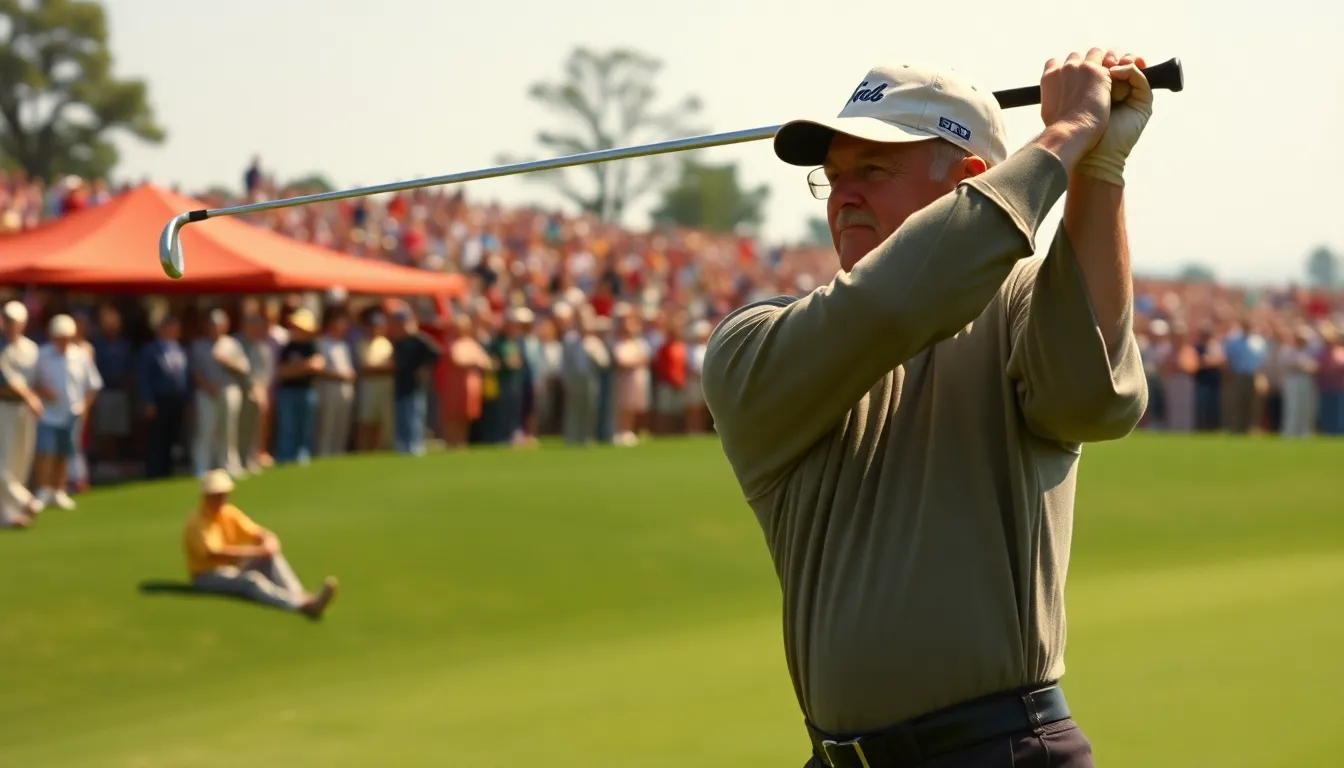
Palmer’s playing style was characterized by an aggressive, “go for it” approach, featuring a powerful, fluid swing that emphasized a high, sweeping takeaway and a full release through the ball. He favored a fade—a left‑to‑right ball flight for right‑handed players—which allowed him to attack pins on the right side of greens and maintain control on windy coastal courses, such as St. Andrews, where he claimed his British Open title.
His charismatic demeanor, coupled with a signature knuckle‑bending putt ritual, endeared him to fans and earned the moniker “The King.” Palmer’s affect on the fan experience was profound; “Arnie’s Army,” a devoted fan base, often traveled in the thousands to track him from tournament to tournament, pioneering modern sports fandom.
Rivalries defined much of Palmer’s era. The most celebrated was his “Big Three” rivalry with Jack Nicklaus and Gary Player. While Nicklaus eclipsed Palmer in total major wins, the three shared a competitive camaraderie that elevated the sport’s global profile. Their head‑to‑head battles, such as the 1960 U.S. Open, where Palmer tied Nicklaus and Player, produced some of golf’s most storied moments.
Palmer’s career was not without setbacks. In 1961, he suffered a severe back injury after a difficult fall on the course at the U.S. Open, leading to a brief hiatus. He again faced health challenges in the late 1970s, undergoing surgery for a gallbladder condition that forced him to miss several tournaments. Despite these obstacles, Palmer repeatedly returned to competitive form, exemplifying resilience and a commitment to the sport.
Off the course, Palmer occasionally courted controversy. In 1975, he faced criticism for publicly supporting a proposed golf course development in a protected Florida wetland, prompting environmental advocacy groups to protest. While the project was ultimately scaled back, the incident highlighted the growing intersection of sport, commercial interests, and environmental stewardship.
Influence and Sporting Legacy
Arnold Palmer’s impact on golf extends beyond his tournament record. He revolutionized the sport’s marketing, becoming one of the first athletes to successfully commercialize his personal brand. His signature “Arnold Palmer” iced tea—a blend of tea and lemonade—became a cultural icon, and his line of equipment (clubs, balls, apparel) set a template for modern athlete endorsement agreements.
Palmer’s outreach to the broader public helped democratize golf, shifting its perception from an elite pastime to a widely accessible sport. His televised victories, especially the 1960 Open Championship win at St. Andrews, were broadcast internationally, leading to a surge in participation rates in the United States and Britain. Golf course architecture also bears his imprint; he designed or co‑designed more than 30 courses, many of which incorporated his philosophy of challenging yet playable layouts that emphasized strategic shotmaking.
Institutionally, Palmer was instrumental in establishing the PGA Tour’s modern structure. He advocated for a player‑focused organization, resulting in the formation of the PGA Tour’s first independent Board of Directors in 1968. In 1974, his philanthropic foundation—the Arnold Palmer Hospital for Children—opened in Orlando, Florida, underscoring his commitment to community service.
His influence on future generations is evident in the careers of such players as Tiger Woods, who cited Palmer as an inspirational figure for his love of competition and fan engagement. In 1994, Palmer was inducted into the World Golf Hall of Fame, cementing his status among the sport’s all‑time greats. The “Arnold Palmer Invitational,” an annual PGA Tour event held at his home course, Bay Hill Club & Lodge, continues to attract elite fields, preserving his competitive spirit for new audiences.
Personal Life and Net Worth
Arnold Palmer married Winnie Davis in 1954; the couple had two children, Keith and Amy. Their marriage endured for 62 years until Winnie’s death in 2016, just weeks before Arnold’s own passing on September 25, 2016, at the age of 87.
Beyond golf, Palmer pursued a passion for automobiles, owning a collection of classic cars and even collaborating on a limited‑edition Buick model in the 1970s. He also appeared in several television series and films, most notably the 1960 documentary “The Arnold Palmer Story,” which chronicled his rise to fame.
Financially, Palmer’s net worth was consistently reported between $100 million and $150 million at the time of his death. This wealth stemmed from his tournament earnings (over $1.5 million in prize money, a substantial sum for his era), a prolific endorsement portfolio (including Chevrolet, Miller Beer, and Kellogg’s), royalties from his line of golf equipment, real‑estate holdings (most notably the Bay Hill property), and licensing of his name and image.
Arnold Palmer’s legacy endures through myriad channels: the Arnold Palmer Hospital for Children, the charitable Arnold Palmer Golf Foundation, the continued popularity of “Arnold Palmer” beverages, and his enduring presence on the fairways of courses worldwide.