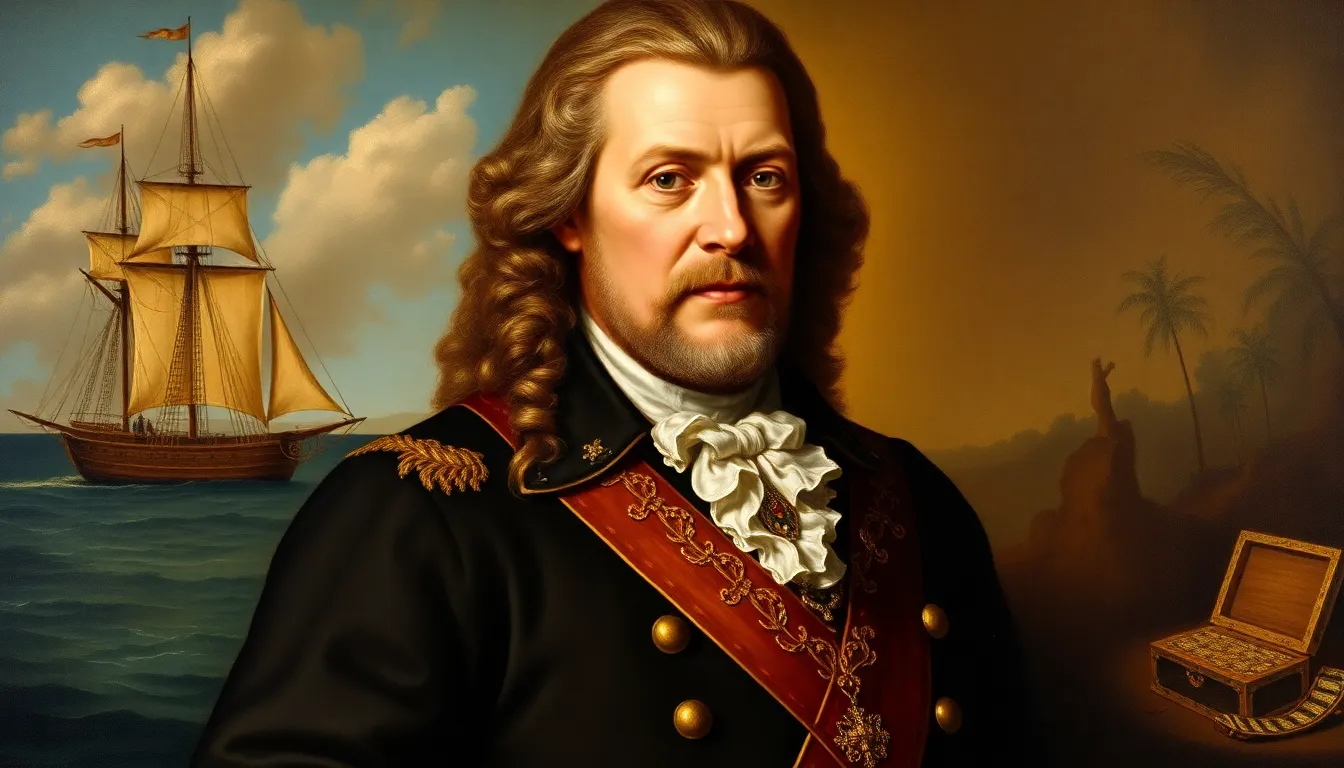
Historical Context
In the mid‑seventeenth century the Caribbean was a contested frontier between rival European empires. Spain, which had claimed the islands since Columbus, struggled to defend its scattered settlements against English, Dutch and French interlopers. The English Crown, under Charles II, encouraged privateering—state‑sanctioned piracy—against Spanish shipping as a means of weakening Spain’s monopoly on New World wealth without committing regular navy forces. The 1655 English conquest of Jamaica marked a turning point: the island became a base for buccaneers, men who blended piracy, mercenary activity and plantation ownership. Within this volatile milieu, Henry Morgan emerged as a pre‑eminent privateer, leading daring raids on Portobelo, Maracaibo, and Panama. His career illustrates the blurred lines between lawlessness and official policy in the early modern Atlantic world.
Early Life and Formation
Exact details of Morgan’s birth are uncertain. Most contemporary records suggest he was born around 1635 in the parish of Llanfihangel-y-Pennant, near Machynlleth, in the historic county of Montgomeryshire, Wales. His family were modest gentry; his father, William Morgan, is thought to have been a yeoman farmer or minor landholder. No surviving baptismal record confirms the date, and historians rely on later depositions and the 1665 marriage licence for his first wife as proxies. Morgan likely received a basic education typical of a rural Welsh gentry child—reading, writing and arithmetic—sufficient for later handling of contracts and correspondence.
In the 1650s, Morgan migrated to the English colony of Barbados, a common destination for Welsh and English youths seeking opportunity. Barbados was at the time the wealthiest English sugar colony, and its ports were a hub for ships bound for the Caribbean. Morgan entered maritime service as a cabin boy, gradually rising through the ranks to become a master gunner. The apprenticeship forged his seamanship, knowledge of navigation, and familiarity with the armaments that would later define his privateering ventures. Primary sources such as the 1659 muster rolls of the parish of St. Michael, Barbados, list a “Henri Morgan” as a gunner on a privateering vessel, providing the earliest concrete evidence of his seafaring career.
Role in Major Events
By the early 1660s Morgan had joined the ranks of the so‑called “Buccaneers of the Caribbean,” a loosely organized coalition of English, French, and Dutch traders‑turned‑raiders. His first notable engagement was the 1665 raid on the Spanish settlement of Maracaibo (present‑day Venezuela), conducted alongside the English pirate John Morris. Though the raid achieved limited material gain, it established Morgan’s reputation for audacity.
Morgan’s most celebrated capture was the 1668 assault on the fortified town of Portobelo, on Panama’s Caribbean coast. Acting under a commission (a “letter of marque”) granted by the Governor of Jamaica, Sir Thomas Modyford, Morgan assembled a fleet of six ships and a force of several hundred men. Over a three‑day siege, they overran the town’s defenses, seized a substantial cache of Spanish treasure, and burned the settlement. Contemporary accounts, such as the diary of the English merchant‑captain Richard Leather, describe the loot as amounting to “tens of thousands of pesos” and “gold and silver of great weight.”
The apex of Morgan’s privateering career occurred in 1671 with the infamous Panama expedition. Again authorized by Modyford, Morgan led a force of roughly 1,200 men—comprising buccaneers, soldiers, and indigenous allies—across the Isthmus of Panama to attack the city of Panama La Vieja, the Spanish “golden” port on the Pacific. The march involved a grueling trek through dense jungle, during which Morgan’s troops endured disease, hunger and attacks from Spanish forces. Upon reaching Panama, they executed a coordinated assault, seized the city’s treasury, and captured a noted quantity of silver bullion and precious gems. The raid’s success was widely reported in European pamphlets and cemented Morgan’s fame; however, it also provoked an outcry from the Spanish Crown, which demanded his arrest.
Following the Panama raid, the political climate shifted. In 1672, Charles II, seeking to avoid war with Spain, revoked Modyford’s privateering commissions. Morgan was arrested in Port Royal on charges of piracy, but after a lengthy interrogation and a petition from influential colonists, he was released without trial. He thereafter turned to plantation agriculture, acquiring considerable sugar estates on Jamaica, most famously the “St. George’s” plantation near Kingston.
In 1675 Morgan was appointed Lieutenant Governor of Jamaica, a position he held until his death. In this capacity he oversaw the colony’s defence, adjudicated civil disputes, and helped reform the notoriously lawless settlement of Port Royal, which had been destroyed by an earthquake in 1692 (after Morgan’s death). His tenure reflected a transition from pirate to respectable colonial administrator, a duality that continues to intrigue scholars.
Morgan died on 25 August 1688, at his estate in Jamaica, reportedly of apoplexy (stroke). His burial took place in the churchyard of St. Philip’s, near Spanish Town, where a marble monument commemorated his service to the Crown.
Allies, Opponents, and Debate
Throughout his career Morgan cultivated a network of allies among colonial officials, merchants, and fellow buccaneers. Governor Thomas Modyford was perhaps his most important patron; Modyford’s willingness to issue privateering commissions enabled Morgan’s raids and provided political cover. Morgan also forged strategic alliances with French and Dutch corsairs, such as the famed privateer François l’Olonnais, though records of direct collaboration are scant.
His principal opponents were, unsurprisingly, the Spanish Empire. Spanish officials, including the viceroy of New Granada, repeatedly condemned Morgan’s incursions as barbaric piracy. The Spanish court lodged diplomatic protests with Charles II, demanding restitution for plundered wealth. Within the English sphere, Morgan faced criticism from Puritan moralists and from some colonial settlers who feared that buccaneer activity invited Spanish retaliation.
Modern historiography debates Morgan’s legacy. Early nineteenth‑century British historians, such as Thomas Babington Macaulay, celebrated him as a “heroic adventurer” who contributed to Britain’s ascendancy. In contrast, twentieth‑century scholars like Clarence H. Haring and more recent Caribbean historians emphasize the destructive impact of his raids on indigenous populations and on the nascent Spanish colonial economy. The paucity of primary source material—many of Morgan’s own reports were lost, and surviving Spanish accounts were often propagandistic—requires caution. Where records differ, scholars favor triangulation of English naval logs, Spanish treasury reports, and contemporary Caribbean chronicles to approximate factual details.
The question of Morgan’s net worth further illustrates source uncertainty. Estate inventories compiled after his death list a mixture of real property (several plantation holdings), cash holdings, and movable assets (art, weapons, and slaves). Estimates range from £10,000 to £30,000—a considerable sum for the period, roughly equivalent to several million pounds today. However, because many of his acquisitions were derived from loot whose exact value was never documented, any figure remains speculative.
Legacy and Interpretation
In the immediate aftermath of his death, Morgan’s reputation oscillated between that of a feared marauder and a loyal servant of the English Crown. The monument in St. Philip’s portrayed him in fine clothing, emphasizing his status as a gentleman rather than a pirate. The Caribbean’s folklore embraced his daring exploits, and he entered popular culture as the archetypal swashbuckler, inspiring countless novels, films, and board games.
Academic interpretation has evolved considerably. Early colonial histories treated privateers like Morgan as extensions of imperial policy, glossing over the moral ambiguities. Later, the “Revisionist” school, influenced by post‑colonial theory, highlighted the violent displacement of indigenous peoples, the exploitation of African slaves on his plantations, and the broader economic motives underpinning privateering. Recent scholarship, such as the 2022 monograph “Piracy, Power, and the Crown: The Life of Sir Henry Morgan” (University of West Indies Press), presents a nuanced portrait: Morgan as a product of his era—an opportunistic entrepreneur who leveraged state sanction to amass personal wealth while simultaneously contributing to the Crown’s strategic interests.
Physical remnants of Morgan’s life survive in Jamaica. The ruins of St. George’s Estate, now a heritage site, contain the foundations of plantation houses, slave quarters, and a small museum dedicated to the island’s colonial past. In Wales, a plaque in the village of Llanfihangel-y‑Pennant commemorates a “native son who rose to fame on the high seas.”
Overall, Henry Morgan’s story illustrates the fluidity of legitimacy in the early modern Atlantic: privateering operated at the intersection of law, violence, commerce and empire. His personal fortunes, political ascent, and enduring myth demonstrate how individual agency could shape, and be shaped by, the wider currents of European colonial expansion.