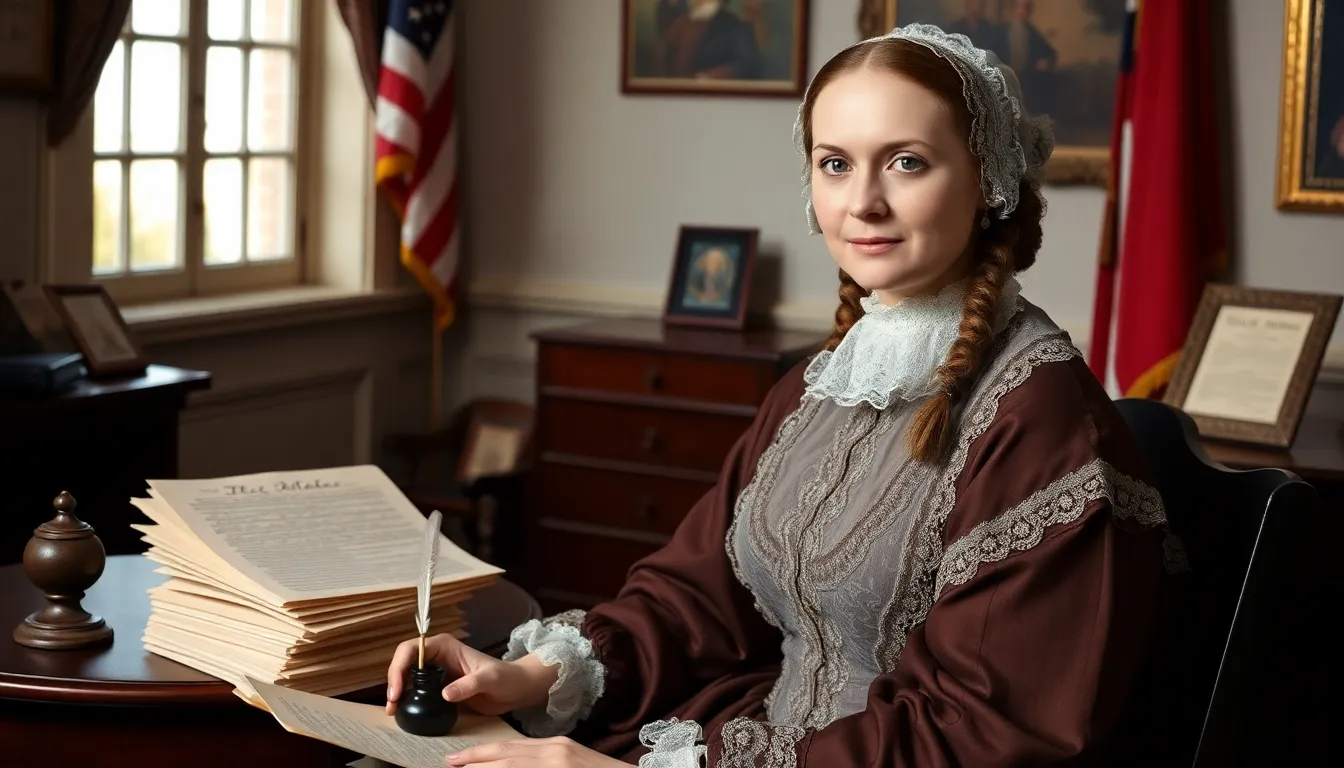
Historical Context
Abigail Adams lived during a period of profound transformation in North America. Born in the British colony of Massachusetts Bay in 1744, she witnessed the escalation of colonial resistance to British policies, the outbreak of the American Revolutionary War (1775–1783), and the establishment of the United States under the Constitution of 1787. The late 18th century was marked by Enlightenment ideas about liberty and republican government, yet the prevailing social order remained patriarchal, restricting women’s legal rights and public participation. Within this milieu, the Adams family occupied a prominent position among the colonial elite, involved in mercantile trade, local politics, and intellectual circles that debated independence and governance.
During the revolutionary era, Massachusetts was a hotbed of political activity, hosting the First and Second Continental Congresses and the drafting of the Massachusetts Constitution. The war created both hardships and opportunities for women, who managed households and businesses while men served in militias. The post‑war period saw the creation of new national institutions, the rise of partisan politics, and debates over the role of women in the new republic. Abigail Adams, through her extensive correspondence with her husband John Adams and other leaders, both reflected and shaped these debates, especially regarding the education and moral status of women.
Early Life and Formation
Abigail Smith was born on November 22, 1744, in Weymouth, Massachusetts Bay, to William Smith, a successful merchant, and Elizabeth (née Quincy) Smith, who came from a distinguished New England family. The Smith household was relatively affluent, allowing Abigail access to a modest education uncommon for women of her era. She learned to read and write, studied the Bible, and acquired basic arithmetic and needlework skills. Her parents emphasized piety, good manners, and domestic competence, values that would later inform her own advice to her husband and children.
Primary sources for this period include town records, the Smith family probate inventory, and letters preserved in the Massachusetts Historical Society. Nonetheless, details of Abigail’s childhood are limited; scholars rely on later recollections recorded by her descendants, which may idealize her early years. By her teenage years, Abigail was known for her quick wit, intelligence, and capacity for persuasive argument, qualities that attracted the attention of John Adams, a young lawyer from Braintree (now Quincy), Massachusetts.
Abigail and John Adams became acquainted in 1764 through mutual friends and family connections. Their courtship was largely epistolary, a common practice among educated elites, and demonstrated early the importance of written communication in Abigail’s life. They married on October 25, 1764, in Braintree, and soon moved into the modest home at 2 Russell Street, which later became the John Adams Birthplace historic site.
Role in Major Events
Throughout the revolutionary era, Abigail Adams played a multifaceted role that extended beyond the domestic sphere. While she never held public office, her influence manifested through three principal channels: household management, political correspondence, and advocacy for women’s education.
Household Management: When John Adams was away for extended periods serving in the Continental Congress (1774–1776) and later as a diplomat in Europe (1778–1780), Abigail oversaw the family’s finances and business affairs. She corresponded with merchants, settled debts, and ensured the well‑being of their children. Her ability to maintain the household under wartime scarcity is documented in letters where she reports shortages of flour, the need to barter for clothing, and the impact of British blockades on trade.
Political Correspondence: Abigail’s letters to John are a primary source for historians studying the Revolutionary period. In a famous March 31, 1776 letter, she urged him to “remember the ladies” when drafting new laws, an early articulation of gender equity in the nascent republic. Over their 57‑year marriage, they exchanged more than 1,200 letters, providing insight into legislative debates, diplomatic negotiations, and personal concerns. Abigail’s commentary on the Continental Congress, the Declaration of Independence, and the Constitution reveals her keen political acumen.
Diplomatic Role in Europe: From 1778 to 1780, Abigail accompanied John to Paris and later to The Hague, where he served as a diplomat negotiating the Treaty of Paris. While her official status was that of a spouse, her presence facilitated informal social gatherings that allowed American diplomats to cultivate relationships with European elites. She kept a detailed diary of life in Paris, noting the contrast between European aristocratic customs and the emerging American republican ethos.
First Lady of the United States: When John Adams was inaugurated as the second president on March 4, 1797, Abigail became the nation’s first recognized First Lady, though the title was not yet formalized. She remained largely confined to the domestic sphere at the President’s House in Philadelphia, where she managed household staff and entertained visiting dignitaries. Her hospitality was praised in contemporary newspapers and in the memoirs of foreign envoys, who noted her conversational skill and ability to explain American political principles to foreign guests.
Family and Personal Tragedy: Abigail bore eight children, though only four survived to adulthood. The loss of their son Charles, who died at age three, and later the death of their son John Quincy’s wife, forced Abigail to navigate grief while maintaining public responsibilities. These personal experiences deepened her empathy, noted in letters wherein she offered counsel to other women coping with loss.
Allies, Opponents, and Debate
Abigail Adams maintained close alliances with prominent political and intellectual figures of her time, while also encountering opposition and controversy.
Allies: Her primary ally was, of course, her husband John Adams, whose political career she supported steadfastly. She also corresponded with Thomas Jefferson, who, despite ideological differences with John, respected Abigail’s intellect. Other allies included James and Mercy Otis Warren, the prominent Massachusetts political family, and the Quincy family, from which she descended. Her relationship with her daughter‑in‑law, Louisa Catherine Adams (who later became First Lady after Abigail’s death), was amicable, though less documented.
Opponents and Critics: In the early republic, some Federalist contemporaries viewed Abigail’s outspoken advocacy for women’s education as overstepping traditional gender roles. A notable critic was the Federalist newspaper columnist John Trumbull, who implied that her “nervous irritation” over political matters was unbecoming. Moreover, Republican opponents of the Adams administration occasionally used Abigail’s letters as evidence of elite elitism, insinuating that the Adamses were out of touch with ordinary citizens.
Debate Over Historical Interpretation: Historians have debated the extent of Abigail’s influence on John Adams’s political decisions. Some scholars, such as Catherine L. Callahan, argue that her counsel was instrumental in shaping his opposition to the Alien and Sedition Acts. Others, like John Ferling, caution against overstating her impact, noting that John’s political philosophy was already well‑formed before their marriage. The debate continues, reflecting broader discussions about women’s informal power in early American politics.
Legacy and Interpretation
Abigail Adams’s legacy rests on multiple pillars: her role as a pioneering First Lady, her contribution to early feminist thought, and the extensive documentary record she left behind.
Historical Memory: In the 19th century, Abigail was romanticized as a “mother of the nation,” with biographies emphasizing her domestic virtues and patriotic zeal. The women’s suffrage movement of the late 19th and early 20th centuries reclaimed her “remember the ladies” letter as an early feminist manifesto, citing it in speeches and publications.
Monuments and Honors: Abigail’s name appears on various public works, including the Abigail Adams State Park in New Hampshire and a portrait hanging in the United States Capitol’s National Statuary Hall. In 2004, the National Women’s History Museum featured her in an exhibit on early American women leaders.
Scholarly Assessment: Modern scholarship treats Abigail as a complex figure who navigated the constraints of her era while exercising intellectual agency. Recent biographies, such as “Abigail Adams: A Woman of the American Revolution” (2021), rely on digitized correspondence and employ feminist historiography to reassess her influence. Historians also note the limits of her power; despite her sharp mind, she lacked formal political authority and her advocacy for women’s education was not realized institutionally during her lifetime.
Net Worth and Personal Finances: Precise figures for Abigail Adams’s net worth are unavailable, as 18th‑century financial records rarely distinguished spousal assets. The Adams family lived modestly compared with some contemporary merchant families, and their wealth was primarily tied to land holdings in Massachusetts and Connecticut. After John’s death in 1826, Abigail’s estate passed to her surviving children, a process documented in probate records that reflect limited liquid assets.
Overall, Abigail Adams remains an emblematic figure of the early republic—an educated woman who leveraged the informal channels of letters, hospitality, and familial counsel to participate in the nation’s founding. Her life continues to inform discussions about gender, politics, and the private sphere in American history.