Education and Scientific Formation
Jane Goodall was born on 3 April 1934 in London, United Kingdom, to a wealthy, middle‑class family. Although she attended a convent school, her early education was uneven; she struggled with dyslexia and was not encouraged to pursue higher academic goals. A formative encounter with a documentary about African wildlife at age 11 sparked an enduring fascination with animals and Africa.
After leaving school at age 17, Goodall worked as a secretary while taking night classes in anatomy and zoology through the University of London External Programme. In 1957, she traveled to Tanzania to work as a secretary for the renowned anthropologist Louis Leakey, who had been impressed by her enthusiasm for primates. Leakey, a pivotal mentor, recognized Goodall’s potential and urged her to propose a field study of chimpanzees in Gombe Stream National Park, Tanzania. He secured funding for her and arranged a research permit, marking the first time a woman was permitted to conduct long‑term primate research in the region.
Research Career
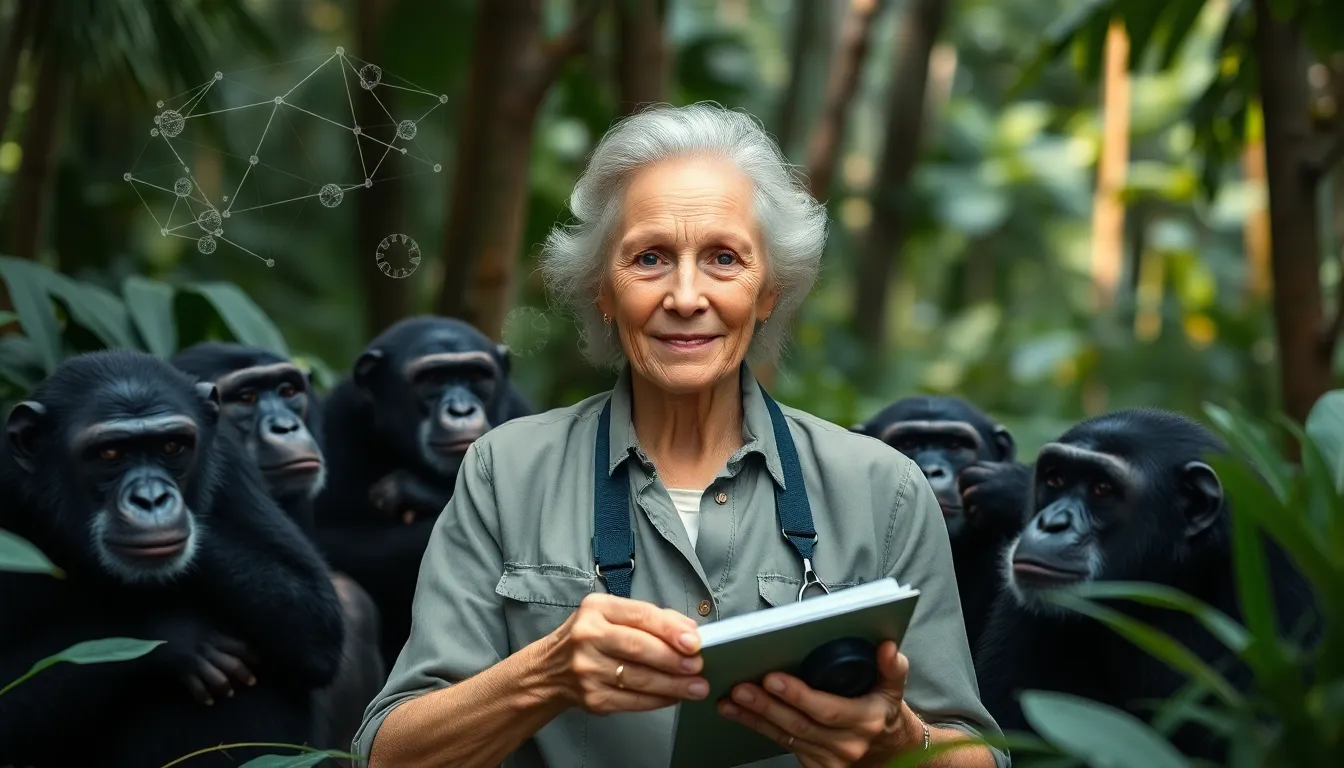
Goodall arrived at Gombe in July 1960 with only a notebook, a camera, and a deep curiosity. She initially lived in a simple hut, enduring primitive conditions, mosquitoes, and a diet of beans and rice. Over the next six weeks, she habituated a group of wild chimpanzees, documenting their daily behaviors with unprecedented patience.
Her early methodology broke with prevailing primatological conventions. Rather than maintaining a strict distance, Goodall allowed herself to observe the chimpanzees from close range, naming each individual after observing their distinctive personalities—a practice that later became standard in ethology. She recorded detailed notes on tool use, social interactions, and feeding patterns, establishing a longitudinal dataset that continues to this day.
In 1965, Goodall earned a Ph.D. in ethology from the University of Cambridge after submitting a dissertation titled “The Behaviour of Free‑Living Chimpanzees in the Gombe Stream Reserve.” She became the first woman to receive a doctorate in the field from Cambridge. Throughout the 1970s, Goodall held a research associate position at the Institute of Animal Behaviour (later the Institute of Zoology) at the University of Cambridge and later an honorary research fellow position at the University of Kent. She also served as a senior researcher at the Jane Goodall Institute, which she founded in 1977 to support conservation and community development in Africa.
Discoveries, Inventions, and Methods
Goodall’s field observations yielded several paradigm‑shifting discoveries:
- Tool Use in Non‑Human Primates: In 1960, she documented a chimpanzee named David Greybeard fashioning a twig to extract termites from a mound. This was the first confirmed instance of tool use by a non‑human animal, challenging the prevailing belief that tool manufacture was uniquely human.
- Complex Social Bonds: Goodall recorded the formation of extended family networks, alliances, and political strategies among chimpanzees, revealing a sophisticated social structure comparable to early human societies.
- Aggression and Warfare: She observed coordinated hunting of colobus monkeys, meat sharing, and lethal inter‑group aggression, providing early evidence of warfare-like behavior in non‑human primates.
- Maternal Care and Emotions: Her notes on mother–infant bonding, grief, and reconciliation after conflicts introduced a nuanced view of animal emotions.
Methodologically, Goodall pioneered participant observation in animal behavior, blending techniques from anthropology and ethology. She advocated for long‑term, continuous data collection, allowing researchers to capture seasonal, developmental, and cultural variations within primate groups.
Publications, Recognition, and Debate
Goodall’s first major publication was the 1965 book In the Shadow of Man: Discovering the Life of the Chimpanzee, which combined scientific observation with a narrative style accessible to the general public. The book garnered critical acclaim and brought chimpanzee research into popular consciousness.
Subsequent works include:
- The Chimpanzees of Gombe: Patterns of Behavior (1971), co‑authored with anthropologists Frans de Waal and Richard Wrangham, presenting systematic analyses of the data collected.
- Reason for Hope: A Spiritual Journey (1999), reflecting her evolving perspective on conservation and ethics.
Goodall has received numerous honors, including:
- The UNESCO Gold Medal (1998)
- The Kyoto Prize in Basic Sciences (2010)
- The United Nations Messenger of Peace designation (2002)
- Numerous honorary doctorates from institutions such as the University of Cambridge, Harvard University, and the University of Edinburgh.
While her scientific contributions are widely celebrated, some aspects of her methodology sparked debate. Critics argued that her close proximity to subjects could influence behavior, potentially compromising objectivity. In response, Goodall emphasized the value of longitudinal immersion and later incorporated blind‑sampling protocols to address concerns. The debate contributed to a broader discussion on the balance between qualitative observation and quantitative rigor in field biology.
Impact on the Field
Jane Goodall’s work reshaped primatology, anthropology, and conservation biology. By documenting tool use, she forced a revision of the definition of “culture” to include non‑human species. Her emphasis on individual personalities led to the development of personality psychology in animal behavior research.
Goodall’s public outreach, embodied in the Jane Goodall Institute and the Roots & Shoots program (founded 1991), has inspired millions of youths worldwide to engage in environmental stewardship. The Institute’s conservation projects have contributed to the protection of over 44,000 hectares of chimpanzee habitat and supported sustainable livelihoods for local communities.
Scientifically, the Gombe dataset remains a cornerstone for comparative studies on primate cognition, disease transmission (including zoonotic research on Ebola and COVID‑19), and climate change impacts on forest ecosystems. Goodall’s advocacy for “one‑world” ethical considerations has also spurred interdisciplinary dialogues linking biology, philosophy, and policy.
Overall, Jane Goodall’s legacy lies not only in her empirical discoveries but also in her transformation of how scientists, policymakers, and the public perceive the relationship between humans and other animals.