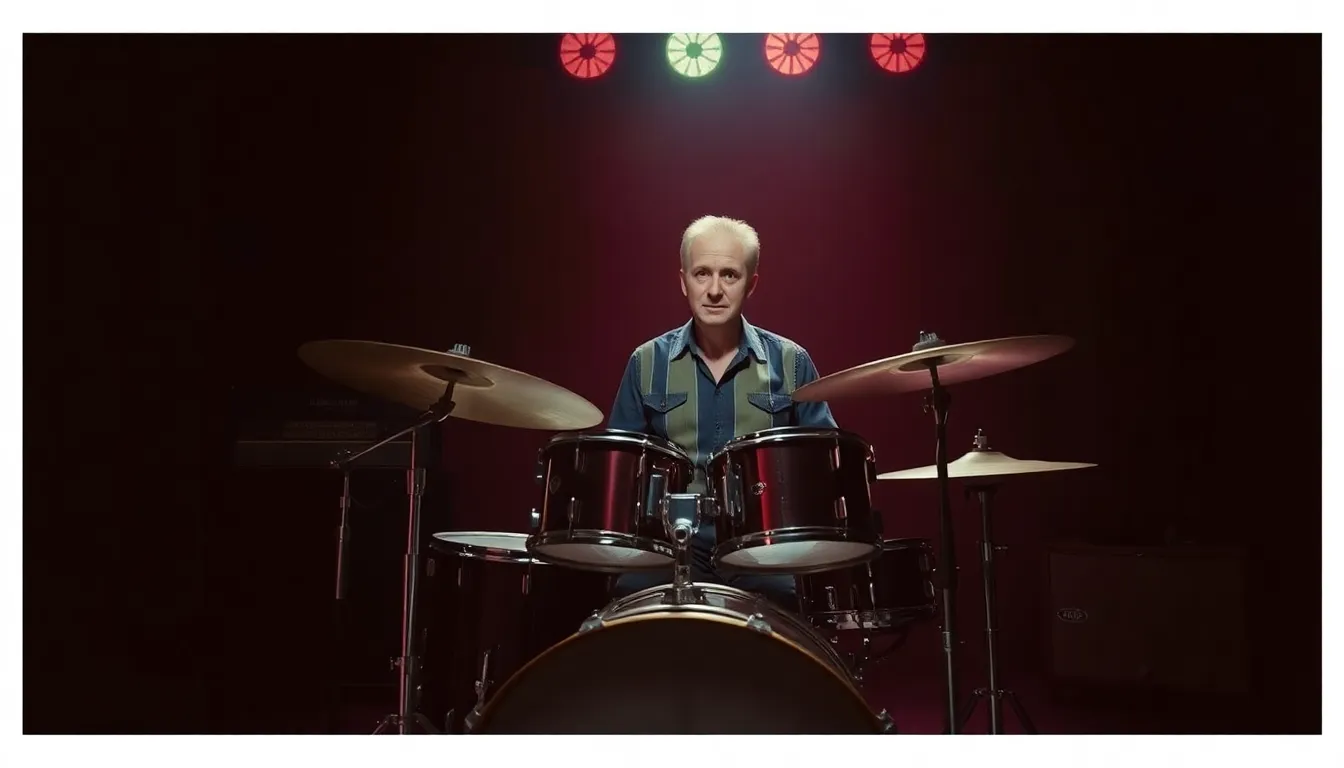
Early Artistic Beginnings
Ronald “Ron” Bushy was born on December 27, 1941, in Washington, D.C., United States. His parents, both working‑class citizens, encouraged an appreciation of music at home; his father owned a modest record collection that included swing, jazz, and early rhythm‑and‑blues. Bushy began playing drums at the age of twelve, initially on a second‑hand kit acquired from a local church. By his teenage years he was performing in modest venues around the D.C. area, notably the burgeoning rhythm‑and‑blues clubs of the late 1950s. After graduating from high school, Bushy briefly attended the University of Maryland, where he studied graphic design, but his commitment to music soon eclipsed academic pursuits.
In the early 1960s Bushy moved to San Diego, California, a city that was emerging as a nexus for surf rock and the early seeds of psychedelic experimentation. He joined several local groups, most notably The Voxmen, where he first recorded on a 45‑rpm single for a regional label. These early sessions honed his technical precision and introduced him to studio work, providing a foundation for later professional recordings.
Influences and Creative Voice
Bushy’s drumming style was shaped by a confluence of musical influences. He cited the swing phrasing of Buddy Rich and the drive of Ringo Starr, while also drawing on the innovative percussive textures of jazz greats such as Elvin Jones. The surf‑rock rhythms of Dick Dale and the psychedelic forays of The Byrds also left an imprint on his evolving voice. Bushy’s exposure to the emerging counter‑culture scene in San Diego, alongside artists experimenting with modal improvisation and extended instrumental sections, fostered his openness to unorthodox structures. This eclectic mix manifested in a style that blended tight back‑beat discipline with fluid, improvisational flourishes—qualities that would become his signature within Iron Butterfly.
In the mid‑1960s, Bushy became fascinated with the emerging technology of multi‑track recording and the expanding role of the drum kit as a melodic rather than purely rhythmic instrument. He began experimenting with drum overdubs, employing tom‑heavy patterns that contributed to the hypnotic atmospheres characteristic of psychedelic rock. These experiments positioned him as a forward‑thinking drummer ready to embrace the avant‑garde tendencies of the late 1960s.
Major Works and Breakthroughs
Ron Bushy’s most consequential break arrived in 1967 when he auditioned for the nascent band Iron Butterfly, a group formed in San Diego by vocalist and bassist Doug Ingle and guitarist Danny Weis. Bushy’s dynamic audition, highlighted by an extended solo on a borrowed kit, secured his place in the lineup alongside Erik Brann (guitar) and Jerry Penrod (bass). The group’s debut album, Heavy (1968), featured Bushy’s propulsive drumming but achieved modest commercial success.

The turning point came with the release of the band’s second album, In‑A‑Gadda‑Da‑Vida (1968). The title track, a 17‑minute opus, became one of rock’s longest singles to chart, reaching No. 30 on the Billboard Hot 100. Bushy’s contribution—particularly the iconic drum solo that spans over three minutes—has been cited by critics as a landmark moment in rock percussion. The solo combines rapid tom‑toms, crisp snare accents, and a pronounced use of cymbal swells, establishing a template for extended drumming showcases.
Following the breakthrough, Bushy continued to record and tour with Iron Butterfly through the early 1970s. Albums such as Ball (1969) and Metamorphosis (1970) featured Bushy’s increasingly intricate patterns, showing an evolution toward funk‑inflected syncopation while retaining the band’s signature psychedelic edge. Though commercial fortunes waned after 1971, the group’s influence persisted, and Bushy’s drumming remained a defining element of the Iron Butterfly sound.
Collaborations and Evolution
Beyond his work with Iron Butterfly, Bushy engaged in several side projects that highlighted his versatility. In 1972 he joined the short‑lived group The Midway State, an experimental collective that blended progressive rock with early electronic textures. Though the band recorded only a handful of demo tracks before dissolving, the sessions revealed Bushy’s willingness to incorporate electronic percussion pads—a precursor to the drum‑machine integration that would dominate the 1980s.
Throughout the 1980s and 1990s, Bushy maintained an intermittent presence on the live circuit, re‑uniting periodically with original Iron Butterfly members for anniversary tours. He also contributed as a session drummer for rising Los Angeles punk and new‑wave acts, where his steady timekeeping provided a bridge between classic rock sensibilities and contemporary sounds. Notably, he appeared on a 1984 EP by the underground garage band The Miquitoes, delivering a raw, stripped‑down groove that contrasted sharply with his earlier psychedelic work.
In the 2000s, Bushy participated in several documentary projects, offering interviews and occasional percussion for film scores that addressed the 1960s counter‑culture. He also performed at tribute concerts honoring psychedelic pioneers, sharing stages with surviving members of The Doors, Jefferson Airplane, and The Velvet Underground. These collaborations underscored his status as a respected elder statesman within the rock community.
Awards, Reception, and Legacy
While Ron Bushy never amassed a trophy cabinet filled with mainstream awards, his impact has been recognized by peers and scholars alike. In 1997, the Rock and Roll Hall of Fame listed the “In‑A‑Gadda‑Da‑Vida” drum solo among the “100 Greatest Drum Performances” in its special exhibit. Academic works on psychedelic rock frequently cite Bushy’s approach to drumming as a primary example of how percussion can drive narrative progression in extended compositions.
Critically, Bushy’s work has been praised for its balance of technical proficiency and emotive power. Reviewers in publications such as *Rolling Stone*, *AllMusic*, and *Mojo* have highlighted his ability to maintain a steady groove while improvising within the spacious structures of Iron Butterfly’s music. Conversely, some early critics dismissed the band’s underground aesthetic, labeling the drumming as “overindulgent.” However, retrospective re‑evaluations have largely overturned these early mischaracterizations, situating Bushy’s contributions within the broader evolution of progressive rock drumming.
Financially, Bushy’s net worth has never been publicly disclosed in detail; estimates based on royalties, touring income, and limited merchandising place it in the low‑to‑mid seven‑figure range, though exact figures remain unverified. He has lived a relatively private life since his retirement from full‑time touring in 2013, residing primarily in the San Diego area and engaging in occasional charitable performances for music education charities.
Ron Bushy’s legacy endures through his influence on subsequent generations of drummers. Notable artists such as Neil Peart (Rush) and John Bonham (Led Zeppelin) have spoken of the 1960s psychedelic era’s impact on their own development, with Bushy’s marathon solos often cited as a catalyst for exploring longer, more atmospheric drum sections. Contemporary prog‑metal and stoner‑rock drummers continue to reference his work as an instructional benchmark. The sustained popularity of “In‑A‑Gadda‑Da‑Vida” on classic‑rock radio and its frequent inclusion in film and television soundtracks attest to the lasting cultural imprint of Bushy’s rhythmic craftsmanship.