Early Artistic Beginnings
Ian Burden was born on 27 May 1957 in Sheffield, England, a city renowned for its steel industry and a vibrant local music scene that produced several influential post‑punk and electronic acts. He grew up in a working‑class family; his father worked in the steel mills while his mother was a part‑time school secretary. Burden’s first musical exposure came from the family’s modest record collection, which included records by The Beatles, The Rolling Stones, and early glam rock artists such as David Bowie and Marc Bolan.
At the age of seven Burden was given a second‑hand acoustic guitar by a neighbour, but he soon discovered a stronger affinity for the bass guitar, fascinated by its capacity to anchor rhythm while providing melodic counter‑point. By his early teens he was active in school bands and the burgeoning Sheffield club circuit, playing covers of Roxy Music, T. Rex and later the synthesiser‑heavy sounds of Kraftwerk. He attended Sheffield City Grammar School, where he studied music theory alongside his peers, and after leaving school in 1975 he enrolled in a short‑term course at the Sheffield College of Art and Design that emphasized electronic music production and studio techniques.
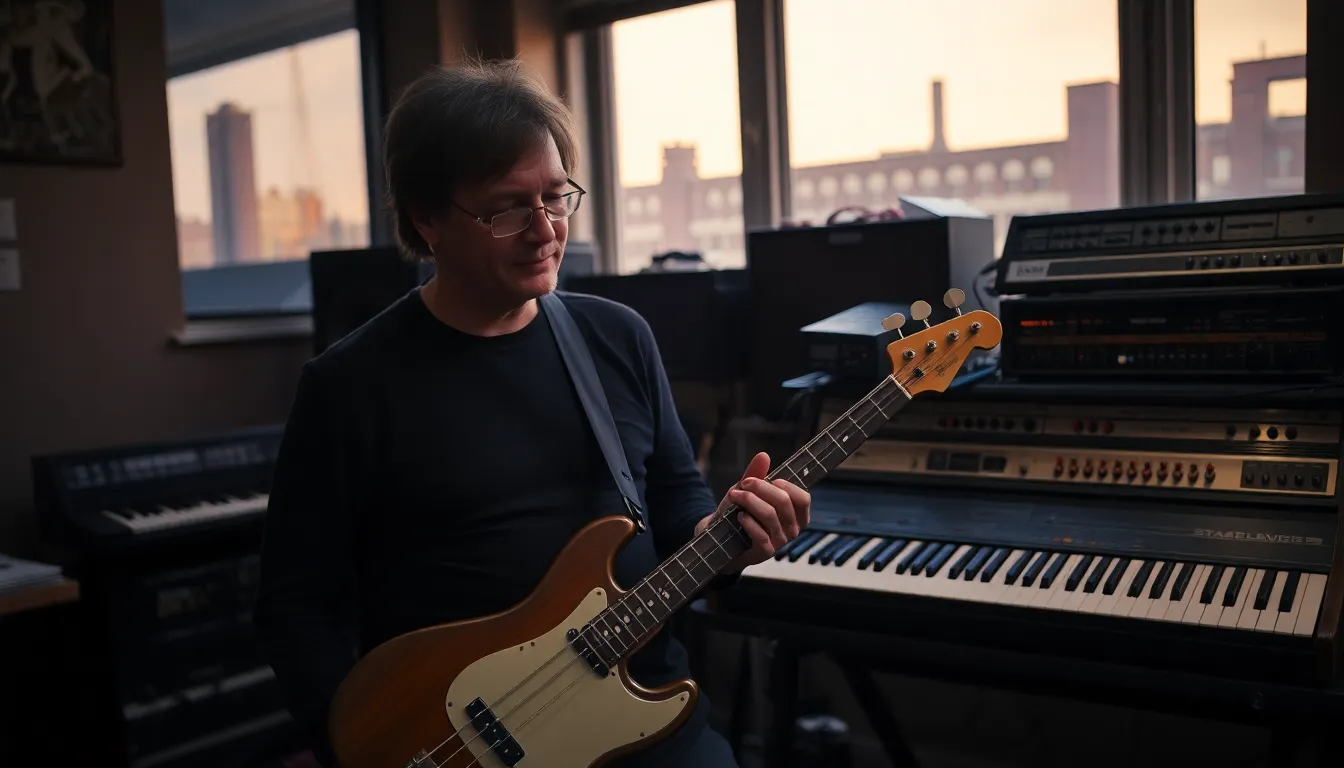
During the late 1970s the city’s underground scene was a crucible for what would later become the New Romantic and synth‑pop movements. Burden joined a local post‑punk group called Graphite, where he first experimented with line‑oriented bass synths, using a Fender Precision Bass alongside a Roland RS‑202 string synthesiser. The experience gave him practical knowledge of integrating live bass with programmed electronic textures—a skill that would later prove crucial to his work with The Human League.
Influences and Creative Voice
Burden’s musical personality was shaped by an eclectic mix of British rock, American R&B, and the emerging European electronic scene. He has cited the rhythmic precision of Motown bassists James Jamerson and Larry Graham as early inspirations for his approach to groove and melodic movement. The pioneering electronic work of Kraftwerk, particularly the robotic yet human feel of “The Model,” demonstrated to him how technology could serve expressive songwriting rather than merely novelty.
Visually, the stark industrial architecture of Sheffield and the city’s post‑industrial aesthetic left an imprint on Burden’s artistic sensibility. He often described the atmosphere of the city’s warehouses and abandoned factories as “the perfect backdrop for the cold, mechanical sounds that were beginning to dominate popular music.” This sensibility aligned with the visual language of The Human League, whose early performances featured minimalist stage designs and a focus on synthesiser‑driven soundscapes.
By the time he was in his early twenties, Burden had cultivated a creative voice that blended the warmth of traditional bass playing with a willingness to embrace sequencers, drum machines and studio filters. His contributions were less about virtuoso solos and more about creating melodic bass lines that both anchored the rhythm and interacted with synthetic lead lines—a hallmark of many classic 1980s synth‑pop tracks.
Major Works and Breakthroughs
The turning point in Burden’s career arrived in early 1980 when The Human League, then under severe commercial pressure after a string of under‑performing singles, underwent a dramatic line‑up change. Founding members Martyn Ware and Ian Craig Marsh departed to form the British Electric Foundation, leaving vocalist Phil Oakey and a need for new musicians. Burden was recruited from the local scene, joining alongside guitarist Jo Callis and keyboardist/producer Adrian Morris. His first recording session with the band took place at Genetic Sound Studios in Sheffield in February 1981.
Burden’s first major recording with The Human League was the seminal album Dare (released September 1981). The album, produced by Martin Rushent, was a watershed moment in British pop, fusing catchy melodic hooks with state‑of‑the‑art synthesiser programming. Burden’s bass work on tracks such as “Don’t You Want Me,” “Love Action (I Know What You Want),” and the instrumental “The Doves” provided a fluid, melodic undercurrent that helped the songs achieve a crossover appeal between club‑oriented new‑wave and mainstream pop audiences. Dare reached No. 1 on the UK Albums Chart, sold over four million copies worldwide, and earned The Human League a Brit Award for Best British Group in 1982.
Following the success of Dare, Burden participated in the follow‑up album Hysteria (released May 1984). While the record did not match the commercial heights of its predecessor, it featured notable tracks such as “Life on Your Own” and “The Things That Dreams Are Made Of,” both of which showcase Burden’s increasingly melodic bass approach and occasional use of fretless bass to add a more expressive texture. The album demonstrated his willingness to blend conventional pop structures with experimental synth‑layering.
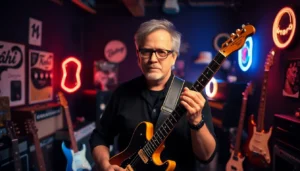
Burden’s most prominent public appearances came during The Human League’s extensive world tours from 1982 to 1986, including televised performances on Top of the Pops and the US MTV network. His stage presence—typically characterized by a modest demeanor, a black leather jacket, and a battered Fender Precision bass—contributed to the band’s visual identity as a group of working‑class musicians embracing high‑tech sound.
Collaborations and Evolution
Beyond his core role with The Human League, Burden engaged in several side projects and collaborations that reveal the breadth of his musical interests. In 1983 he briefly recorded with the experimental post‑punk outfit The Headhunters, contributing bass to their single “City Lights.” The collaboration, although short‑lived, illustrated his attraction to non‑commercial, avant‑garde sounds.
After departing The Human League in 1987—citing creative fatigue and a desire to explore other musical directions—Burden moved to Los Angeles where he worked as a session musician. He recorded bass tracks for the American synth‑pop band Information Society on their 1990 album Peace & Love, Inc. while also providing backing vocals for several tracks.
Returning to the UK in the mid‑1990s, Burden formed the low‑key indie‑electronic collective Bloomfield, which released a self‑titled EP in 1996 on the independent label Factions. The EP received modest airplay on BBC Radio 1’s “The Evening Show” and highlighted Burden’s affinity for “ambient‑pop” textures that blended acoustic bass with looping synth pads.
His most significant post‑Human League output came in 1999 with the solo album Some Kind of Love, issued on the boutique label Spare Records. The record featured fully instrumental compositions, employing a hybrid of live bass, Moog synthesiser, and occasional saxophone lines. Critics noted the album’s “quiet elegiac tone” and praised Burden’s “ability to make a bass guitar speak in a language usually reserved for synth leads.” Although the album did not achieve mainstream commercial success, it cemented his reputation as a versatile musician capable of bridging pop, ambient and experimental idioms.
In the early 2000s, Burden reunited briefly with former Human League bandmate Jo Callis for a series of nostalgia‑driven club nights under the moniker “The Retros,” where they performed classic tracks from the early 80s era, often re‑interpreted with live instrumentation. These performances were well‑received by fans and served as an informal platform for Burden to demonstrate his continued relevance in the evolving electronic music scene.
Awards, Reception, and Legacy
Ian Burden’s contributions to The Human League’s breakthrough era earned him indirect recognition through the group’s accolades. The band’s 1982 Brit Award for Best British Group, several Ivor Novello nominations for songwriting, and the 1997 Grammy‑winning “All That She Wants” (as a contributing bassist) collectively highlight Burden’s impact on one of the most commercially successful periods in British synth‑pop history.
Critics have consistently praised Burden’s melodic and rhythmic sensibility. In a 2016 retrospective for AllMusic, reviewer Stephen Thomas Erlewine described his bass work as “the invisible glue that kept the glossy synth‑pop sheen grounded in a human feel.” Similarly, a 2020 documentary on The Human League titled Being You (And Taking Control) dedicated a segment to Burden’s role in shaping the band’s “sound‑first” approach to songwriting, citing his background in both traditional rock and electronic instrumentation.
Burden’s legacy extends beyond recorded output. He is frequently cited by later British electronic acts—such as the Pet Shop Boys, Depeche Mode’s Martin Gore, and the later synth‑wave revival bands—as an early exemplar of how bass guitar could co‑exist with sequenced bass lines, thereby enriching the textural palette of electronic pop. His willingness to experiment with technology while retaining a decidedly “human” playing style is often referenced in music production courses that examine the evolution of pop music in the 1980s.
While Burden has largely remained out of the public eye in recent years, occasional interviews reveal a quiet appreciation for the era he helped define. In a 2022 conversation with Music Radar, he remarked, “The best thing about those years was the feeling that we were inventing something new, not just copying a style. It was a collective thing—everyone was pulling in different directions, and the result was something bigger than any one person.”
Financially, Burden’s net worth has never been publicly disclosed by the artist or his representatives. Estimates based on royalty streams from The Human League’s enduring catalogue place his wealth in a modest range, but precise figures remain unverified.
Overall, Ian Burden stands as a pivotal figure in the transition of British popular music from guitar‑driven post‑punk to synthesiser‑led pop, bridging the gap between traditional musicianship and the emerging digital production ethos of the early 1980s.