Historical Context
Paul Revere lived during a period of profound transformation in North America. Born in the Province of Massachusetts Bay, part of the British Empire, he witnessed the escalation of colonial resistance to British taxation and laws in the 1760s and 1770s. The decade leading up to the American Revolutionary War saw the passage of the Stamp Act (1765), the Townshend Acts (1767), and the Intolerable Acts (1774), which mobilized a network of local committees of correspondence and militias. Massachusetts, and especially Boston, became the epicenter of political agitation, street protests, and confrontations such as the Boston Massacre (1770) and the Boston Tea Party (1773). These events created a volatile environment in which artisans, merchants, and tradesmen—among them Paul Revere—were drawn into political activism. The Revolution (1775‑1783) ultimately resulted in the creation of the United States, a new nation defined by republican ideals and a constitutional framework that would shape the subsequent century.
Early Life and Formation
Paul Revere was born on January 1, 1735, in Boston, Massachusetts, to French‑Huguenot immigrants. His father, Apollos Rivoire (later Anglicized to Paul Revere), was a silversmith who had arrived in Boston around 1710. The family belonged to the Protestant dissenting tradition, which emphasized literacy, community participation, and a degree of independence from established Anglican authority. Revere attended the Boston Latin School, a colonial institution that prepared young men for collegiate study, though he did not matriculate at Harvard. In 1751, at age sixteen, he began an apprenticeship with his father, learning the trade of silversmithing, engraving, and metalworking. This apprenticeship provided him with a respected craft, a modest income, and a network of clients among Boston’s mercantile and political elite.
The documentary record of Revere’s childhood is limited to church baptismal registers, the family ledger kept by his father, and later recollections compiled by his son, Joseph Warren Revere. These sources indicate that Revere was literate, religiously observant, and exposed early to the civic debates that animated Boston’s public sphere. By 1754, Revere had completed his apprenticeship and established his own shop on Ann Street (later North Street). His early work—silverware, tea sets, and military insignia—demonstrates both technical skill and an awareness of emerging American aesthetic preferences.
Role in Major Events
Revere’s public activity intensified in the 1760s as tension with Britain grew. In 1765, he joined the Sons of Liberty, a clandestine group that organized protests against the Stamp Act. Revere contributed his engraving talents to produce political pamphlets and broadsides, most notably a 1767 illustration of the British “Customs Officer” that circulated widely among colonial dissenters. He also participated in the 1768 raid on the warehouses of British customs officials, an event recorded in the diaries of contemporary merchant John Adams.
During the early 1770s, Revere expanded his civic engagement. He served as a lieutenant in the Massachusetts militia and was elected to the Boston Committee of Correspondence in 1772, a body responsible for coordinating colonial resistance. In 1773, Revere acted as a messenger during the Boston Tea Party, delivering news of the seizure of the tea ships to Patriot leaders in Charlestown. His position as a silversmith placed him at the intersection of commerce and politics; he repaired and sold instruments used by both British authorities and colonial militias.
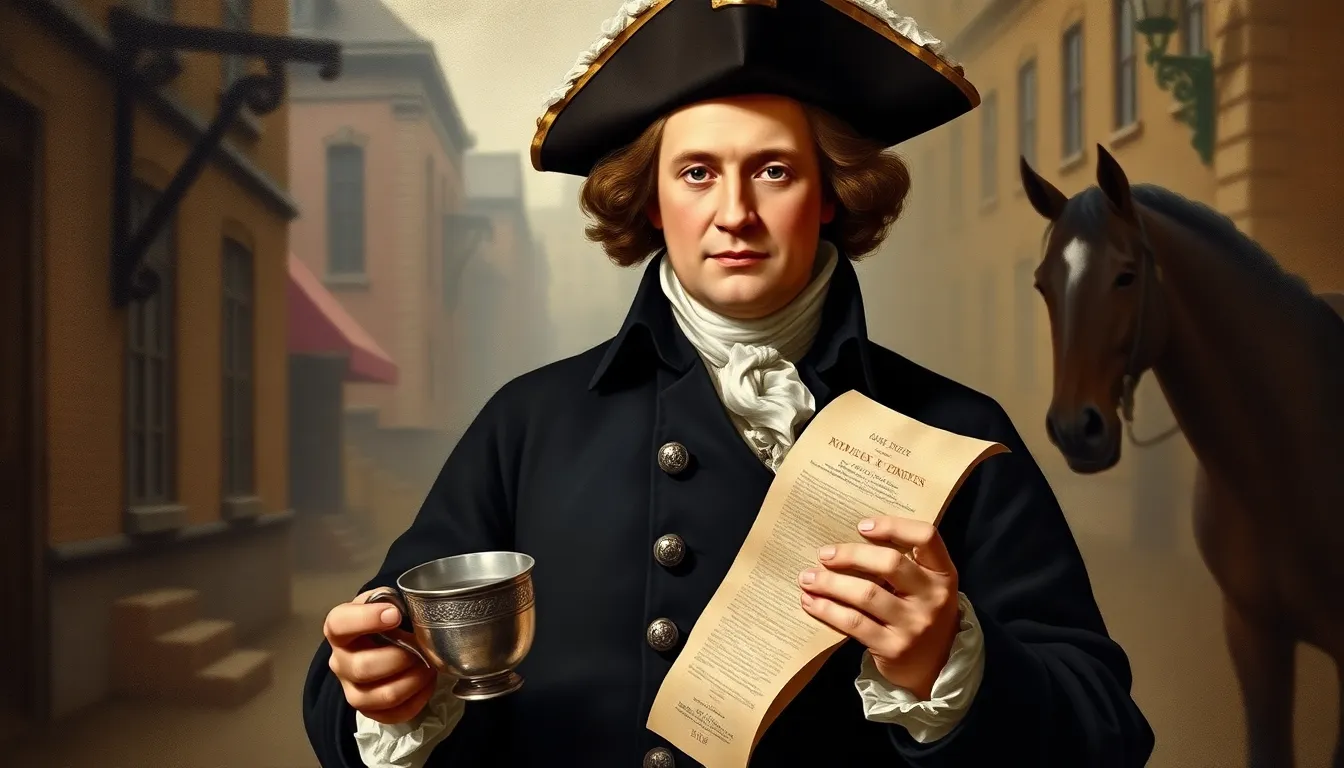
The most celebrated episode of Revere’s life occurred on the night of April 18–19, 1775. Acting on intelligence that British regulars were moving from Boston to seize colonial arms at Concord, Revere rode from Boston to Lexington, alerting Samuel Adams, John Hancock, and other Patriot leaders. He then continued on to Concord, covering a distance of roughly 20 miles in a single night. Contemporary accounts—most famously the 1798 poem “Paul Revere’s Ride” by Henry Wadsworth Longfellow—have mythologized the event, but primary sources such as Revere’s own testimony before the Massachusetts Bay Committee of Safety (1775) and the diaries of fellow rider William Dawes confirm the basic sequence of events while noting that Revere was ultimately detained by a British patrol at the North Bridge and did not complete the entire ride.
Following the outbreak of hostilities at Lexington and Concord, Revere remained active in the war effort. He served as a lieutenant colonel in the Massachusetts militia, commanded artillery units, and oversaw the construction of fortifications around Boston. In 1776, he was appointed the first Agri‑Messenger of the Massachusetts Provincial Congress, a role that involved delivering intelligence across New England. Revere also contributed to the war economy by acting as a copperplate engraver for the Continental Congress, producing currency and postage stamps.
After the war, Revere returned to his silversmith business, which he expanded into a diversified manufacturing operation. He opened a foundry that produced bells, cannons, and church organs, employing apprentices and contributing to the early American industrial base. His notable commissions include the “Old North Church” bell (1785) and the “Massachusetts State House” bronze doors (1792). Revere’s financial status improved steadily; tax records from 1790 indicate an estate value of approximately $2,500—a respectable sum for a colonial craftsman‑turned‑industrialist, though not comparable to the wealth of contemporary mercantile magnates.
In his later years, Revere became involved in civic affairs, serving on Boston’s board of fire wardens and supporting the establishment of the Massachusetts Historical Society in 1791. He wrote several pamphlets defending the Revolution and the new Constitution, illustrating his continued engagement with the political discourse of the fledgling United States.
Revere died on May 10, 1818, in Boston, at the age of 83. His obituary, printed in the Boston Gazette, highlighted his contributions as a “patriot, silversmith, and citizen of the Republic.”
Allies, Opponents, and Debate
Revere’s network of allies included prominent Revolutionary leaders such as Samuel Adams, John Hancock, and Paul’s brother‑in‑law, Dr. Joseph Warren, who was killed at the Battle of Bunker Hill. His membership in the Sons of Liberty linked him to a broader cadre of artisans, merchants, and writers who coordinated resistance to British policy. The militia commissions he held placed him under the command of General George Washington, although Revere never served directly in the Continental Army’s regular forces.
Opposition to Revere emerged primarily from Loyalist circles and British authorities, who regarded him as a subversive agitator. British colonial officials, including Governor Thomas Gage, listed Revere among the most “dangerous” insurgents in 1774. Loyalist pamphleteer Samuel Seabury condemned Revere’s “incendiary” broadsides, accusing him of “calumniating the Crown.” After the war, some of Revere’s business rivals—particularly imported silver merchants—criticized his expansion into foundry work as a threat to traditional craft guilds.
Historians have debated the accuracy and symbolism of the “midnight ride.” Early 19th‑century biographers such as William H. Prescott amplified the narrative for nationalist purposes, while 20th‑century scholars like Bernard Bailyn emphasized the collective nature of intelligence networks, noting that Revere’s ride was one element of a larger communication system that included riders William Dawes and Dr. Samuel Prescott. Contemporary scholarship tends to portray Revere not as a solitary hero but as an integral part of a coordinated Patriot apparatus.
Another point of contention concerns Revere’s financial success. Some 19th‑century popular histories inflated his wealth, portraying him as a “rich man” who financed the Revolution. However, tax assessments, probate inventories, and Revere’s own correspondence reveal a modest but growing middle‑class status. The notion of “net worth” in the 18th‑century colonial context is therefore complex; Revere’s assets were largely tied up in workshop tools, inventory, and property rather than liquid cash.
Finally, recent scholarship has examined Revere’s role in the early American industrial scene. Economic historians such as Robert Higgs argue that Revere’s foundry represented an early shift from artisanal production to factory‑based manufacturing, anticipating the broader Industrial Revolution in New England. Others caution against overstating his impact, noting that his operation remained relatively small compared with later large‑scale factories.
Legacy and Interpretation
Paul Revere’s legacy has been shaped by layers of myth, commemoration, and scholarly reassessment. The most visible memorial is the Paul Revere House in Boston’s North End, preserved as a museum since the early 20th century. In 1941, the United States minted a 3‑cent postage stamp featuring Revere on horseback, reinforcing his image as a patriotic icon. The phrase “the British are coming!”—although not documented in contemporary sources—has entered popular culture as an emblem of Revolutionary urgency.
In historiography, Revere was initially celebrated as a singular patriotic hero in the early Republic, a narrative bolstered by the centennial celebrations of 1875 and the patriotic poetry of Longfellow. The 20th‑century “new‑social history” movement broadened the focus to include Revere’s role as a craftsman, an early industrialist, and a participant in the trans‑Atlantic exchange of ideas. Recent monographs, such as “Paul Revere’s Ride: The Myth and the Man” (2020), have sought to disentangle fact from fiction, emphasizing the collaborative intelligence network and the economic motivations behind his activities.
Public memory of Revere continues to evolve. Educational curricula often present his ride as a succinct illustration of colonial resistance, while museums increasingly contextualize his work within the broader material culture of the period, displaying his silverware alongside contemporary British imports. Heritage tourism in Boston capitalizes on Revere’s story, offering guided “midnight ride” tours that blend historical fact with dramatized reenactments.
Scholarly discourse now recognizes Revere as a multifaceted figure: a skilled artisan, an engaged citizen, a participant in early American industrial development, and a symbol of the Revolutionary mythos. This nuanced view acknowledges both his documented contributions and the later mythmaking that amplified his fame.
Overall, Paul Revere’s life exemplifies the complex interplay between individual agency and collective action in the American Revolution. His enduring presence in public memory underscores the power of narrative in shaping national identity, while ongoing research continues to refine our understanding of his actual impact on the formation of the United States.