Early Life and Formation
Jacques-Yves Cousteau was born on 11 June 1910 in Saint‑André‑de‑Cubzac, a small town in the Gironde department of southwestern France. His father, Daniel Cousteau, was a civil engineer, and his mother, Elisabeth Lorthioir, came from a modest Catholic family. The Cousteaus were not wealthy, but they valued education and the outdoors. Jacques attended the local lycée, where he showed an early fascination with mechanics, drawing, and natural history.
In 1930, Cousteau entered the École Navale, France’s naval academy, receiving formal training in navigation, engineering, and leadership. The rigorous curriculum, combined with sea‑time aboard training vessels, forged his technical competence and introduced him to maritime culture. During his naval service, Cousteau was posted to the cruiser “Kleber” and later to the submarine “Le Glorieux,” experiences that deepened his appreciation for underwater environments.
While still a cadet, he met fellow enthusiast Frédéric Dumas, an experienced diver who would later become a lifelong collaborator. The pair shared a curiosity about what lay beneath the waves, a curiosity that would later drive Cousteau toward diving technology. Cousteau’s early exposure to engineering, navigation, and camaraderie with fellow seafarers created the skill set that underpinned his later explorations.
Exploration Context and Ambitions
The interwar period witnessed a burgeoning interest in marine science, spurred by advances in chemistry, optics, and shipbuilding. French scientific institutions, such as the Muséum national d’Histoire naturelle, were encouraging field studies of the oceans, yet most investigations remained surface‑oriented. The commercial fishing fleet was extensive, and naval intelligence kept a keen eye on undersea warfare, still a legacy of World War I.
Cousteau’s personal ambition was twofold: to develop a practical means for humans to breathe underwater for extended periods, and to document the marine world for both scientific and public audiences. He believed that direct, immersive observation would yield insights unavailable to remote sensing or specimen collection. This conviction aligned with broader 20th‑century trends that emphasized experiential science and mass communication, especially with the rise of radio and later television.
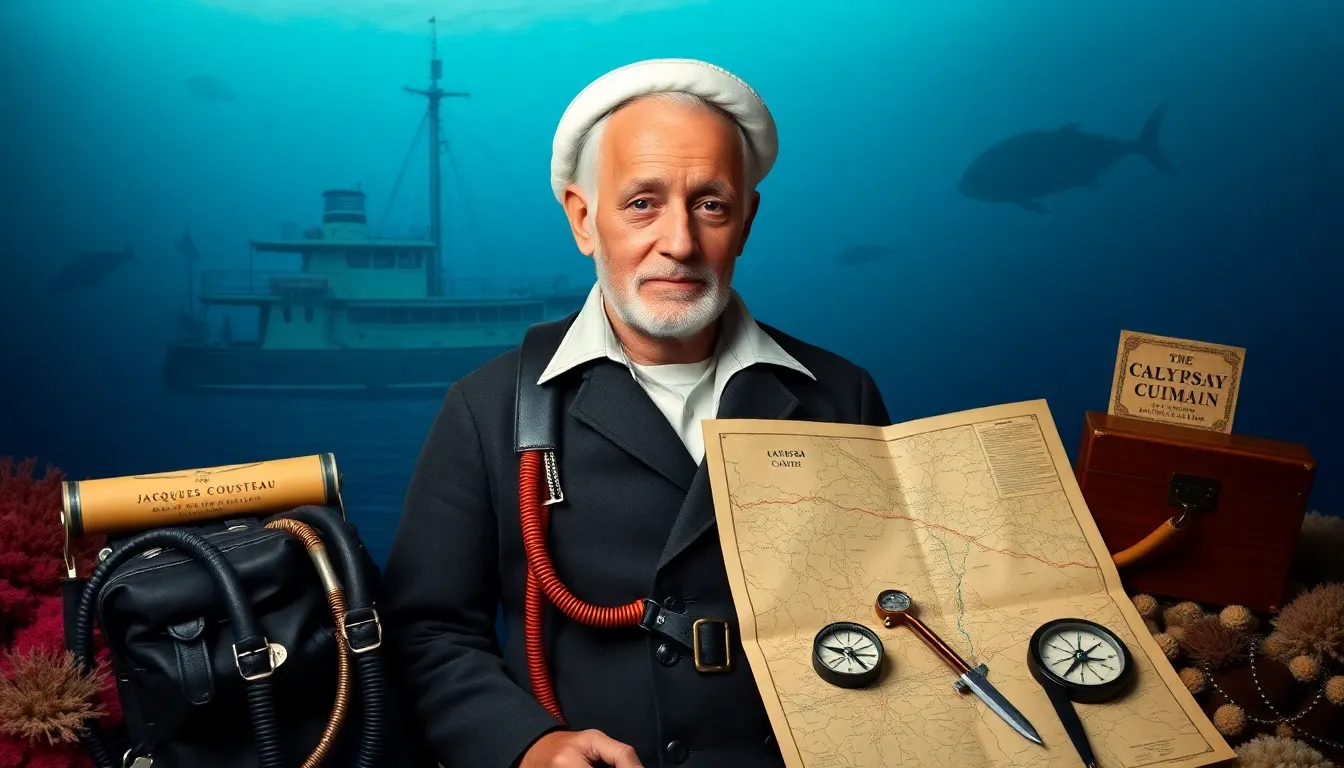
In 1942, amid the German occupation of France, Cousteau began experimenting with a miniature underwater breathing apparatus alongside Dumas and the French naval engineer Émile Gagnan. Their work culminated in the Aqua‑Lung, a demand‑regulator scuba system that allowed divers to inhale compressed air at ambient pressure. The invention was motivated by military needs (sabotage and reconnaissance) but quickly attracted civilian interest, setting the stage for a new era of recreational and scientific diving.
Major Expeditions and Journeys
With the Aqua‑Lung perfected, Cousteau embarked on a series of increasingly ambitious voyages that combined exploration, film‑making, and scientific research.
1947 – La Méduse and the Red Sea: Cousteau’s first major public demonstration of the Aqua‑Lung occurred aboard the yacht La Méduse. He filmed “The Red Sea” (original French title: “La Mer Rouge”), documenting coral reefs and fish behavior. These images were among the first moving pictures of underwater life shown to a Western audience.
1950 – Calypso Acquisition: In 1950, Cousteau purchased a former British minesweeper, renaming it Calypso. The vessel was extensively refitted with laboratories, a film studio, and a deck‑mounted diving platform. It became the mobile base for most of Cousteau’s subsequent field work.
1952–1953 – The Red Sea and Mediterranean Survey: Over two years, Cousteau, Dumas, and a small crew conducted systematic transects of coral reefs, compiling data on species distribution, water temperature, and illumination. Their findings were published in the French scientific journal Oceanus and contributed to early baseline maps of reef health.
1956 – The Silent World: The expedition that produced the groundbreaking film “The Silent World” (“Le Monde du Silence”) combined scientific observation with cinematic storytelling. The film, co‑directed with Lilli Palmer, won the Palme d’Or at Cannes and the Academy Award for Best Documentary, cementing Cousteau’s public profile.
1957–1961 – Global Cruise of Calypso: The most extensive voyage of the vessel spanned the Atlantic, Indian, and Pacific Oceans. The crew surveyed kelp forests off California, the galápagos archipelago, the Great Barrier Reef, and the coral atolls of the South Pacific. Notable achievements included the first underwater footage of a sperm whale’s blowhole and the discovery of five new species of nudibranch molluscs.
1963 – Jacques-Yves Cousteau’s Underwater Archaeology: On a Mediterranean mission, Cousteau’s team located the wreck of the 16th‑century galley La Parade near the island of Lampedusa, employing side‑scan sonar, a relatively new technology. The excavation contributed to the field of marine archaeology and demonstrated the interdisciplinary potential of underwater exploration.
1975 – Calypso Deep Dive: In collaboration with a French Navy submersible, Cousteau participated in a deep‑sea dive to the Calypso Deep, the deepest point of the Mediterranean (5,140 m). While he did not descend himself, his role in coordinating the mission highlighted his continued influence in scientific planning.
Beyond fieldwork, Cousteau authored numerous books (including “The Silent World,” “The Living Sea,” and “The Ocean World”) and produced a long‑running television series (“Les Aventures de Jacques Cousteau”) that brought marine science into living rooms worldwide.
Risks, Companions, and Controversies
Cousteau’s career was marked by both genuine hazard and occasional contention. Early diving operations carried the risk of decompression sickness, a danger mitigated only gradually through emergent dive‑tables. In 1965, a near‑fatal accident on the Great Barrier Reef, when Dumas suffered a severe arterial gas embolism, prompted stricter safety protocols.
The composition of Cousteau’s crews reflected a mix of naval officers, civilian scientists, and film technicians. Notable companions included the French diver and author Philippe Cousteau (his son), marine biologist Jacques Boudreau, and cinematographer Henri de Tila.
Controversy arose around Cousteau’s depiction of marine life. Critics argued that his films occasionally staged or exaggerated animal behavior for dramatic effect. Conservationists also questioned the environmental impact of frequent boat traffic and film equipment on fragile reef ecosystems. Cousteau responded by advocating for marine protected areas, and in 1973 he helped establish the Calypso Marine Conservation Fund, which financed research on sustainable fishing.
Ethical debates also touched on the colonial context of his early voyages. While Cousteau frequently collaborated with local fishermen and guides, he, like many mid‑century explorers, sometimes presented indigenous knowledge without full attribution. Recent scholarship calls for a more nuanced view that acknowledges the contributions of Mediterranean and Pacific coastal communities to his data collection.
Legacy and Historical Impact
Jacques Cousteau’s influence extends across multiple domains. Technologically, the Aqua‑Lung opened the underwater world to scientific, military, and recreational divers, laying the groundwork for modern scuba equipment manufacturers. His emphasis on visual documentation revolutionized marine science, making underwater photography a standard research tool.
Scientifically, Cousteau’s systematic surveys of coral reefs contributed to the baseline data used today to assess reef degradation caused by climate change and ocean acidification. His interdisciplinary approach—combining engineering, biology, cinematography, and advocacy—prefigured contemporary “big‑science” ocean projects.
Publicly, Cousteau became one of the 20th century’s most recognizable environmental voices. His television series and books educated millions about oceanic ecosystems, spurring a generation of marine biologists and conservationists. Institutions such as the International Oceanographic Commission and UNESCO’s Man and the Biosphere Programme cited his work when shaping marine policy.
After his death on 25 June 1997, the Cousteau Society—a nonprofit he founded in 1973—continues to operate the vessel Calypso, now a floating research and education platform. The Society’s programs focus on marine education, sustainable fisheries, and climate‑change research, directly echoing Cousteau’s original mission.
In the historiography of exploration, Cousteau occupies a unique niche: a naval officer who turned engineer, a filmmaker who was also a meticulous field scientist, and an early environmentalist who navigated the tensions between public spectacle and scientific rigor. Modern scholars assess his legacy with both admiration for his pioneering contributions and critical awareness of the cultural and ecological impacts of his methods.