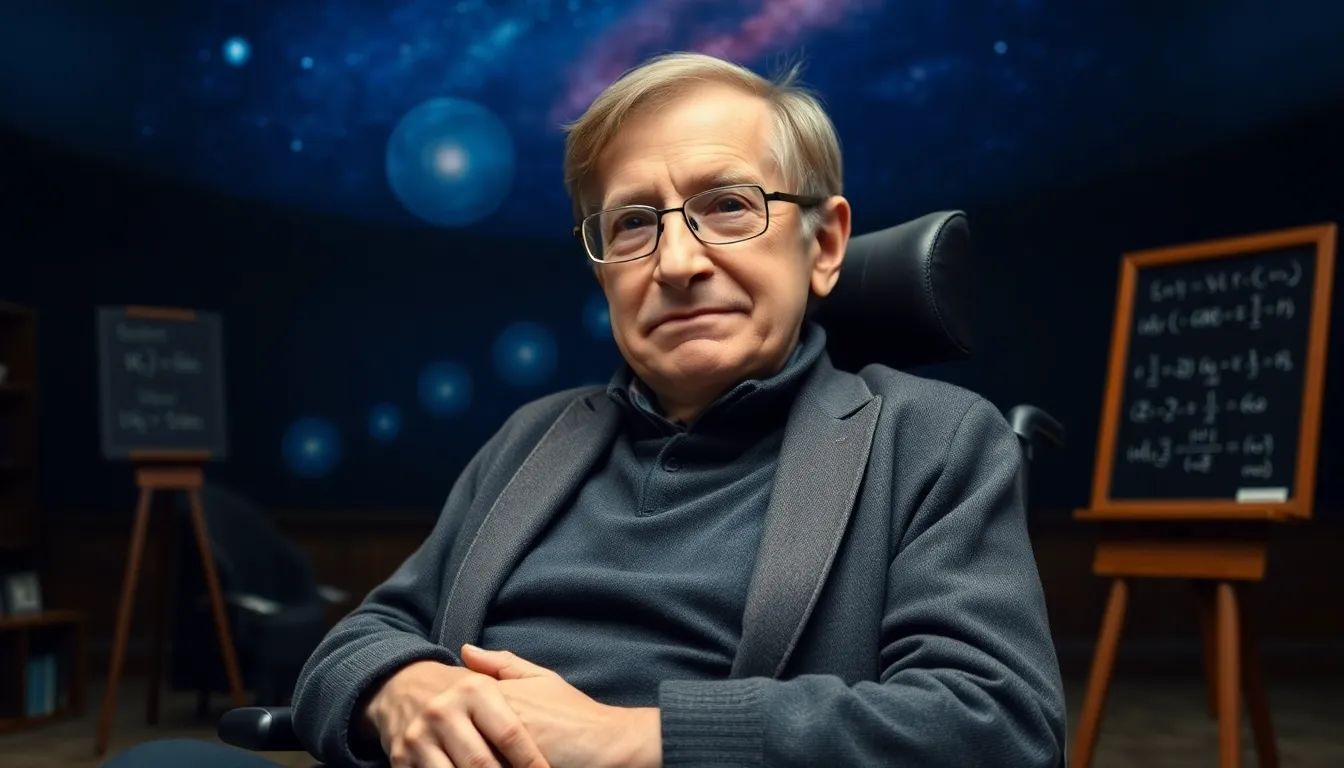
Stephen William Hawking (8 January 1942 – 14 March 2018) was a British theoretical physicist, cosmologist, and author. Renowned for his contributions to the understanding of black holes and the early universe, Hawking became a prominent public figure through his popular science writings and media appearances. Diagnosed with amyotrophic lateral sclerosis (ALS) at age 21, he lived with the condition for more than five decades, a period far longer than typical prognosis, while producing a body of work that profoundly influenced both scientific research and public perception of complex physics.
Education and Scientific Formation
Hawking was born in Oxford, England, where his father, Frank Hawking, was a medical researcher, and his mother, Isobel Hawking, a social worker. He attended St Albans School, a grammar school noted for its strong emphasis on mathematics and science. From an early age he displayed an aptitude for mathematics, winning a school competition at age 16 that encouraged him to consider a career in scientific research.
In 1959, Hawking earned a scholarship to University College, Oxford, to study physics. The undergraduate program at Oxford emphasized classical mechanics, electromagnetism, and thermodynamics, providing a solid foundation for his later theoretical work. He graduated in 1962 with a first‑class BA (later MA) in physics. During his time at Oxford, Hawking was influenced by the lectures of Sir Hermann Bondi, whose work on gravitation inspired Hawking’s interest in general relativity.
Hawking continued his graduate studies at Trinity College, Cambridge, beginning in 1962. He initially enrolled in a Ph.D. program in cosmology under the supervision of Dennis Sciama, a pioneering relativist who had mentored other notable physicists such as Martin Rees and Roger Penrose. Hawking’s doctoral research focused on singularity theorems in general relativity, a topic that would later become central to his most celebrated contributions.
Research Career
While completing his Ph.D., Hawking was diagnosed with ALS in 1963. The disease, which progressively weakens motor neurons, forced him to use a wheelchair and, eventually, a speech-generating device. Despite these challenges, he completed his doctorate in 1966, with a dissertation titled “Properties of Expanding Universes.” Shortly after, he was elected a Fellow of the Royal Society at the age of 32, making him one of the youngest recipients in modern times.
From 1971 to 1979, Hawking held a position as the Lucasian Professor of Mathematics at the University of Cambridge— a chair previously occupied by Isaac Newton. The Lucasian Professorship provided Hawking with access to Cambridge’s Department of Applied Mathematics and Theoretical Physics (DAMTP), where he built a research group that explored quantum effects in gravitational fields. He also served as a Fellow of Gonville and Caius College, fostering interdisciplinary collaborations with mathematicians and astronomers.
Hawking’s career involved numerous visiting appointments, including stints at the Institute for Advanced Study in Princeton (1979–1980) and the California Institute of Technology (1981). He was a regular invited speaker at international conferences such as the Solvay Conference (1979) and the International Congress of Mathematicians (1986), where his presentations helped disseminate his groundbreaking ideas across the scientific community.
Discoveries, Inventions, and Methods
Hawking’s most famous theoretical breakthrough came in 1974, when he applied quantum field theory to the curved spacetime surrounding a black hole. He demonstrated that black holes are not completely black; instead, they emit thermal radiation due to quantum effects, a phenomenon now known as Hawking radiation. The result combined principles from general relativity, thermodynamics, and quantum mechanics, and it suggested that black holes can lose mass over time, eventually evaporating entirely.
Earlier, in 1969, Hawking, together with Roger Penrose, extended the singularity theorems of Einstein’s theory, proving that the universe must have begun from a singularity— a point of infinite density and curvature. This work provided rigorous mathematical support for the Big Bang model and earned Hawking and Penrose the 1979 Albert Einstein Medal.
Hawking also introduced the concept of “no‑boundary” proposal in collaboration with James Hartle (1983). Their model proposed that the universe has no temporal boundary in the past, eliminating the need for a singular creation event. This proposal utilized Euclidean quantum gravity techniques, employing a path‑integral approach that summed over possible geometries of spacetime.
In addition to his theoretical contributions, Hawking pioneered methods for simplifying complex calculations in quantum cosmology. He developed the “thin‑shell” approximation for modeling the evaporation of black holes and employed the “Euclidean” analytic continuation to treat gravitational instantons. These methodological advances remain integral to contemporary research in quantum gravity and string theory.
Publications, Recognition, and Debate
Hawking authored several landmark scientific papers, including the 1975 paper “Particle Creation by Black Holes” (Communications in Mathematical Physics) and the 1976 collaboration with Hartle on the wave function of the universe. His 1988 book “A Brief History of Time” sold over 10 million copies worldwide, translating complex cosmological concepts for a general audience and remaining in print for decades.
Beyond “A Brief History of Time,” Hawking wrote other popular works such as “Black Holes and Baby Universes and Other Essays” (1993), “The Universe in a Nutshell” (2001), and “The Grand Design” (2010, co‑authored with Leonard Mlodinow). These texts combined scholarly rigor with accessible language, contributing significantly to public scientific literacy.
Hawking received numerous honors, including the Wolf Prize in Physics (1988), the Copley Medal of the Royal Society (2006), and the Presidential Medal of Freedom (2009) awarded by U.S. President Barack Obama. He was a Fellow of the Royal Society (FRS), a member of the United Kingdom’s Order of the Companions of Honour, and held honorary doctorates from over 30 universities.
Scientific debate surrounding Hawking’s work has been vigorous but constructive. While Hawking radiation is widely accepted theoretically, its direct experimental verification remains elusive due to the extremely low temperature of emitted radiation for astrophysical black holes. Nonetheless, analog experiments in laboratory systems— such as sonic black holes in Bose‑Einstein condensates— have produced observations consistent with Hawking’s predictions, reinforcing the plausibility of his theory.
Critics have also examined the “information paradox” that arises from Hawking radiation, which suggests that information entering a black hole could be lost, challenging the tenet of unitarity in quantum mechanics. Hawking’s later work (2015) proposed that information is preserved in subtle correlations of the radiation, a hypothesis that continues to stimulate research in quantum gravity and the holographic principle.
Impact on the Field
Stephen Hawking’s contributions fundamentally altered the landscape of theoretical physics. The concept of Hawking radiation linked quantum mechanics with gravity, marking the first serious step toward a unified theory of quantum gravity. His singularity theorems reinforced the Big Bang paradigm, guiding cosmologists in developing modern inflationary models.
Beyond academia, Hawking’s public engagement demystified high‑level physics for millions. His popular books, media appearances (including the documentary “Black Holes: The Edge of the Universe” and a cameo on “The Simpsons”), and advocacy for scientific funding amplified the societal relevance of fundamental research. He also championed accessibility for disabled scientists, influencing policies on inclusive research environments.
In the decades following his death, research inspired by Hawking’s ideas continues to thrive. Studies of black hole thermodynamics, the holographic principle, and the string‑theoretic description of black holes all trace intellectual lineage to Hawking’s pioneering work. Projects such as the Event Horizon Telescope, which captured the first image of a supermassive black hole in 2019, directly relate to questions Hawking raised about black‑hole horizons and information loss.
Overall, Hawking’s legacy endures through the theoretical frameworks he helped construct, the generations of scientists he mentored, and the public imagination he captured. His life exemplifies how intellectual curiosity combined with personal resilience can produce discoveries that reshape humanity’s understanding of the universe.